Why Most Brands Fail on Amazon Even With Great Products
You spent a year building something good. The product is solid, the packaging looks premium, the early customers love it, and friends keep telling you it should sell itself. Then you launch on Amazon, and the orders trickle in at a rate that does not cover your ad spend. Sessions move, units do not, and the spreadsheet that looked exciting in month one starts to look like a slow leak.
Here is the hard part that most sellers learn too late. Quality is the entry ticket, not the win. Plenty of genuinely great products die on Amazon every quarter, and almost none of them die because the product was bad. They fail because the system around the product was weak.
That is the whole reason this guide exists. We are going to walk through why brands fail on Amazon even when the product deserves to win, and what actually separates the brands that stall from those that scale. If you want the fix-side companion to this diagnosis, our 90-day Amazon growth plan shows the exact sequence we use to rebuild a stuck account.
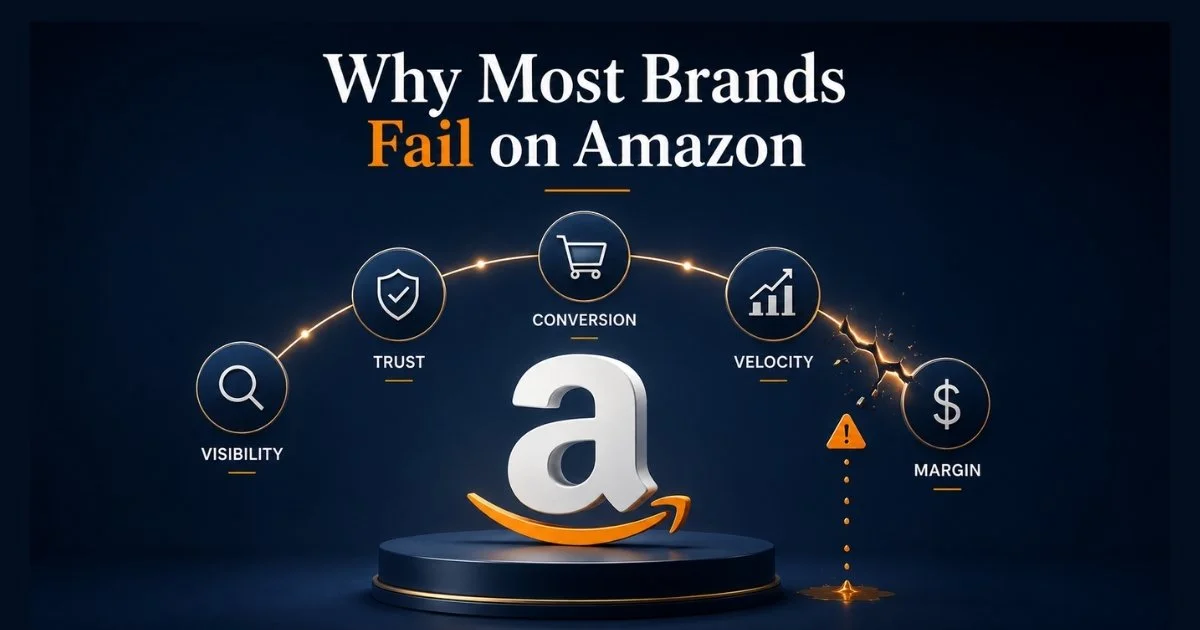
Quick Answer: There is one short answer to why brands fail on Amazon: a strong product without the right Amazon brand strategy. The most common problems are weak demand validation, poor listing conversion, thin unit economics, slow review velocity, rising Amazon fees, inventory issues, poor account health, and PPC that sends traffic before the product page is ready to convert. A great product gives you potential, but Amazon rewards visibility, trust, conversion, sales velocity, and profit discipline.
Want a second set of eyes on where your account is leaking?
Great Products Still Lose on Amazon
A great product and a great Amazon product are two different things. One wins on a shelf or a DTC site where you control the story. The other wins inside a search engine, where a shopper compares you against twenty near-identical options in about four seconds.
That gap is where most brands fall through. Your product can be objectively better and still lose to a worse product that ranks higher, prices sharper, and proves itself faster. Amazon does not reward quality directly. It rewards the signals that suggest quality, which means visibility, conversion, velocity, and margin all have to work together.
So when we say why brands fail on Amazon, we are really talking about a system failure, not a product failure. The rest of this guide breaks that system into the parts that break most often.
Nobody Is Searching for What You Built
The first reason great products fail is brutal in its simplicity. The demand was never there at the scale you assumed, and the Amazon brand strategy was built on hope instead of search data.
Amazon is a search engine before it is a store. If shoppers are not typing words that lead to your product, no amount of polish will save it. You can have the best cold-brew filter ever made, but if the search volume for that solution is tiny, you are fighting for a sliver of traffic that cannot feed a real business.
Demand validation beats gut feeling
Most brands validate the product and skip validating the market. They confirm that people like the item, then assume that liking equals searching. Those are different behaviors. Liking happens after discovery. Searching is discovery, and on Amazon searching is everything.
Before you commit inventory, pull real numbers. Keyword tools like Helium 10, along with your own Amazon keyword research, should help you estimate whether the primary terms have enough monthly search volume to support your unit goals, and whether the top listings are beatable or locked down by sellers with thousands of reviews.
The off-Amazon winner trap
A product that crushes it on your own site or in retail can flop on Amazon for a simple reason. Off Amazon, you create demand. On Amazon, you capture existing demand. A brand built to create demand often has no captureable search behavior waiting for it, so it sits invisible while the founder blames the listing.
Let us say you sell a premium protein powder with a unique adaptogen blend. On your DTC site, you sell the story and the science. On Amazon, shoppers search protein powder, compare prices and reviews, and your beautiful story never gets read—same product, different game.
Your Listing Wins Clicks but Loses Buyer
The second failure point is conversion. Your listing earns a click, only to lose the buyer somewhere on the page.
This is where many sellers confuse clean design with conversion strategy. A polished listing is not the same as a persuasive one. Amazon listing optimization has to focus on buyer objections, not just clean images, tidy bullet points, and on-brand A+ Content.
A shopper is asking a few simple questions before they buy. Is this right for me? Can I trust it? Is the price fair? Why should I choose this product instead of the option right below it?
A great product hides this problem because the founder assumes the quality is obvious. It is not obvious on a product detail page. It has to be proven through the image stack, offer, reviews, comparison points, and clear use-case messaging.
If your main image earns clicks but your secondary images do not explain size, use case, ingredients, comparison, or trust proof, shoppers will bounce back to the search results.
Quick Tip
Pull Unit Session Percentage per child ASIN in Business Reports, not only the parent roll-up. The blended number can hide the one SKU that is bleeding sales.
The Margin Was Too Thin to Survive Amazon
Here is the failure almost nobody talks about in the “great product” articles. The margin was broken before the first unit shipped.
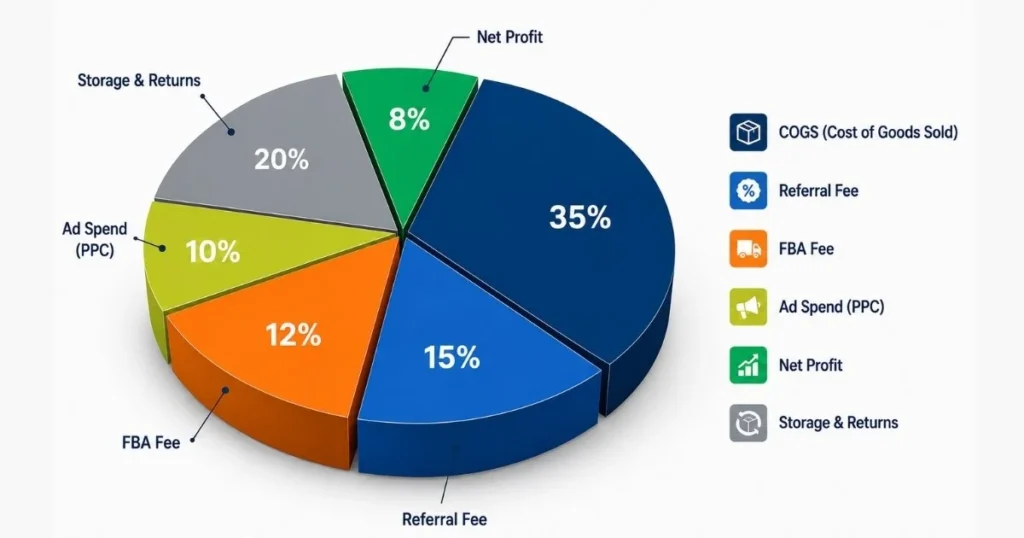
A product can sell well and still lose money on Amazon once Amazon fees, ad spend, returns, and fulfillment costs are added to the real model. That happens when the unit economics are modeled on a shelf price minus COGS, rather then the real Amazon stack of referral fees, fulfillment fees, storage, returns, and ad spend.
Why revenue lies
Revenue is a vanity number on Amazon. Two brands can both do a million in sales and have completely different outcomes because one kept 20% and the other kept 3%. The seller doing huge revenue with no profit is not winning. They are funding Amazon and their competitors.
This is why brands fail on Amazon even when they look successful from the outside. Top-line growth feels like progress right up until a fee increase or an ad-cost spike pushes a thin SKU into the red.
The numbers every SKU needs
Every active SKU needs three numbers before you scale it. Contribution margin after all Amazon costs, break-even ACoS, and your target ACoS based on that margin. Without those, you are setting bids and prices in the dark.
Run the honest math. Take the sale price, subtract COGS, referral fee, FBA fulfillment fee, storage, average returns cost, and average ad spend per unit. What is left is what you actually keep. If that number only works under perfect conditions, the SKU is not ready to scale.
Quick Tip: If your overall account margin looks healthy, break it down per ASIN anyway. It is common to find a few SKUs with weak contribution margin that quietly drain profit from the winners.
The 2026 Fee and Cash-Flow Squeeze
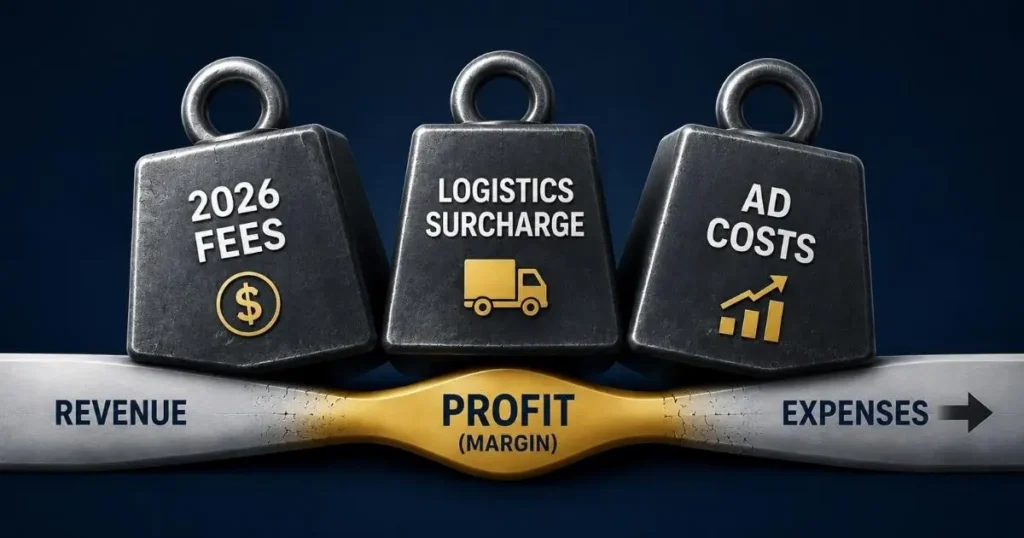
Even brands that modeled their margin correctly a year ago can get squeezed when fees, fulfillment costs, ad costs, and payout timing shift.
Two forces tighten simultaneously. Costs going out increase, and cash coming in can slow down. On the cost side, Amazon added a 3.5 percent fuel and logistics-related surcharge to FBA fulfillment fees starting April 17, 2026, while Multi-Channel Fulfillment and Buy with Prime followed on May 2, 2026. Low-inventory-level fees, inbound placement fees, returns-processing costs, and rising ad costs can all make an older profit model unreliable.
On the cash-flow side, DD+7 reserve timing can hold funds until seven days after delivery before they become available for disbursement. For brands with tight reorder cycles, that delay can create pressure even when sales look healthy.
None of this usually feels dramatic at first. It arrives in small increments that are easy to miss until the profit you counted on is gone. A brand with a great product and a 2024 cost model can lose on 2026 math.
Reviews Move Too Slow to Build Momentum
Amazon rewards momentum, not just quality, and momentum has a chicken-and-egg problem at launch.
You need reviews to convert, conversions to rank, and ranking to get the traffic that produces more reviews. A great product that starts cold with zero social proof sits in a hole while competitors with hundreds of reviews soak up the clicks. Review velocity and recency often matter as much as the star rating itself. A 4.3 with fresh, relevant reviews can outsell a 4.7 that has gone quiet.
This is where many great products quietly die. The founder waits for organic reviews that come too slowly the listing never builds sales velocity the cold-start window closes, and the launch budget runs out before the flywheel ever spins. Eligible new ASINs can use Amazon Vine to seed early reviews, but Vine is a starter, not a guarantee of positive proof.
If your launch is stalling and you cannot tell whether it is a review, a traffic, or a margin problem, start with a full Amazon account audit before increasing ad spend.
Operational Failures You Never See Coming
Not every reason why brands fail on Amazon is about marketing. Some brands do not fail at marketing at all. They fail at operations, and operational failures are the quietest killers because they do not announce themselves.
Stranded and suppressed listings
A listing can get suppressed for a missing or non-compliant attribute and simply stop showing, while you keep paying storage on inventory shoppers cannot buy. Inventory can go stranded after a catalog glitch. Units can get lost or damaged inbound, returns may not be returned to sellable stock, and reimbursement opportunities can be missed if no one audits them regularly.
Account health and the Buy Box
Account health problems rarely arrive out of nowhere. A creeping Order Defect Rate, a slipping IPI score, or a late-shipment trend builds quietly until a suspension lands at the worst possible time. Lose the Featured Offer or Buy Box due to pricing, inventory, or account metrics, and your ads may keep running while shoppers buy from another seller.
A great product behind a suppressed listing or a suspended account sells exactly zero units. The quality is irrelevant if buyers cannot reach it.
Quick Tip: Check IPI, Order Defect Rate, late-shipment rate, inventory levels, suppressed listings, and Featured Offer percentage every week. Most serious issues give early warning signs before they become account-level problems.
You Treat Amazon Like a Shelf, Not a System
The last and most common failure is a mindset, not a metric. Brands treat Amazon as a passive shelf where good products sell themselves, rather than an active channel that may be managed.
Amazon is not set-it-and-forget-it. Keyword research goes stale, competitors move, fees shift, CPCs rise, and a listing that converted in spring drifts by fall. The brands that win run a weekly rhythm. They mine search terms, prune wasted spend, adjust bids based on real conversion data, refresh creative, and monitor profitability per SKU instead of chasing a single flattering number like a low ACoS. They also track TACoS to see whether paid traffic is helping or hiding weak organic growth.
This is the difference between activity and progress. Doing more random tasks in Seller Central is not the same as operating a system, and our breakdown of how to structure Amazon PPC for profit shows what that disciplined rhythm looks like in the ad account.
This is also where ScaleA2Z adds value. We use AI-driven data analysis to review PPC, listing performance, profit leaks, keyword movement, and account health, then prioritize the fixes that can improve Amazon brand growth without simply increasing ad spend.
What Winning Amazon Brands Do Differently
Winning Amazon brands do not treat Amazon as one task. They integrate product research, Amazon listing optimization, Amazon PPC strategy, pricing, inventory, reviews, and account management into one operating system.
The brands that scale usually do five things better.
- They validate demand before they overbuy inventory.
- They build listings around buyer objections, not just clean design.
- They know break-even ACoS before increasing bids.
- They watch review velocity and account health every week.
- They connect PPC data with organic rank, inventory, pricing, and margin.
That is the difference between simply selling on Amazon and building long-term Amazon brand growth. Winning brands do not just make random changes inside Seller Central. They run a repeatable system, measure what changed, and fix the next bottleneck before it becomes expensive.
How to Find Out Why Your Brand Is Failing
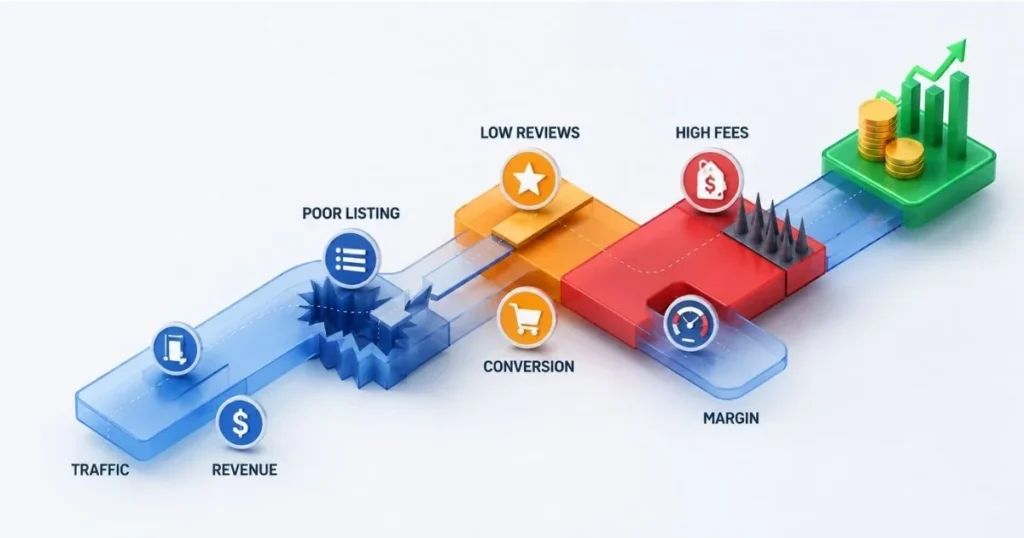
Knowing the six failure points is not the same as knowing which one is hurting you. Diagnosis beats guessing, so work the funnel in order and stop at the first stage that breaks.
- Traffic first. Check impressions, click-through rate, and organic rank. If shoppers are not finding you, fix visibility and demand before anything else. No search volume means no business to optimize.
- Conversion second. If traffic is healthy but units stay flat, the leak is on the product detail page. Read Unit Session Percentage per ASIN and fix the image stack and offer first.
- Margin third. If the product converts but profit is thin, review contribution margin, break-even ACoS, customer acquisition cost, and total Amazon fees. Find the SKUs with weak or negative contribution margins and fix prices, costs, or ad efficiency before scaling.
- Cash and fees fourth. Re-model your SKU against the 2026 fee stack, payout timing, storage costs, and reorder cycle, so you plan reorders based on current reality, not last year’s numbers.
- Operations fifth. Audit suppressed listings, stranded inventory, account health, reimbursements, inventory levels, and Featured Offer ownership. Fix anything blocking the sale.
- System last. Build a weekly operating rhythm so the same problems do not return.
Triage by the bottleneck, not the symptom. Fixing conversion does nothing if no one sees the product, and pouring traffic onto a thin-margin SKU just speeds up the loss.
If you would rather have someone run that diagnosis for you, ScaleA2Z will pressure-test your traffic, conversion, margin, fees, and operations, then show you the single highest-impact fix first.
Final Word
The real answer to why brands fail on Amazon rarely comes down to the product alone. It usually comes from demand you did not validate, conversion you did not engineer, margin that could not survive the fee stack, reviews that moved too slowly, operations that broke quietly, and a shelf mindset in a channel that demands a system.
The good news is that every one of those problems is fixable once you know which one is yours. Diagnose the real leak, fix the highest-impact issue first, and back every decision with data rather than gut feel.
Book your free Amazon audit and see which part of your Amazon system is blocking growth first.
Frequently Asked Questions
Why do good products fail on Amazon?
Good products usually fail because the system around them is weak, not because the product itself is bad. Common causes include poor demand validation, low organic rank, weak listing conversion, thin margins, slow review velocity, rising Amazon fees, and operational issues such as suppressed listings or poor account health.
Is a great product enough to succeed on Amazon?
No. A great product gives you potential, but Amazon’s success depends on visibility, conversion, reviews, pricing, sales velocity, inventory health, and profitable advertising. A weaker product with stronger Amazon execution can often outsell a better product with a poor marketplace strategy.
How do I know if my Amazon listing has a demand problem or a conversion problem?
Look at the funnel. Low impressions and weak organic rank usually point to a demand or visibility problem. Healthy traffic with low Unit Session Percentage usually points to a conversion problem on the product detail page. Fix visibility first, then conversion.
Why is my Amazon product profitable on paper but losing money in reality?
Usually, the unit economics left out part of the Amazon cost stack. Referral fees, FBA fulfillment, storage, inbound placement, returns, and ad spend all reduce real margin. Calculate the contribution margin per SKU after every cost, then compare it to your break-even ACoS before you scale.
How have the 2026 Amazon changes affected seller profitability?
Costs went up, and cash flow became harder to manage. The 2026 fee stack includes the fuel and logistics-related surcharge, ongoing inventory-related fees, inbound placement costs, and DD+7 reserve timing that can delay when funds become available. Brands using older cost models are quietly losing the margin they assumed was safe.
Can poor account health cause an Amazon brand to fail?
Yes. A rising Order Defect Rate, late shipments, or a falling IPI score can lead to suppression or suspension, and a suspended account sells nothing regardless of product quality. Losing the Buy Box has a similar effect, since your ads keep spending while buyers go to a competitor.