How to Structure Amazon PPC for Profit (Real Framework)
Running Amazon ads is easy. Running them profitably is a completely different game. Most sellers jump straight into campaigns — add some keywords, set a bid, and wait. When ACOS climbs, or sales dry up, they tweak bids randomly and hope for a turnaround. The problem is never just the bids. The real problem is the foundation underneath.
Knowing how to structure Amazon PPC for profit is what separates sellers who scale confidently from those who just burn through ad spend. This guide gives you a real, step-by-step framework — not theory, but an actual system you can build today.
Quick Answer — Best Amazon PPC Structure for Profit
If you want to know how to structure Amazon PPC for profit, start with one simple principle — separate discovery from profit.
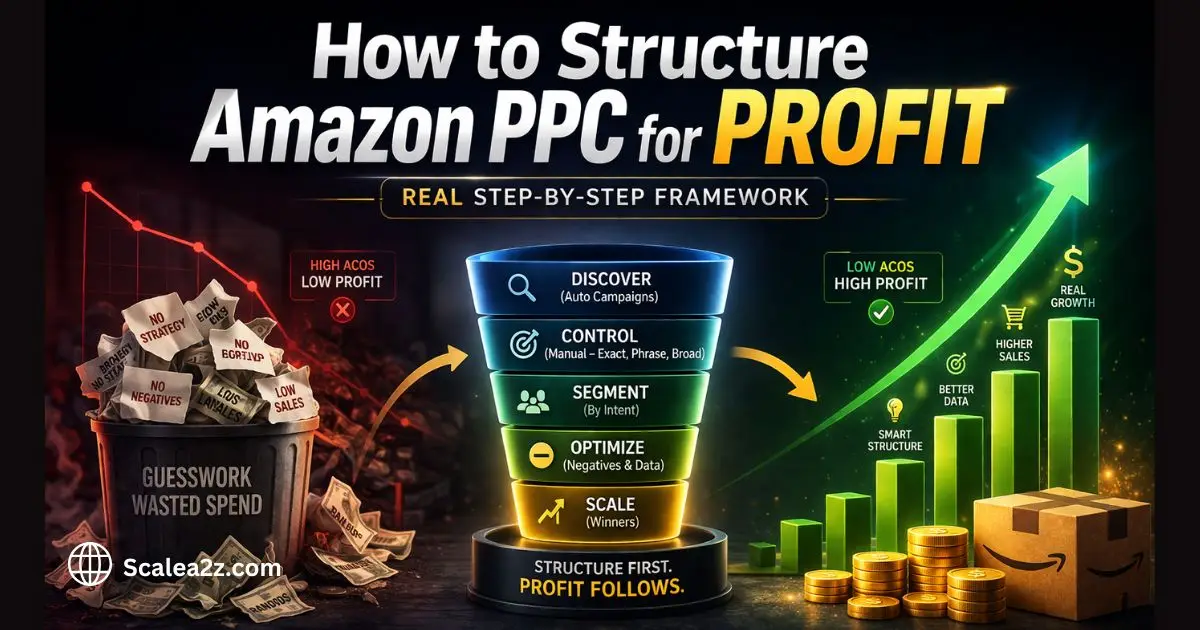
Here is the framework at a glance:
- Auto Campaigns — Let Amazon find relevant search terms for you. This is your data collection layer.
- Manual Campaigns (Exact, Phrase, Broad) — Take your best keywords and bid on them with full control.
- Segment by Intent — Split campaigns into high, medium, and low intent. Never mix them.
- Negative Keywords — Block irrelevant searches before they drain your budget.
- Scale Only Winners — Increase bids and budgets only on keywords that are already converting profitably.
Structure first. Profit follows.
Why Amazon PPC Structure Matters for Profitability
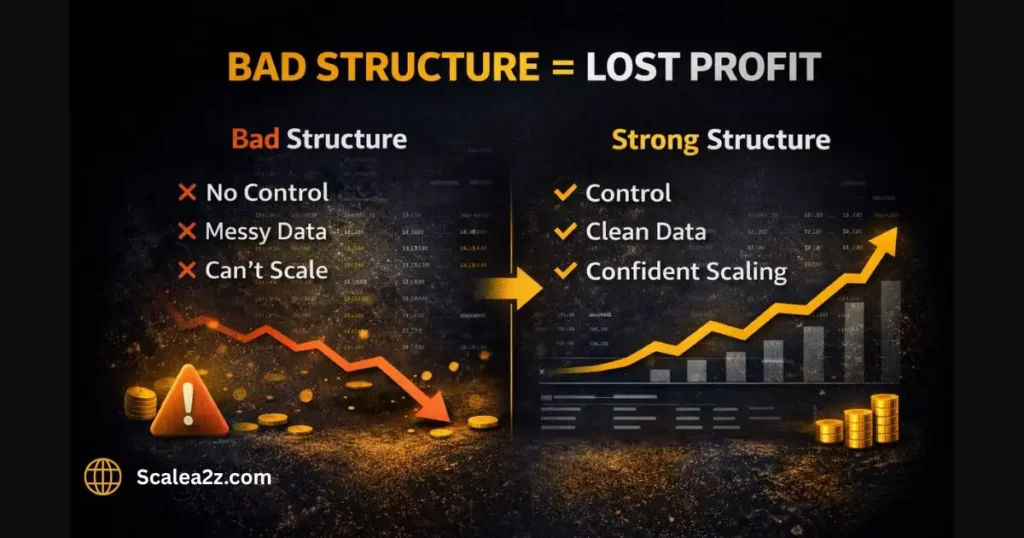
Think of your PPC account like a building. You can have the best furniture, best paint, best lighting — but if the foundation is weak, everything collapses. Sellers who know how to structure Amazon PPC for profit always have three things disorganised accounts don’t:
Control: When campaigns are structured properly, you know exactly where your money is going. Every dollar is assigned to a purpose — discovery, conversion, or scaling.
Data Clarity: Messy accounts produce messy data. When ad groups are bloated and match types are mixed, you cannot tell which keyword is actually driving sales. Clean structure equals clean data equals better decisions.
Scalability: You cannot scale what you cannot control. Sellers who try to grow with a broken structure just lose more money faster. A proper framework lets you increase spending confidently because you know which campaigns deserve more budget.
Without structure, you are not running PPC. You are just guessing — and Amazon is happily charging you for it.
Amazon PPC Structure vs Strategy — What Most Sellers Get Wrong
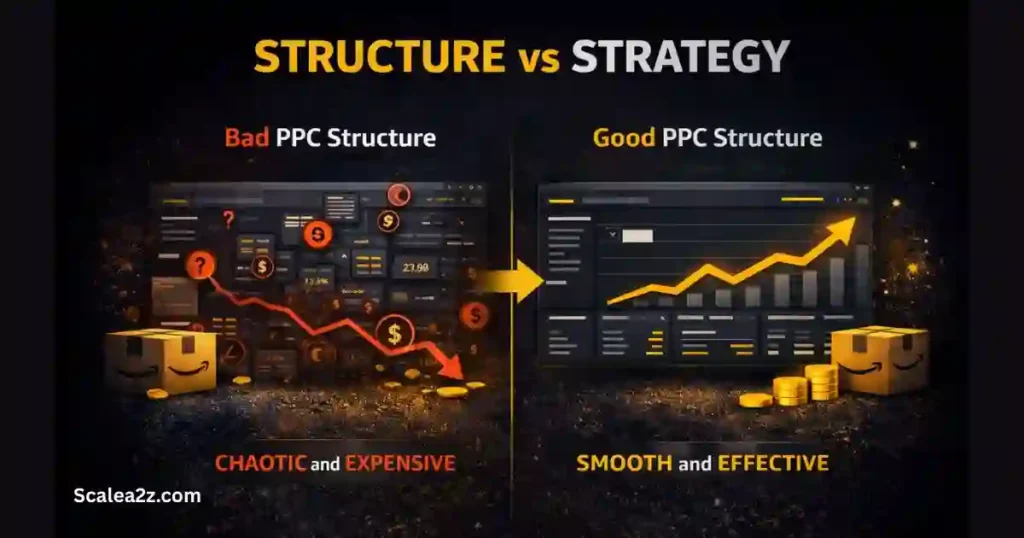
Here is something most sellers confuse: structure and strategy are not the same thing. Strategy is what you want to achieve — lower ACOS, more sales, launch a new product, or defend a keyword. Structure is the system that makes your strategy possible.
Most sellers obsess over strategy. They read about bid optimisation, dayparting, TACOS targets — but their campaigns are still a mess. One auto campaign, keywords dumped into a single ad group, no negatives added in months. You cannot execute a good strategy inside a bad structure. It is like trying to drive fast on a road with no lanes — chaotic and expensive. Fix the structure first. Then layer your strategy on top. That is the order that actually works.
The Real Amazon PPC Campaign Structure Framework (Step-by-Step)
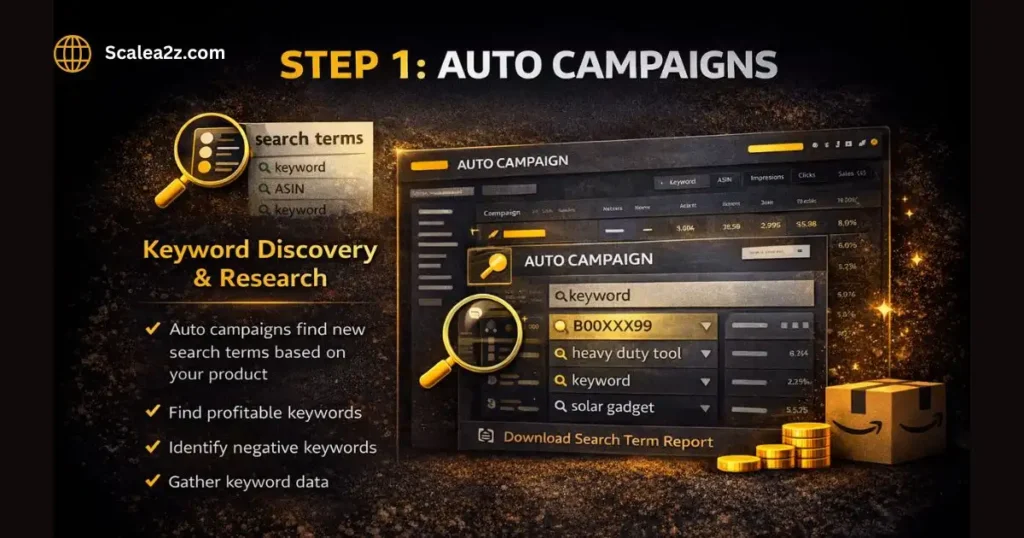
Step 1 — Auto Campaign (Data Collection Layer)
Every profitable PPC setup starts with an auto campaign — but not for sales. For data. Amazon’s auto campaign matches your ad to search terms automatically across four targeting types: close match, loose match, substitutes, and complements. Your job here is to let it run, collect search term data, and identify which terms are actually converting. Set a conservative bid. Keep the budget moderate.
Check your search term report weekly. You are mining for keywords — this is your discovery engine. Do not expect your auto campaign to be profitable from day one. That is not its job.
Step 2 — Manual Campaign Setup (Core Structure)
Once you have search term data from your auto campaign, move the winners into manual campaigns. Once you know how to structure Amazon PPC for profit at the manual level, real returns begin.
Build three separate manual campaigns:
- Exact Match Campaign — Your profit engine. Only proven, high-converting keywords go here. Tight bids, tight control.
- Phrase Match Campaign — Your scaling layer. Broader reach while still maintaining relevance.
- Broad Match Campaign — Your secondary discovery tool. Finds new keyword variations. Keep bids lower here.
Never mix match types in the same campaign. This is one of the most common and costly structural mistakes sellers make.
Step 3 — Campaign Segmentation by Intent
Not all keywords are equal. A buyer searching “best wireless earbuds under $50” is much closer to purchasing than someone searching “how do wireless earbuds work.”
Segment your campaigns by intent level:
- High Intent — Transactional keywords. “Buy,” “best,” specific product names. Highest bids, tightest structure.
- Medium Intent — Research keywords. Interested buyers are comparing options. Moderate bids.
- Low Intent — Informational keywords. Awareness stage. Low bids or exclude entirely.
Mixing intent levels in one campaign destroys your data and wastes budget. Separate them, and you will immediately see which tier is actually driving your ACOS up.
Step 4 — Ad Group & Keyword Organisation
Each ad group should contain one theme — one product variation, one keyword cluster, or one intent type. That is it. The classic mistake is dumping 50 keywords into one ad group. When that ad group underperforms, you have no idea which keyword is the problem.
Keep it clean:
- 5 to 15 keywords per ad group maximum
- One product per ad group, where possible
- Name your campaigns clearly — “Manual-Exact-High Intent-Product A” is infinitely better than “Campaign 1”
The organisation now saves hours of confusion later.
Step 5 — Match Type Strategy Inside Structure
Each match type serves a different role inside your campaign and should be treated accordingly.
- Exact — Maximum control, minimum waste. Use for keywords with proven conversion data.
- Phrase — Balanced reach. Good for scaling keywords performing well in exact.
- Broad — Maximum discovery, maximum risk. Always pair with aggressive negative keywords.
The golden rule: when a keyword proves itself in a broad or phrase, graduate it to exact. When a keyword bleeds budget with no conversions, add it as a negative. This graduation system keeps your structure efficient and self-improving over time.
Step 6 — Budget Allocation Strategy
A common mistake is distributing the budget equally across all campaigns. That is not a strategy — that is indecision.
Allocate budget based on performance and purpose:
- Auto Campaign — 15 to 20% of total budget. It is discovery, not profit.
- Exact Match — 50 to 60% of budget. This is where your money should work hardest.
- Phrase & Broad — Remaining 20 to 30%, split based on performance data.
Review allocation monthly. As exact match campaigns prove profitable, shift more budget toward them. Never fund underperforming campaigns out of habit.
Step 7 — Negative Keywords System
Negative keywords are not optional. They are the backbone of a profitable campaign setup. Without negatives, your exact and phrase campaigns bleed into irrelevant searches. Your ACOS climbs. Your profit disappears.
Build a three-layer negative system:
- Campaign-Level Negatives — Block irrelevant broad categories that will never convert for your product.
- Ad Group-Level Negatives — Prevent keyword cannibalisation between your own campaigns.
- Ongoing Negatives — Review your search term report weekly. Add non-converting terms consistently.
A good negative keyword list is never finished. It grows with your account.
Step 8 — Bidding & Optimisation Layer
Bidding is not a set-and-forget activity. It is an ongoing process that sits on top of your structure.
Key bidding principles:
- Start bids conservatively. Let data guide increases, not guesswork.
- Use dynamic bids — down only for discovery campaigns. Use fixed or dynamic up-and-down for proven exact match campaigns.
- Adjust bids based on placement data. Top of search placement often converts better — but costs more. Check if the premium is worth it for your product.
AI-driven bid adjustments and data analysis — like those used in professional PPC management — can automate this layer efficiently once your structure is solid. But automation built on a broken structure just automates failure faster.
Step 9 — Tracking Performance
Two metrics matter most for a profitable PPC account:
ACOS (Advertising Cost of Sale) — What percentage of ad revenue is going back into ads? Lower is better for profit. But too low might mean you are leaving sales on the table.
TACOS (Total Advertising Cost of Sale) — Ad spend divided by total revenue, including organic. This is the real health metric. As your organic ranking improves from PPC activity, TACOS should gradually decrease over time.
Track weekly:
- ACOS per campaign
- TACOS account-wide
- Conversion rate per keyword
- Impression share on top keywords
Let the data tell you where to move budget, where to cut, and where to push harder.
Step 10 — Scaling for Profit
Scaling is not increasing all bids by 20%. That is how sellers destroy profitable campaigns overnight.
Scale surgically:
- Identify your top 3 to 5 converting exact match keywords
- Increase their bids by 10 to 15% incrementally
- Monitor ACOS for 7 to 10 days before increasing again
- Increase budgets on campaigns hitting daily caps consistently
Only scale what is already profitable. Scaling a losing campaign just accelerates the loss.
Ideal Amazon PPC Campaign Structure
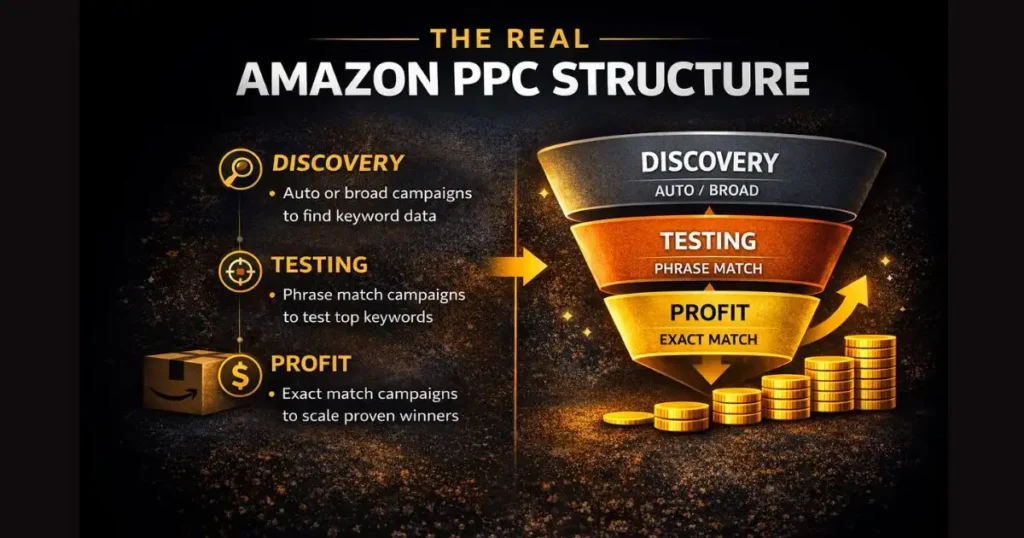
The best way to understand how to structure Amazon PPC for profit is to picture it as a funnel:
Top of Funnel → Auto + Broad — Wide reach, data collection, keyword discovery
Middle of Funnel → Phrase Match — Narrowing down, scaling proven terms
Bottom of Funnel → Exact Match — Tight control, maximum profit, lowest wasted spend
Keywords flow downward through this funnel. Auto discovers them. Phrase tests them at scale. Exact converts them profitably. Negatives prevent leakage at every level. This funnel approach is what makes an Amazon PPC structure for profit self-sustaining — constantly feeding new keywords downward while protecting margins at the bottom.
Common Amazon PPC Structure Mistakes to Avoid
- Mixing match types in one campaign. This destroys your ability to control bids per match type. Always keep them separate.
- One massive ad group with all keywords. No visibility, no control, no clean data. Break it down by theme and intent.
- Never add negative keywords. Your budget leaks silently into irrelevant searches every single day without them.
- Scaling before structure is solid. Increasing the budget on a broken structure accelerates loss, not growth.
- Ignoring TACOS and only watching ACOS ACOS alone is incomplete. TACOS shows the real impact of your ads on total business health.
Advanced Tips to Improve PPC Profitability
SKAG Strategy (Single Keyword Ad Groups): For your absolute best performers, give each keyword its own ad group: maximum bid control, maximum data clarity, minimum waste.
Product Targeting Campaigns: Target competitor ASINs and your own product pages. Often lower cost-per-click with high purchase intent.
Brand Defence Campaigns: Bid on your own brand name. Prevent competitors from stealing your branded traffic at the bottom of the funnel.
Dayparting / Bid Scheduling: Analyse when your conversions occur. Reduce bids during low-converting hours. Some accounts save 15 to 20% of ad spend with this strategy alone.
FAQ
What is the best Amazon PPC campaign structure for profit?
The best structure separates auto campaigns for discovery, manual exact/phrase/broad campaigns for control, and uses negative keywords to prevent budget waste at every level. Segment by intent for maximum efficiency.
How many campaigns should I run on Amazon?
For a single product, a minimum of 4 campaigns — one auto, one exact, one phrase, one broad. Add segmentation campaigns as your data grows.
What is a good ACOS for Amazon PPC?
It depends on your profit margin. A general target is below 30%, but your break-even ACOS based on your margin is the real number to work backwards from.
How do I organise ad groups in Amazon PPC?
Keep 5 to 15 closely related keywords per ad group, organised by theme or intent. One product variation per ad group, wherever possible.
Should I use exact, phrase, or broad match on Amazon?
Use all three — but in separate campaigns. Exact for profit, phrase for scaling, broad for discovery. Each serves a different role inside your structure.
How does campaign structure affect Amazon PPC profitability?
Poor structure mixes data, prevents bid control, and lets budget drain into irrelevant searches. A clean structure gives you the visibility and control you need to optimise for profit consistently.
Final Thoughts
Most sellers try to fix Amazon PPC by adjusting bids or switching strategies. But if the structure underneath is broken, no strategy will save it. Knowing how to structure Amazon PPC for profit is not complicated — but it requires discipline. Separate your campaigns, segment by intent, build your negative keyword system, and let data guide every decision.
Do that consistently, and profitability is not a matter of luck. It is a matter of time.
Want expert eyes on your PPC account? 👉 Get a free Amazon PPC audit at ScaleA2Z