How We Reduced Ad Spend on Amazon by 80% Without Losing Sales — PPC Case Study
Most Amazon sellers facing high ad costs do the same thing — they start cutting campaigns randomly, pausing keywords, and slashing budgets across the board. Sales drop. Panic sets in. The budget goes back up. The real problem was never the spending. It was where the spending was going.
In this case study, we walk through exactly how ScaleA2Z helped an Amazon seller achieve reduced ad spend by 80% — without a meaningful drop in total revenue. No guesswork. No blind pausing. Just a structured audit, smarter bid decisions, and a shift in how we measure success.
If your Amazon PPC costs are climbing while sales stay flat, this breakdown will show you what actually moves the needle.
Table of Contents
Rising Amazon Ad Spend, Flat Revenue, and No Clear Fix
High ad spend with flat revenue is one of the most frustrating positions an Amazon seller can be in. You keep investing, the campaigns keep running, but the numbers refuse to move. Before making any changes, the first step is understanding exactly why this happens — and it rarely comes down to budget size.
What the Ad Account Looked Like Before the Audit
An established private-label Amazon seller in the home/kitchen category came to ScaleA2Z — monthly ad spend had nearly doubled over six months while revenue stayed flat. They were running 40+ active campaigns across sponsored products, with auto and manual campaigns frequently targeting the same keywords. The Budget was distributed evenly regardless of performance, and there was no system to identify what was actually working.
The Advertising Metrics Quietly Bleeding Budget
The numbers told the story immediately. ACoS was sitting above 45% across most campaigns. CTR on several auto campaigns was under 0.2%, meaning impressions were burning through budget without generating meaningful clicks. CVR varied wildly across manual campaigns — some keywords converting at 12%, others below 1% — yet both received nearly identical bids. The search term report had not been reviewed in over two months.
Why More Budget Was Not the Right Answer
Adding more budget to a broken structure amplifies the problem. Every additional dollar spent on irrelevant search terms compounds wasted ad spend over time. The account did not need more investment. It needed a full audit.
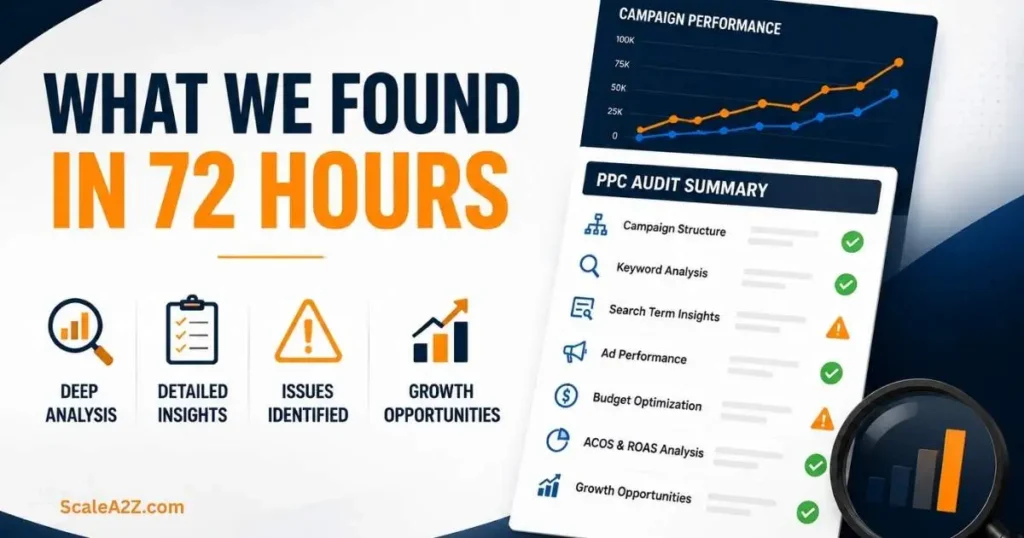
Full Amazon PPC Account Audit: What We Found in 72 Hours
Most Amazon sellers make the mistake of optimizing before they audit. Changing bids, pausing campaigns, or shifting budgets without a clear picture of account performance is guesswork. A structured audit removes the guesswork entirely and shows you, with data, where every dollar is going.
Where Wasted Ad Spend Was Hiding in Plain Sight
Within 72 hours, the audit revealed three major sources of waste. First, auto campaigns were matching to completely irrelevant search terms — unrelated categories, competitor brand names, and generic queries with no purchase intent. Second, broad match keywords were generating thousands of impressions on searches unrelated to the product. Third, multiple campaigns were cannibalizing each other — bidding on identical keywords simultaneously and inflating CPC without improving sales.
Search Term Report Forensics
Reviewing the search term report across the previous 90 days revealed a clear pattern. Roughly 15% of search terms were driving over 70% of attributed sales. The remaining 85% were generating clicks, consuming budget, and producing almost no conversions. This is the signature pattern of an account that has grown without consistent keyword harvesting and pruning.
Campaigns, Keywords, and ASINs That Looked Busy but Were Not Profitable
High impression counts are not the same as profitability. Several campaigns had strong CTR but near-zero CVR — attracting the wrong buyers entirely. A few ASINs were being aggressively promoted despite poor listing conversion rates, a problem no amount of bid optimization alone could solve.
Negative Keyword Strategy at Scale
Once the audit identified where wasted ad spend was coming from, the fastest way to stop the bleeding was a comprehensive negative keyword strategy. This single step produced the most immediate and measurable improvement in ad efficiency across the entire 90-day process.

How We Built a Negative Keyword List From Scratch
Using 90 days of search term data, we identified every term that had generated five or more clicks with zero conversions. These were added as exact match negatives at the campaign level. Broad category terms, competitor brand names, and unrelated queries were added as phrase match negatives. Over 300 negative keywords were implemented in the first week alone.
Match Type Cleanup That Immediately Reduced Ad Spend
Broad match keywords were the single largest source of irrelevant traffic. High-performing broad terms were converted to phrase or exact match. Low-performing broad terms with no conversion history were paused entirely. This change alone cut daily spend by nearly 30% within the first ten days — while keeping ROAS stable.
The Difference Between Cutting Waste and Blocking Growth
Not every unfamiliar search term is a bad one. Some terms show early conversion signals worth monitoring. The goal was to eliminate confirmed waste, not blocking discovery. Auto campaigns continued running at reduced budgets specifically to support keyword harvesting and feed new converting terms into manual campaigns.
Amazon PPC Bid Restructuring Without Touching Sales Volume
Cutting spending is easy. Cutting spending without hurting revenue is the real challenge. Bid restructuring is the process of reducing what you pay on low-performing terms while protecting — and strengthening — the keywords already proven to drive sales.
Lowering Bids on High-Impression, Low-CVR Keywords
Keywords with strong impression share but consistently low CVR were reduced in increments of 15–20%. Rather than pausing outright, gradual bid reductions tested whether lower placement still drove conversions. For most terms, the drop in CPC produced a healthier ACoS without meaningfully affecting sales volume.
Doubling Down on Proven Converters
Keywords with strong CVR and efficient ACoS received bid increases. These were already proven to drive attributed sales reliably. Reallocating budget from low-performers to proven converters kept total revenue consistent while overall spend continued to drop.
How We Protected High-Intent Keywords While Reducing Spend
Branded keywords and high-intent exact match terms stayed at competitive bids throughout the entire process. These drive the most predictable return and directly support organic rank. Cutting spending on high-intent terms to save budget is one of the most damaging mistakes sellers make during any cost reduction effort.
Campaign Consolidation: Fewer Campaigns, More Control
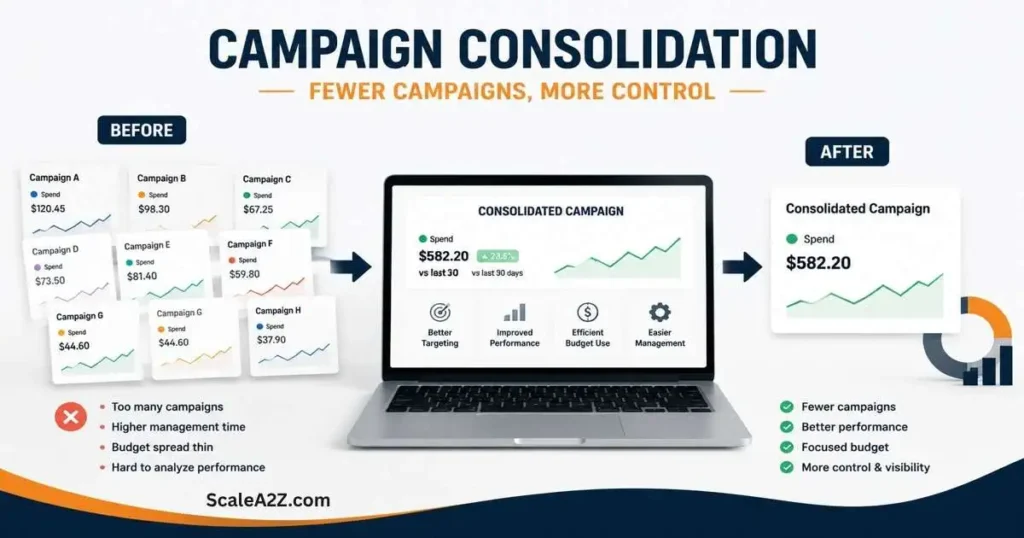
An overcrowded account is a poorly managed account. When too many campaigns are running simultaneously, budgets fragment, data becomes unreliable, and campaigns compete against each other. Consolidation brings clarity — and clarity leads to better decisions.
Why Too Many Campaigns Inflate Spend
When identical keywords appear across multiple campaigns with different match types and bids, campaigns compete against each other in the auction. This internal competition raises CPC without improving results and spreads data thin, making it harder to identify what is genuinely working.
The Campaign Consolidation Framework We Used
We merged overlapping campaigns, archived zero-performance ad groups, and restructured everything into a clean three-layer system — auto campaigns for discovery, broad and phrase for expansion, and exact match for conversion. Each layer had a defined budget, a clear role, and specific performance benchmarks.
How Consolidation Improved Budget Control and Data Clarity
After campaign consolidation, budget control became significantly more precise. Data was no longer fragmented across 40+ campaigns, making weekly bid optimization faster and more accurate. Consolidation alone reduced monthly ad spend by an additional 18%.
Switching to TACoS as the North Star, Not ACoS
ACoS tells you how efficiently your ads are performing in isolation. TACoS tells you how your ads are performing relative to your entire business. For any seller serious about sustainable growth, TACoS is the only metric that gives you the full picture.
Why ACoS Alone Was Misleading for Amazon Sellers
The seller had been optimizing exclusively for ACoS. On paper, it looked high. But organic rank was strong, and organic sales were contributing significantly to total revenue. Optimizing only for ACoS would have cut campaigns that were actively supporting organic visibility and overall sales performance.
How TACoS Guided Every Bid Decision Going Forward
Once TACoS reduction became the primary success metric, bid decisions became clearer. Campaigns that appeared expensive in isolation were justified when total revenue was factored in. TACoS dropped from 22% to 8% over three months — a far more meaningful improvement than any ACoS figure alone.
How We Balanced Paid Sales, Organic Sales, and Total Revenue
As ad efficiency improved and organic rank held steady, the ratio of paid to organic attributed sales shifted gradually. Paid sales contribution dropped from 68% to 41% of total revenue — a healthy signal that the brand was becoming less reliant on paid ads to sustain sales velocity.
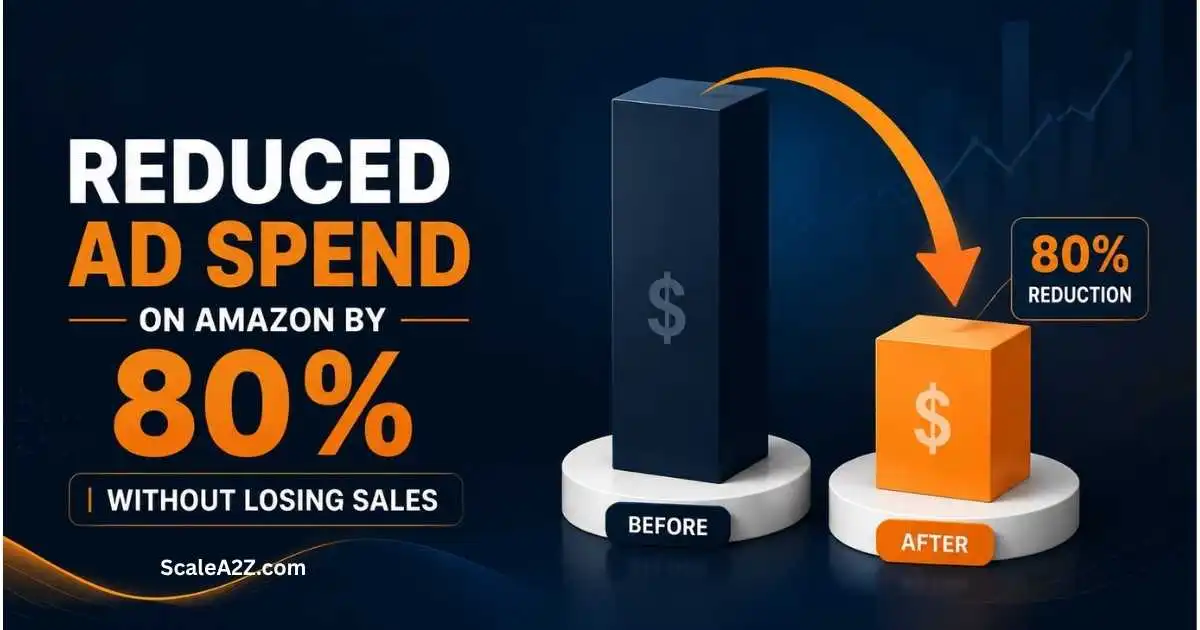
Reduced Ad Spend on Amazon by 80% Without Losing Sales
Numbers tell the real story. After 90 days of structured auditing, negative keyword implementation, bid restructuring, and campaign consolidation — here is exactly what changed, what held steady, and what improved beyond initial projections.
Before vs. After Metrics Breakdown
| Metric | Before | After |
|---|---|---|
| Monthly Ad Spend | $18,400 | $3,680 |
| ACoS | 46% | 18% |
| TACoS | 22% | 8% |
| ROAS | 2.1x | 5.5x |
| CPC | $1.84 | $0.91 |
| CVR | 8.2% | 14.6% |
| Total Revenue | $84,000 | $82,500 |
What Changed in TACoS, ACoS, CPC, CVR, and Total Sales
Every core metric improved. ACoS dropped by more than half. ROAS more than doubled. CPC fell as internal campaign competition was eliminated through consolidation. CVR improved because the budget was now concentrated on high-intent, high-converting terms. Total revenue remained virtually unchanged despite an 80% reduction in ad spend.
What Happened to Organic Rank During This Period
Organic rank held steady across all primary keywords throughout the 90 days. This was a direct result of protecting high-intent campaigns and maintaining consistent sales velocity through proven converters. Because total sales volume — paid and organic combined — remained stable, organic rank was never compromised.
What We Did Not Do to Reduce Ad Spend on Amazon
Strategy is as much about what you avoid as what you execute. Several common cost-cutting approaches would have produced short-term savings but damaged long-term performance. Understanding what we deliberately chose not to do is just as important as understanding what we did.
We Did Not Pause Every Low-ACoS Campaign Blindly
ACoS alone is not a reliable signal for pausing a campaign. Some campaigns with seemingly high ACoS were actively supporting organic rank and long-tail keyword discovery. Every pause decision was made using full-funnel data — not a single isolated metric.
We Did Not Cut Branded or High-Intent Keywords Too Aggressively
Branded and high-intent exact match keywords stayed live throughout the entire process. These are the terms most likely to convert and most important for protecting organic rank. They were never sacrificed for short-term spending savings.
We Did Not Optimize for ACoS Alone
Chasing ACoS targets without tracking TACoS and organic performance leads to shortsighted decisions. The entire strategy was built around total account health — not a single advertising metric in isolation.
Key Takeaways for Amazon PPC Sellers
This case study is not just about one account. The patterns we identified — wasted ad spend, bloated campaign structures, ACoS-only optimization — exist in the majority of Amazon PPC accounts. These takeaways apply directly to any seller dealing with high costs and inconsistent returns.
You Don't Need More Budget — You Need Better Allocation
Most Amazon ad accounts are not underfunded — they are poorly allocated. Before increasing spend, audit where your current budget is actually going. The majority of wasted ad spend can be identified and eliminated within the first 30 days of a structured review.
How to Know When You've Cut Enough
The signal that you have cut enough is when TACoS stabilizes, organic rank holds, and CVR improves consistently. If further cuts begin affecting total revenue or organic visibility, you have found your floor.
When to Reduce Spend vs. When to Scale Again
Reduce spend when ACoS is high, CVR is low, and search term data shows significant irrelevant traffic. Scale again when CVR is strong, TACoS is healthy, and you have a clean, consolidated campaign structure capable of handling higher volume efficiently.
How ScaleA2Z Helps Amazon Sellers Optimize Ad Efficiency
Every Amazon ad account is different. But the principles behind ad efficiency — clean structure, data-driven bidding, and TACoS-focused optimization — are universal. Here is how ScaleA2Z applies these principles to every client we work with.
- Amazon PPC Audits Based on Real Sales Data: ScaleA2Z begins every engagement with a full account audit using real search terms and attributed sales data — not assumptions or industry averages. Every optimization decision is grounded in what the account is actually doing.
- TACoS-Focused Campaign Optimization: Rather than chasing ACoS targets in isolation, ScaleA2Z uses TACoS as the guiding metric for all bid optimization and budget decisions — ensuring paid performance is always evaluated in the context of total revenue.
- Waste Reduction Without Killing Sales Momentum: The goal is never simply to cut spending. It is to eliminate waste while protecting the keywords, campaigns, and structures genuinely driving growth.
- Want to find where your Amazon PPC budget is leaking? ScaleA2Z can audit your campaigns, identify wasted spend, and build a TACoS-focused optimization plan. Explore our Amazon PPC management service.
Final Thoughts
Reduced ad spend does not mean reduced results. This case study proves that with the right audit process, a structured negative keyword strategy, disciplined bid optimization, and TACoS as your north star, spending less and performing better is entirely achievable. The goal was never to spend less for its own sake. It was to make every dollar work harder.
FAQ — Reduced Ad Spend on Amazon Without Hurting Sales
Can reduced ad spend actually improve my Amazon ranking?
Yes — and this surprises most sellers. When you eliminate wasted ad spend and concentrate the budget on high-converting, high-intent keywords, your CVR improves. Strong CVR is widely considered an important relevance and performance signal, which can support organic visibility when sales velocity remains stable. Additionally, when total sales velocity stays consistent — through a smarter mix of paid and organic attributed sales — Amazon continues to reward the listing with strong organic placement. The key is maintaining sales momentum during the reduction process, not simply cutting spend and hoping rank holds on its own.
What is a good TACoS target for Amazon sellers?
TACoS targets vary depending on where a product sits in its lifecycle. For new product launches, a TACoS between 15% and 25% is often acceptable because you are investing in visibility and organic rank before organic sales kick in. For established products with strong organic rank, a healthy TACoS typically falls between 6% and 12%. If your TACoS is consistently above 20% on a mature product, it usually signals that organic rank is weak and the product is overly dependent on paid traffic to sustain revenue, which is an expensive and unsustainable position.
How long does it take to see results after cutting ad spend?
The timeline depends on how aggressively changes are made and how much wasted ad spend exists in the account. In most cases, initial improvements in ACoS and CPC are visible within the first 2 to 4 weeks after implementing a negative keyword strategy and cleaning up match types. Meaningful TACoS improvement typically follows over a 60 to 90 day period as the account stabilizes around higher-quality traffic. Organic rank improvements, when they occur, are usually visible in the 45 to 75-day window as CVR data accumulates and Amazon updates ranking signals accordingly.
What's the first thing to fix when Amazon PPC costs are too high?
Start with your search term report — specifically, the last 60 to 90 days of data. Sort by spend and filter for terms that have generated five or more clicks with zero conversions. These are confirmed sources of wasted ad spend, and adding them as negative keywords is the lowest-risk, highest-impact action you can take immediately. Most accounts have hundreds of these terms hiding in plain sight. This single step costs nothing, takes less than a few hours, and typically produces a measurable reduction in daily spend within the first week of implementation.
Is it safe to pause underperforming campaigns?
It depends entirely on the campaign’s role within the account. Campaigns that have generated zero attributed sales over 60 days with meaningful spend behind them are generally safe to pause. However, campaigns running at low spend for the purpose of keyword harvesting, brand defense, or organic rank support should be restructured — not paused. Pausing without understanding a campaign’s function can create gaps in coverage that hurt organic visibility and long-term sales velocity. Always review a campaign’s contribution to total account performance before making a pause decision based on ACoS alone.
How do negative keywords contribute to reduced ad spend?
Negative keywords are the most direct and immediate tool for eliminating wasted ad spend in any Amazon PPC account. Every time your ad appears on an irrelevant search query, you risk paying for a click that has almost no chance of converting. Over time, these irrelevant clicks accumulate into significant budget waste — sometimes accounting for 30% to 50% of total monthly spend in poorly managed accounts. A well-built negative keyword list, maintained and updated regularly using search term report data, ensures your budget is spent only on searches with genuine purchase intent — improving ACoS, ROAS, and overall ad efficiency simultaneously.