Why Most Amazon PPC Agencies Fail — And How to Spot One Before It’s Too Late
You hired an agency. They sent reports. Spent your budget. And yet — sales stayed flat, ACoS crept up, and nobody could explain why. This is not a rare story. Many Amazon sellers experience the same pattern every year. The problem is not Amazon PPC itself. The problem is how most agencies manage it — chasing surface-level metrics while your actual profit quietly erodes.
This guide breaks down the most common reasons an Amazon PPC agency fails its clients, what those failures look like in real campaigns, and how to evaluate whether your current agency is actually moving the needle — or just moving money around.
Most Amazon PPC agencies fail because they focus on campaign activity instead of profitable growth. Amazon PPC Services like ours focus on ensuring this growth.
Table of Contents
Why Most Amazon PPC Agencies Fail
Most sellers assume that hiring an agency means their advertising is handled by people who understand their business. That assumption is rarely tested — until it is too late. The gap between what agencies promise and what they deliver starts with a fundamental misalignment in focus.
They Manage Ads, Not Profit Growth
There is a clear difference between managing ad campaigns and managing business growth. Most agencies focus on the first and rarely connect their work to the second. They set up campaigns, adjust bids, and send reports. But if an agency celebrates a 15% ACoS without understanding your margin, fulfillment cost, or return rate, it is not managing profit — it is managing a dashboard. Real PPC management starts by asking whether this spend is generating profitable growth.
Why Sellers Often Realize the Problem Too Late
Bad agency work is easy to miss in the short term. Ad spend flows, campaigns run, and reports arrive on schedule. The warning signs appear gradually — ACoS rises, sales plateau, wasted spend compounds month after month. By the time a seller pulls a full account audit, thousands of dollars are already gone. Sellers stay too long because switching feels risky. But staying with the wrong Amazon PPC agency is far more expensive than making the move earlier.
The Amazon PPC Agency Problem Nobody Talks About
Amazon advertising grew fast. The supply of qualified specialists did not keep up. The result is a market where credentials are self-declared, experience is overstated, and sellers have no reliable way to separate genuine expertise from polished sales decks.
Why the Market Is Flooded with Underqualified Agencies
Anyone with a Seller Central account and a keyword tool can call themselves an Amazon PPC expert. There is no required license to become an Amazon PPC agency, and sellers often have to judge expertise based on results, process, and transparency. Sellers are left sorting through hundreds of agencies with no objective way to measure competence — until money has already been spent. The loudest agencies with the best-looking case studies are not always the most qualified.
What "Managed by Experts" Really Means
In many cases, “experts” means a junior account manager following a standard operating procedure — adjusting bids weekly and escalating nothing unless a client complains. True expertise means understanding how campaign structure, match types, listing quality, and profit margins interact with each other. That level of thinking is rare, and it is rarely what sellers are actually getting when they sign a contract.
Mistake #1 — They Use Cookie-Cutter Campaign Structures
Campaign structure is the foundation of everything in Amazon PPC. Get it wrong, and no amount of bid optimization will fix the results. Most agencies skip the thinking required to build a structure that fits a specific product and business goal.

One-Size-Fits-All Campaigns Don't Work on Amazon
A product launch needs aggressive, broad match and discovery campaigns. A mature ASIN needs tight exact match control. A seasonal product needs a completely different approach by quarter. Cookie-cutter agencies apply the same structure regardless — three auto campaigns, a broad phrase, an exact phrase — and call it done. The results are average. And average performance on Amazon means losing ground to competitors who are more intentional.
Why Generic Keyword Lists Drain Your Ad Budget
Agencies that skip deep keyword research rely on auto-suggested terms and surface-level tools. The result is campaigns stuffed with high-volume, low-relevance keywords that spend budget without converting. A generic keyword list does not account for your category competition, price point, or conversion rate. Every dollar spent on an irrelevant keyword is a dollar not spent on a term that could actually close a sale.
Mistake #2 — They Optimize for ACoS, Not Profit
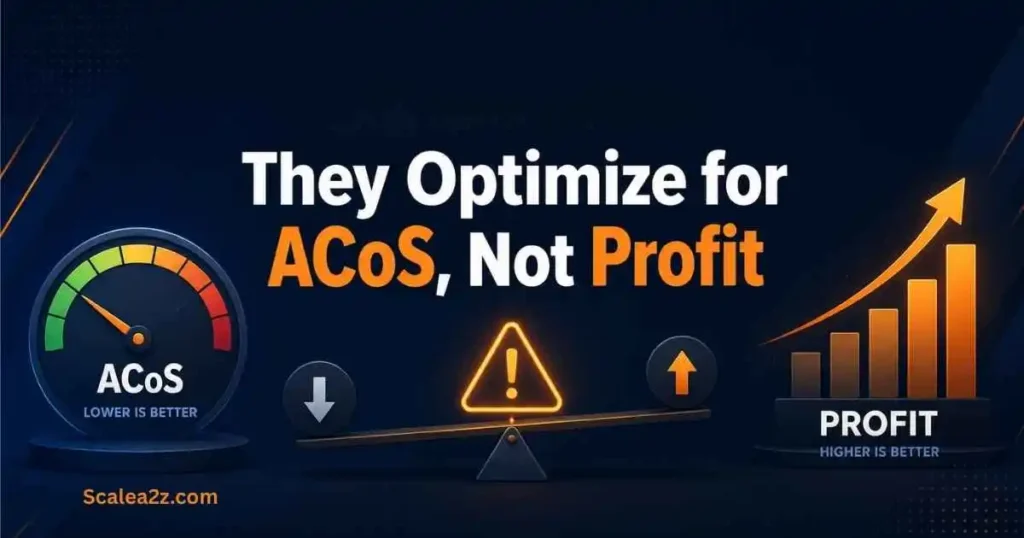
ACoS is the most commonly reported metric in Amazon advertising — and the most commonly misused. Agencies that optimize purely around ACoS targets are solving for the wrong variable, making decisions that look good on reports but quietly damage the business underneath.
The Difference Between Low ACoS and Real Profit
A low ACoS looks good in a report. It does not always mean the business is profitable. If an agency cuts spending on every campaign above a fixed ACoS target, they may also be cutting campaigns that drive revenue or support organic rank. ACoS is a ratio. It tells you nothing about absolute profit, order volume, or business trajectory on its own.
Why TACoS Matters More Than ACoS Alone
TACoS measures ad spend against total revenue — not just ad-attributed revenue. It reflects the true cost of advertising relative to the entire business. An Amazon advertising agency that only reports ACoS is giving you an incomplete picture. TACoS shows whether paid campaigns are supporting overall growth or simply recycling existing demand — and sellers who ignore it often miss the slow erosion happening underneath.
How Bad Agencies Hide Behind Vanity Metrics
Impressions are up. Click-through rate improved. ACoS is below target. These are the metrics bad agencies highlight when results are actually declining. If your reports are full of activity-based numbers but short on profit data, conversion trends, or TACoS movement, your agency is managing optics, not outcomes. Ask for a breakdown of the net profit contribution from PPC. If they cannot provide it, that tells you everything.
Mistake #3 — They Ignore Search Term Mining
Search term data is the most valuable intelligence Amazon gives advertisers. The agencies that win for their clients mine it constantly. The ones that fail treat it as a monthly checkbox — and sellers pay in wasted spend and missed opportunities.

Winning Search Terms Are Not Moved Properly
The job of a good agency is to identify converting search terms and move them into exact match campaigns with controlled bids. Most agencies do this infrequently or not at all. Winning terms stay buried in broad campaigns, getting inconsistent bids, when they should be isolated and scaled. This oversight compounds every week it goes unaddressed.
Wasted Search Terms Are Not Negated
Every irrelevant term that triggers your ad costs money. Without disciplined negative keyword additions, campaigns continue serving ads for queries that will never convert — draining budget daily. Negative keyword management is one of the highest-return activities in Amazon PPC when done consistently. Most agencies treat it as an afterthought.
Why Poor Negative Keyword Strategy Burns Budget
Negative keyword strategy is not a one-time setup. As campaigns run, new irrelevant terms constantly emerge. An agency without a weekly search term review is allowing waste to accumulate silently. Over 90 days, this compounds into significant lost spend — money that could have been redirected toward proven converting terms or new campaign opportunities.
Mistake #4 — They Don't Understand the Full Funnel
Amazon PPC is not just Sponsored Products. It is a coordinated system of ad types, each serving a different role in the buyer journey. Agencies that treat each type in isolation miss the compounding effect of a connected strategy.
Treating Sponsored Products, Sponsored Brands, and Sponsored Display as Separate Islands
Sponsored Products drive direct conversions. Sponsored Brands capture category traffic. Sponsored Display supports retargeting and defends your product page. A shopper exposed to multiple relevant ad touchpoints is often easier to convert than someone seeing a single ad in isolation. Agencies that manage these in isolation leave that compounding impact on the table entirely.
Ignoring the Organic Rank Impact of Paid Campaigns
Sales velocity from PPC can support organic ranking on Amazon when campaigns drive relevant traffic and conversions. An agency that cuts spend at the wrong moment drops velocity, reduces organic rank, and triggers a decline that hurts both paid and organic performance simultaneously. PPC and organic are not separate levers — decisions made in one affect outcomes in the other.
Why PPC Cannot Fix a Weak Listing
An agency running aggressive PPC on a listing with poor images or a weak title is burning budget. Traffic that does not convert raises ACoS and signals low quality to Amazon’s algorithm. A responsible Amazon advertising agency flags listing issues before recommending increased ad spend. If yours has never raised this point, they are spending your money on a problem PPC cannot solve.
Mistake #5 — Zero Transparency in Reporting
Reporting is where the relationship between a seller and an agency either builds trust or slowly breaks down. Most agencies deliver data. The best ones deliver understanding. That difference determines whether you actually know what is happening in your account.
What a Real Amazon PPC Audit Should Include
A genuine audit covers campaign structure logic, keyword coverage gaps, search term waste, match type distribution, bid strategy alignment with margins, and placement performance. Most agency reports show what happened. A real audit explains why it happened, what decisions were made, and what needs to change going forward.
Red Flags in Agency Reports You Should Never Ignore
Watch for reports that show only improving metrics — no account improves in every area every month. Watch for reports without commentary or context. Watch for numbers presented without comparison to previous periods. And watch for agencies that respond to direct questions with more data instead of clear explanations. Transparency means accountability — and most agencies are not built for it.
Why Reports Should Explain Decisions, Not Just Metrics
Every bid change, every campaign pause, every budget reallocation is a decision that should be documented and explained. Reporting that shows results without reasoning is not a partnership — it is a black box. And black boxes are where ad budgets quietly disappear month after month without anyone being held responsible.
Mistake #6 — No Strategy Behind Scaling
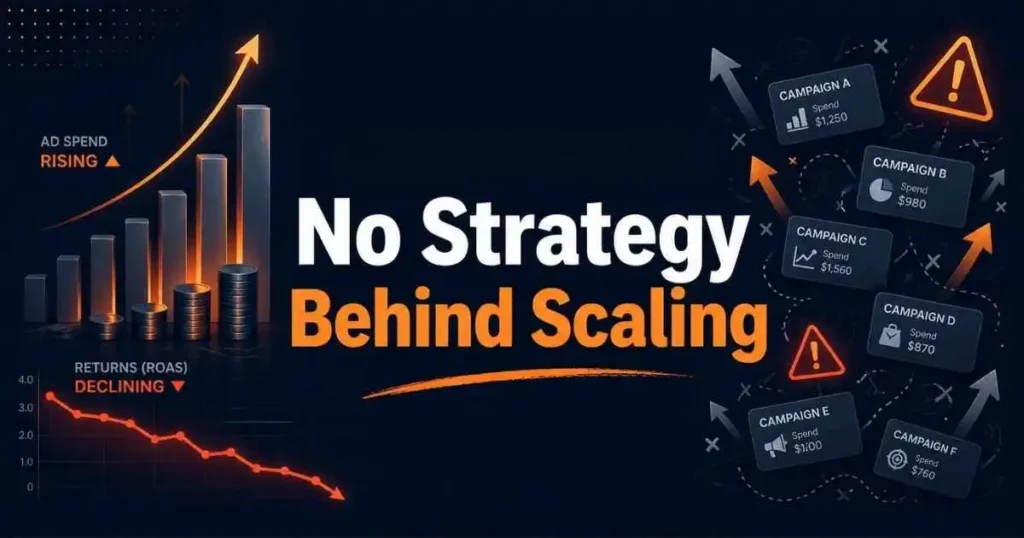
Scaling is the goal every seller has when hiring an agency. But scaling without a plan is not growth — it is just more spending. The agencies that damage accounts most are often not the ones doing nothing. They are the ones moving fast in the wrong direction.
Throwing Budget at What's Already Working
Scaling the budget on a high-performing campaign sounds logical. But without understanding why it is performing — a single keyword, a seasonal spike, a competitor going out of stock — increasing spend often leads to diminishing returns. Agencies that scale by instinct rather than data overspend during temporary windows and miss the structural changes needed to sustain growth.
Scaling Spend Without Scaling Returns
The goal of scaling is to grow profitable revenue — not just ad spend. An Amazon PPC agency that doubles your budget without a documented plan for proportional returns is not scaling your business. They may be increasing spending without proving that the extra budget is creating proportional returns. Real scaling requires new keyword discovery, new structures, and constant evaluation of where incremental spend generates incremental profit.
Why Growth Needs Structure, Not Just More Budget
Sustainable growth comes from campaign architecture that can absorb more spend efficiently — segmented campaigns, controlled match types, and proven keywords in exact match. Without that structure, adding budget creates chaos, not growth. More money into a poorly built account produces more waste, not more sales. Structure first. Scale second. That sequence is not optional.
Weak vs Strong Amazon PPC Agency
| Weak Amazon PPC Agency | Strong Amazon PPC Agency |
|---|---|
| Reports only ACoS | Tracks ACoS, TACoS, and profit direction |
| Uses generic campaign structures | Builds campaigns around product goals |
| Reviews search terms occasionally | Mines search terms consistently |
| Adds negatives randomly | Uses disciplined negative keyword strategy |
| Sends reports without context | Explains decisions and next steps |
| Scales spend blindly | Scales based on incremental profit |
What a High-Performing Amazon PPC Agency Actually Does
- Builds Campaigns Around Product Goals: A competent Amazon PPC agency builds campaigns around your specific product goals — launch, scale, or defend — not a generic template.
- Runs Continuous Search Term Analysis: They run continuous search term analysis, move winning terms into exact match campaigns, and eliminate waste through disciplined negative keyword management.
- Uses Data-Driven Bid Adjustments: They use bid adjustments that respond to conversion signals, margins, and product goals — not arbitrary ACoS targets.
- Connects PPC with Listing Conversion and Profit: They connect PPC performance directly to listing conversion rates and profit margins because ads do not operate in isolation.
How to Evaluate Your Current Amazon Advertising Agency
Most sellers wait for results to collapse before asking hard questions. The smarter approach is to evaluate your agency before damage compounds — with specific questions that separate genuine expertise from polished reporting.
5 Questions to Ask Before Renewing Any PPC Contract
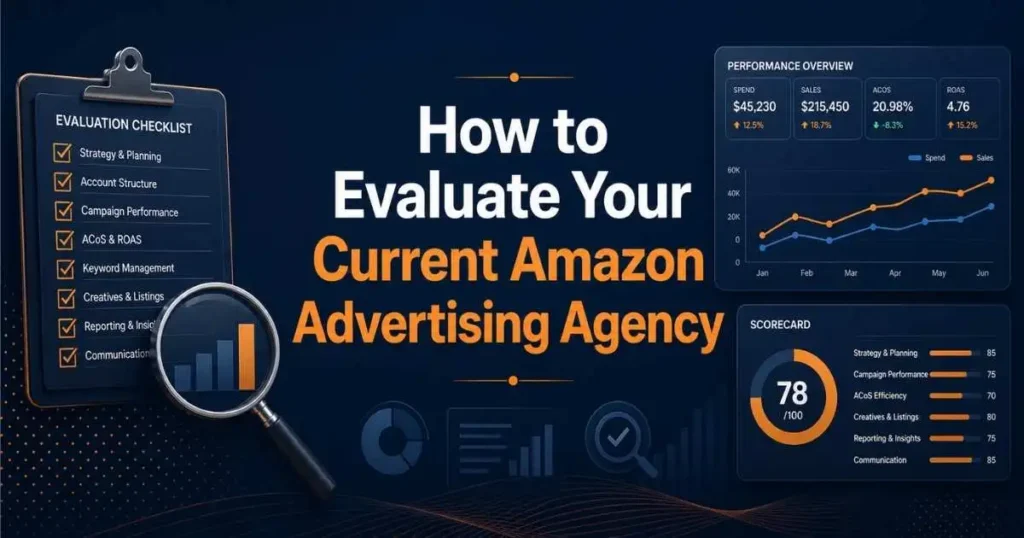
Ask your agency what your breakeven ACoS is and how the current strategy reflects it. Ask how often they review search term reports, add negative keywords, and track TACoS over the last 90 days. You should also know what structural campaign changes they made this quarter and how your PPC strategy supports organic rank. If they cannot answer these questions clearly, your renewal decision is already made.
What 90 Days of Real Performance Should Look Like
In 90 days, a competent agency should have audited your structure, eliminated wasted spend, converted search terms into controlled campaigns, and established clear performance baselines. You should have a cleaner campaign architecture and reporting that explains decisions — not just outcomes. If you are still looking at the same campaigns with slightly adjusted bids, very little real work has been done.
When It's Time to Switch Your Amazon Advertising Agency
If your agency cannot explain its decisions, wasted spend goes unaddressed, reports arrive without context, and profit is not improving despite consistent spend, it is time to move on. Staying with the wrong Amazon advertising agency is far more expensive than switching. The right partner treats your account like a business, not a billing line item.
Not sure whether your current agency is improving profit or just managing reports? ScaleA2Z can audit your Amazon PPC structure, wasted spend, search terms, and TACoS direction to show what is really happening inside your account.
Final Thoughts
Amazon PPC is not impossible to understand. But managing it well — in a way that grows profit, not just ad spend — requires strategy, discipline, and genuine accountability. Most Amazon PPC agencies fail not because they lack tools, but because they lack the right focus. They manage campaigns. The best ones manage businesses.
If your current Amazon PPC agency cannot connect their work directly to your profit growth, the question is not whether they are failing you — it is how long you have been letting it happen. The right partner asks harder questions, reports with honesty, and builds campaigns with purpose. That is the standard your business deserves.
If your Amazon PPC campaigns are spending without clear profit growth, ScaleA2Z can help you identify wasted ad spend, fix campaign structure, and build a PPC strategy focused on profitable growth. Book a free consultation today.
FAQs About Why Amazon PPC Agencies Fail
Most sellers have questions about agency performance only after something has already gone wrong. These answers are meant to help you ask the right questions before that point — so you can hold your agency accountable from day one.
Why do most Amazon PPC agencies fail?
Most fail because there is a fundamental misalignment between what they track and what actually matters. Agencies are built around deliverables — reports, bid changes, campaign setups. Sellers need outcomes — profitable growth, reduced waste, and improved TACoS over time. When an agency measures its own success by activity rather than results, failure becomes inevitable. The campaigns run. The budget is spent. And the business either stagnates or slowly declines while the reports continue to look clean.
What are the signs of a bad Amazon PPC agency?
The clearest signs are not always dramatic. They are quiet and consistent. Reports that only show improving metrics. No evidence of regular negative keyword additions. Campaign structures that look identical month after month with no explanation. Answers to direct questions that come back as more data instead of clear reasoning. An agency that has never asked about your margins, your breakeven ACoS, or your profit targets is not managing your business — they are managing a process. That distinction matters more than most sellers realize until the damage is already done.
Should an agency focus on ACoS or TACoS?
Both metrics have a role, but TACoS tells the more honest story. ACoS measures efficiency within ad-attributed sales only. TACoS measures total ad spend against total revenue — including organic — which reflects the real cost of advertising relative to the entire business. An agency that reports only ACoS can show you a healthy ratio while your overall business is quietly declining. TACoS exposes that gap. Any agency managing a serious Amazon account should be tracking and reporting both, and explaining what the trend in each means for business direction.
How often should an agency optimize Amazon PPC campaigns?
Search term reports should be reviewed and acted on weekly. Bid adjustments should follow the same cadence, based on actual conversion data rather than fixed schedules. Match type refinements and structural changes should happen monthly as performance patterns become clear. A full strategic review — covering TACoS trajectory, profitability alignment, keyword coverage, and campaign architecture — should happen quarterly. If your agency cannot describe a specific optimization cadence when asked, that absence of process is itself a serious red flag worth addressing immediately.
Can PPC fix a poor Amazon listing?
No — and any agency that suggests otherwise is either uninformed or avoiding a difficult conversation. PPC drives traffic to a listing. It cannot convert that traffic if the listing is not doing its job. Poor main images, a weak title, thin bullet points, low review count, or an uncompetitive price will produce the same result regardless of how precisely the campaigns are built — high spend, low conversion, inflated ACoS. A responsible agency identifies listing weaknesses before recommending aggressive ad spend. If yours has never raised this point, they are spending your money on a problem they cannot solve.
What should a good Amazon PPC report include?
A strong report goes beyond surface numbers. It should cover ACoS and TACoS with period-over-period comparison, total ad spend broken down by campaign type, search term performance including new winners identified and negatives added, bid changes with clear reasoning attached, conversion rate trends at the campaign and ASIN level, and a written summary that explains what changed, why decisions were made, and what the focus will be in the next period. Data without explanation is just noise. The explanation is where accountability lives — and where the quality of an agency’s thinking becomes visible.