
Amazon Is Not Just Ads: It’s a Full Ecosystem
You doubled your ad budget last quarter. Sales barely moved. ACoS crept up. And somewhere in the back of your mind, a quiet question started forming. Why am I spending more to stand still?
Here is the uncomfortable answer. Ads were not the whole problem. They were just the most visible symptom. Most sellers treat Amazon like a vending machine. Put money in, get sales out. But the Amazon ecosystem is a connected system, and ads are only one moving part inside it. When listings, customer reviews, inventory, or account health are weak, ads become the most expensive way to expose the problem.
This guide breaks down the full Amazon ecosystem, the six layers that actually decide your growth, and how they feed each other. If your ad spend keeps climbing while profit flattens, start with why that happens here, then come back and read the rest.
Ready to stop paying for problems that ads cannot fix? Keep reading.
Table of Contents
Why Sellers Get Stuck on Ads
Amazon PPC feels like control because sellers can change bids, budgets, and campaigns quickly. You set a bid, you see a click, you watch a sale land in the dashboard. It is the one lever with an instant feedback loop, so it gets all the attention.
The trap is simple. When sales dip, the easy move is to push the lever harder. More budget, higher bids, new campaigns. For a week or two, it works, then the plateau comes back.
Here is what is really going on. A bid only decides whether a shopper sees your product. It does nothing to make them buy. If your listing, customer reviews, price, or stock are weak, every extra dollar just buys more clicks that bounce.
Let us say you sell a protein powder. You raise bids, and traffic jumps 40 percent. But your main image is dull, and you have 19 customer reviews against a competitor with 4,000. Those new clicks scroll right past you. You did not buy sales. You bought a more expensive way to lose.
That is the core lesson of the Amazon ecosystem. Ads amplify whatever already exists. Strong listing, ads multiply it. Weak listing, ads expose it.
The Amazon Ecosystem in Plain Terms
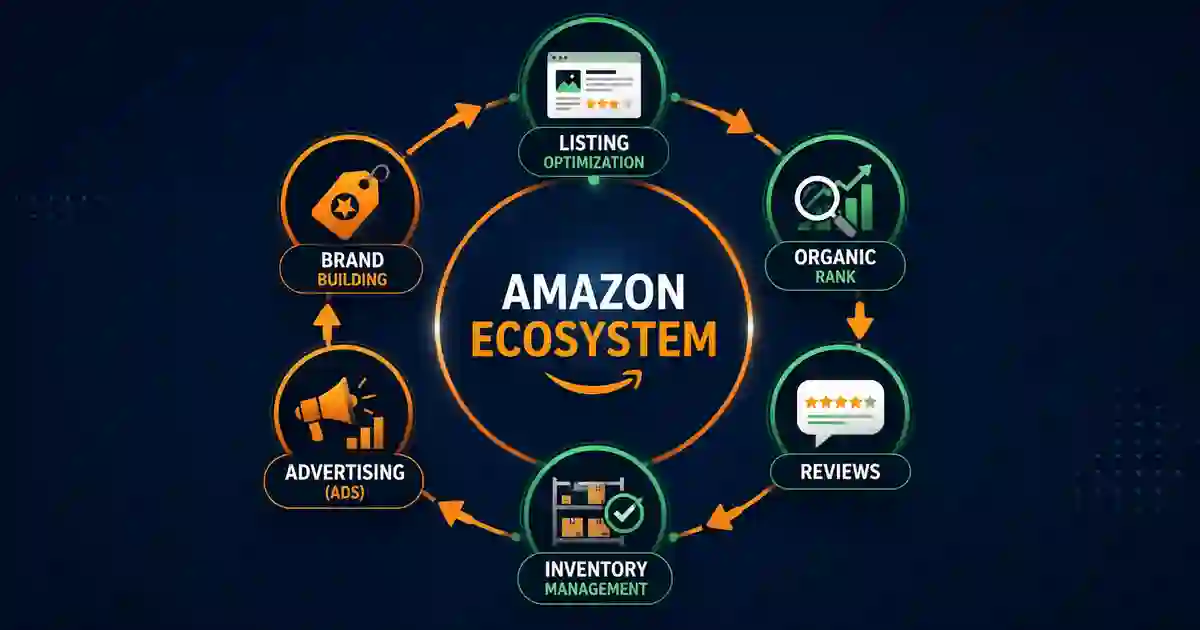
Think of your Amazon presence as a flywheel, not a switchboard. Each part pushes the next, and the whole thing spins faster over time.
Traffic brings shoppers. Your listing converts them. Sales send relevance and performance signals to Amazon’s ranking system. A better rank brings free organic traffic. Reviews build trust that lifts conversion again. And steady inventory keeps the whole wheel turning without a stall.
Ads sit on the outside of that wheel. They give it a push when it is slow or when you want it to spin faster. They are powerful, but they are not the wheel itself.
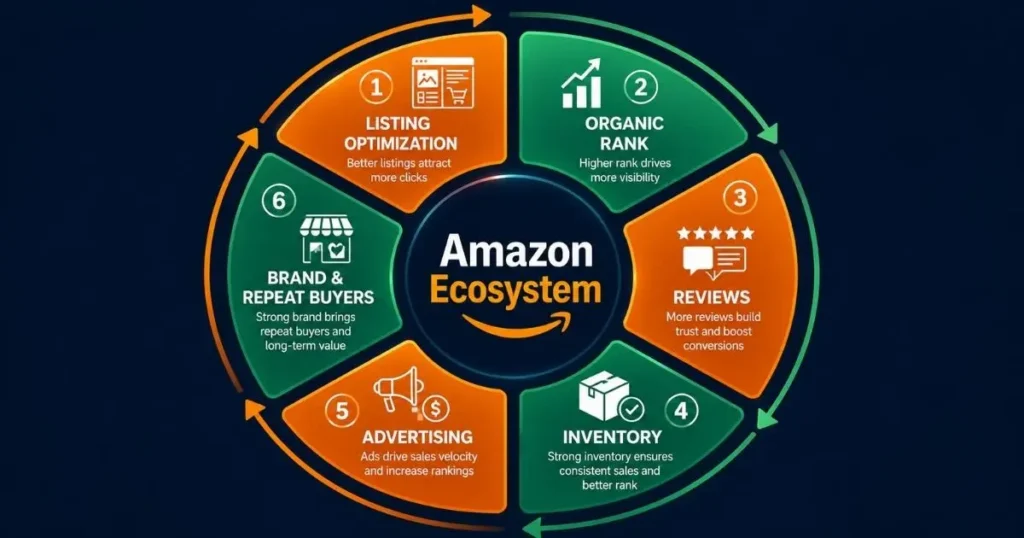
The six layers of the Amazon ecosystem are your listing, your organic rank, your reviews, your inventory and account health, your ads, and your brand. Most sellers obsess over one and ignore five. Winners manage all six as one system.
The rest of this post walks through each layer, then shows how they connect. By the end, you will see exactly where your own flywheel is leaking.
Your Listing Does the Selling
Your listing is the conversion engine of the entire Amazon ecosystem, because Amazon listing optimization decides whether traffic turns into sales. Ads and SEO bring people to the door. The listing decides whether they walk in.
A 2 percent jump in conversion rate changes everything downstream. Cheaper ads, faster ranking, lower TACoS. This is the highest-leverage layer most sellers underinvest in.
Images carry the click
Shoppers scan images before they read a word. Your main image earns the click in search, and your secondary images close the sale on the product detail page.
Take a yoga mat. One seller shows a flat product on white. The competitor shows the mat rolled, in use, with thickness callouts and a size comparison. Same product, very different conversion rate. Strong Amazon creatives are not decoration. They are demand capture.
Title and bullets carry the search
Your title and bullets do two jobs at once. They tell Amazon’s ranking system what you are, and they tell the shopper why to choose you.
Lead the title with the core keyword and the clearest benefit. Use bullets to answer objections, not to list features. A shopper buying a coffee grinder cares about consistency and noise, so say that plainly.
A+ Content carries the trust
A+ Content turns a flat page into a brand story. Comparison charts, lifestyle modules, and clear specs lift conversion and reduce returns.
If your brand is eligible through Amazon Brand Registry, use A+ Content and Amazon Stores to make the listing more complete and trustworthy. A registered brand with rich content almost always out-converts a bare listing in the same niche.
Organic Rank and Amazon SEO
Paid traffic stops the moment your budget stops. Organic rank keeps working while you sleep. That is why Amazon SEO is the layer that compounds.
Your goal is to climb to page one for the keywords that actually convert, then let free traffic carry more of the load. Done right, your ad reliance drops as your rank rises.
Indexing comes first
You cannot rank for a keyword that Amazon does not know you carry. Indexing means the term lives in your title, bullets, or backend keywords so the listing is eligible to show.
Tools like Helium 10 let you check which terms you index for and which you are missing. Fix indexing gaps before you spend a cent chasing rank with ads.
Sales velocity moves you up
Once you are indexed, sales velocity decides how high you climb. Amazon’s A9 ranking system rewards listings that convert clicks into orders at a steady pace for a given keyword.
This is the bridge between ads and SEO. Early on, ads create the velocity that earns organic rank. Later, that rank feeds you free sales, and your TACoS falls. Skip this connection, and you stay dependent on paid traffic forever. For the deeper fixes here, see our breakdown of the most common Amazon SEO mistakes.
Reviews and Social Proof
Reviews are the trust layer of the Amazon ecosystem, and they quietly control your conversion rate. Two listings can have identical images and price, and the one with more reviews wins almost every time.
The numbers are blunt. A product sitting at 12 reviews and 3.9 stars converts far worse than the same product at 400 reviews and 4.5 stars. Same traffic, very different result.
Say you sell a water bottle. You and a competitor both rank on page one. They have 2,100 reviews, you have 60. Your ad clicks cost the same, but theirs convert at double the rate. Customer reviews made their Amazon advertising more efficient before the bid even changed.
Build review velocity the right way. Use Amazon Vine for new products, request reviews through the Seller Central button, and fix the product issues that trigger negative reviews. Never buy fake reviews. The short-term lift is not worth the account risk.
Quick Tip: Read your one and two star reviews before your next ad push. They tell you exactly why clicks are not converting. Fixing the top complaint often beats raising any bid.
Inventory and Account Health
This is the layer sellers forget until it burns them. Inventory and account health sit under everything else, and when they crack, the whole Amazon ecosystem stalls.
Running out of stock means you do not just lose sales. You lose the Buy Box, you lose the ranking you paid to build, and you restart from a weaker position when you return. A serious stockout can wipe out weeks of organic ranking momentum.
Inventory management is a growth lever, not a back-office chore. Forecast demand, account for lead times, and never let a best seller go dark during a ranking climb or a seasonal peak.
Account health matters just as much. Policy warnings, listing suppressions, and late shipment rates can throttle visibility or freeze your account. A suspended ASIN earns nothing, no matter how good the ad strategy is.
If catalog and account work feels like whack-a-mole, that is usually a sign the operational layer needs a real owner. Weak account health and poor inventory management leak money in places that ads can never fix.
Ads as the Accelerator
Now we get to ads, and notice where they land. Layer five, not layer one. Amazon advertising is the accelerator of the ecosystem, not the engine.
Used well, ads do three jobs. They capture demand from in-market shoppers, they create the early sales velocity that earns organic rank, and they defend your top keywords from competitors.
The structure is what makes or breaks them. Separate campaigns by purpose, launch, scale, defend, and harvest. Mine your search term report weekly, promote winners to exact match, and negate the waste. A clean campaign structure is the difference between Amazon PPC that supports profitable growth and PPC that only increases ad spend. We cover the full framework on how to structure Amazon PPC for profit.
But here is the rule that ties this layer to every other one. Ads are only as efficient as the listing, reviews, and rank behind them. Fix those first, and the same budget produces more sales at a lower ACoS.
This is exactly where ScaleA2Z does its sharpest work. We use AI-driven data analysis to read the full picture, then make bid adjustments that account for your listing strength and organic rank, not just yesterday’s ACoS. Full PPC management only pays off when it sits on top of a healthy ecosystem, so that is how we run it.
Brand and Repeat Buyers
The final layer is the one that turns a product into a business. Brand and repeat buyers lower your cost to grow because the same customer comes back without a new ad click.
A shopper who buys your protein powder once might buy it eight times a year. If you earned that first sale through a brand they remember, the next purchases often cost much less to earn. That is lifetime value, and it quietly funds everything else.
Build the brand layer with Amazon Stores, a consistent visual identity across creatives, Sponsored Brands that get your name in front of new shoppers, and a reason to come back. Subscribe and Save, bundles, and follow-on launches all feed repeat purchase.
Brand also protects you. When shoppers search for your name directly, competitors cannot buy their way to the top of search results as easily. Demand you create is cheaper to keep than demand you rent.
How the Layers Feed Each Other
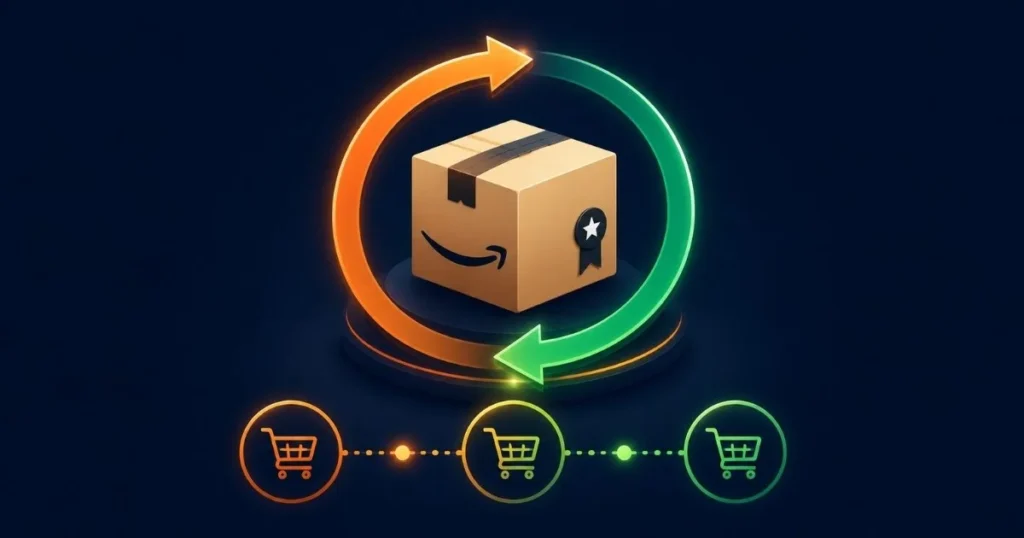
Here is the part many sellers miss. The six layers are not a checklist. They are a loop, and a weak link drags the whole Amazon ecosystem down.
Walk the chain. A weak listing lowers conversion. Low conversion raises your ACoS and slows sales velocity. Slow velocity drops your organic rank. Lower rank means you lean harder on ads, which costs more because conversion is still weak. The loop feeds on itself.
Now run it forward instead. Strong images lift conversion. Higher conversion lowers ACoS and speeds velocity. Faster velocity climbs the rank. Better rank cuts ad reliance and frees budget. Reviews keep compounding the trust. The same flywheel that punished you now pays you.
That is why fixing one layer in isolation rarely works. You do not have an ad problem or an SEO problem. You have a system, and the system is only as strong as its weakest layer.
Quick Tip. Before scaling spend, find your weakest layer and fix that first. Pouring budget into a flywheel with a flat tire just spins faster in place.
How to Audit Your Own Ecosystem
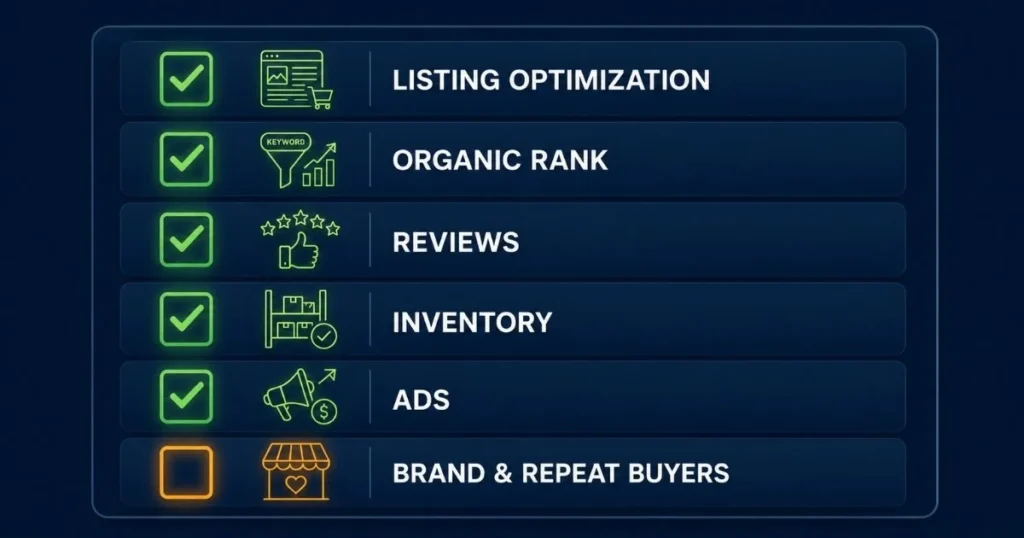
You do not need a tool to find your weak link. You need an honest hour. Walk these six checks in order.
- Listing: Is your main image clearly better than the top three competitors? Does your A+ Content answer the top buying objection?
- SEO: Pull your indexed terms in Helium 10. Are you missing any high-volume keywords you should rank for?
- Reviews: How do your star rating and review count stack up against page one rivals? What is the top complaint?
- Inventory: Do you have enough stock to cover lead time plus a sales spike? Any account health flags open?
- Ads: Is your Amazon PPC split by purpose, or is it one messy campaign? When did you last clean the search term report?
- Brand: Do you have a Store, repeat-purchase offers, and branded search defense?
Whichever check made you wince is your starting point. Fix that layer, then watch the next one improve on its own.
Quick Tip: Score each layer one to five. The lowest number is your highest-ROI project this month, no matter how tempting it is to just raise bids.
If working through all six feels like a second full-time job, that is the honest reality of the Amazon ecosystem, and it is the exact reason sellers bring in a team that runs every layer together.
Final Thoughts
Amazon is not a simple ad platform. It is a system, and systems only grow when every part is working together. You now know what the six layers are, how they connect, and where most sellers lose money without realizing it.
The sellers who scale profitably are not the ones with the biggest ad budgets. They are the ones who treat the Amazon ecosystem as one connected machine and fix the weakest layer before they spend another dollar on ads.
That is the mindset shift that changes everything.
You do not need to fix every layer overnight. You need to find the weakest layer before you scale ad spend. If your Amazon ecosystem is leaking profit, ScaleA2Z can audit your listings, Amazon SEO, PPC, customer reviews, inventory, and account health to show where the real bottleneck is.
Frequently Asked Questions
Is Amazon really more than just ads?
Yes. Ads are one of six layers in the Amazon ecosystem, alongside your listing, organic rank, customer reviews, inventory, and brand. Ads only amplify how well those other layers already perform, so a strong system makes every ad dollar work harder.
Why is my ad spend rising but my sales staying flat?
Usually, because a non-ad layer is weak. A poor listing, thin reviews, or a low organic rank means new clicks do not convert. Higher bids then just buy more traffic that bounces, which raises spend without adding sales.
Which layer should I fix first?
Start with conversion. Your listing and reviews decide whether traffic turns into orders. Fixing conversion lowers your ACoS, speeds sales velocity, and lifts organic rank, which improves nearly every other layer at once.
How do ads and Amazon SEO work together?
Ads create early sales velocity that signals relevance to Amazon’s ranking system, which builds organic rank. As your rank climbs, free organic traffic carries more sales and your reliance on paid ads drops, lowering your TACoS over time.
Does inventory affect my ranking and ads?
Strongly. A stockout can cost you the Buy Box and the organic rank you paid to build, forcing a restart from a weaker position. Steady inventory keeps the whole ecosystem and your ad efficiency intact.
Can I manage all six layers myself?
Many sellers do at first. It gets harder as the catalog grows, since the layers interact and a fix in one can expose a gap in another. At that point, a team that manages the full ecosystem together usually scales faster than ads alone ever could.