Freelancer or Agency for Amazon? Why Results Differ So Much
Your ACoS is fine. Your listing looks solid. But your account still feels like it’s held together with duct tape.
That’s usually the moment sellers ask the same question: do I hire a freelancer, or bring in an agency?
The honest answer is that neither option is automatically better. In an Amazon agency vs freelancer comparison, the results differ because each model is built for a different type of work. A freelancer usually provides focused execution on a defined task. An agency is structured to coordinate PPC, listings, account health, inventory, and other connected parts of the account.
Let’s say you sell protein powder on Amazon. Your ads look fine on paper, but your organic rank has been slipping for two months. A freelancer hired only to manage PPC can spot the advertising symptoms, but listing conversion, inventory, pricing, and organic visibility sit outside that scope. A full account management team is better positioned to investigate how those issues connect.
This guide breaks down what separates the two, where each option makes sense, and the account-access questions sellers should ask before granting permissions.
A quick note before we get into it: if unclear reporting or narrow account ownership has already caused problems, our Amazon PPC Management team can review whether the real issue is execution, scope, or coordination.
Table of Contents
What Freelancer and Agency Actually Mean on Amazon
A freelancer is an individual who handles a specific task, usually PPC or listing work, on a contract basis. An agency is a team of specialists covering multiple parts of your account together, with shared processes and backup coverage. The difference in structure is what drives the difference in results.

What an Amazon Freelancer Handles
Freelancers are typically hired for one narrow scope.
Common examples:
- Running and optimizing Sponsored Products campaigns
- Writing or refreshing listing copy
- Building A+ Content
- One-time keyword research or launch support
They work independently, usually through platforms like Upwork or Fiverr, or through referrals. You get direct access to the person doing the work, which some sellers prefer.
The limitation shows up in coverage. If your freelancer specializes only in PPC, monitoring a suppressed listing or Featured Offer issue, still commonly called a Buy Box issue, sits outside the agreed scope. That reflects the agreed service boundary, not necessarily a lack of skill.
What an Amazon Agency Handles
An agency brings together specialists across different parts of your account. The team may include PPC specialists, listing strategists, account managers, creative specialists, and inventory support working from shared account data.
That structure helps issues get caught earlier, when the PPC, listing, and account-management teams genuinely share data and coordinate decisions instead of working in isolation.
The possible trade-offs include a higher monthly fee and less direct access to individual specialists, depending on how the agency structures communication.
The Real Differences That Affect Your Results
In most Amazon agency vs freelancer comparisons, cost is the difference sellers notice first. It’s rarely the difference that matters most.
Skill Coverage
A freelancer often specializes in one or two areas. One person may have strong Sponsored Products experience but limited exposure to Sponsored Brands, Sponsored Display, Amazon DSP, catalog work, or creative strategy. An agency can distribute those responsibilities across different specialists, although you should still verify who will actually work on your account.
For sellers comparing an Amazon PPC freelancer with an Amazon PPC agency, the provider’s channel experience, scope, and ability to coordinate decisions matter more than the label alone.
Bandwidth and Response Time
One person has one calendar. During Prime Day or BFCM, a solo freelancer may also be managing other clients’ deadlines, so confirm availability and emergency response expectations before the event.
An agency may provide backup coverage through multiple team members, but you should confirm response times, account workloads, and peak-event support before signing.
Tools and Data Access
Agencies and freelancers may both use paid tools for bid management, search-term analysis, and reporting. Access varies by provider, so ask which platforms are included, who controls the data, and whether the strategy depends on tools you will lose access to after the agreement ends.
Also confirm what happens when the agreement ends. Ask whether you will retain historical reports, campaign documentation, creative source files, dashboards, naming structures, and any account-specific SOPs created during the engagement.
Account Access and Permissions
How a provider accesses your Amazon account matters, regardless of whether you hire a freelancer or an agency.
Never share the primary Seller Central password. Amazon provides separate permission systems so account owners can control which areas another person or company can access.
External service providers should be added through Amazon’s Authorized Partners process rather than being treated like ordinary internal users. Before granting access, confirm:
- Whether the provider is registered through the Solution Provider Portal
- Which permissions they need
- Why each permission is required
- Who inside their team will use the access
- How access will be removed when the agreement ends
Being registered does not prove that a provider will produce strong results. It does show that the access arrangement follows a more appropriate structure for an external service provider.
Quick Tip: Ask the provider to explain the access process before you sign. Never send your primary login details through email, chat, or a shared document.
What You Actually Pay For (Cost Breakdown)
Freelancers usually have a lower direct fee because they handle a narrower scope. Agencies normally cost more because the service may include several specialists, coordination, reporting, and backup coverage. Neither option is automatically cheaper per result. Compare the complete scope and the internal management time each option requires.
| Factor | Freelancer | Agency |
|---|---|---|
| Pricing model | Hourly, fixed project, or monthly retainer | Monthly retainer, percentage of ad spend, or hybrid pricing |
| Typical scope | One task or specialist function | Multiple connected functions, depending on the agreement |
| Peak-period coverage | Depends on availability and workload | May include backup coverage, but this must be verified |
| Backup if unavailable | May be limited unless arranged | Often available through a team structure |
| Tool access | Depends on the individual provider | May be standardized across the team |
| Onboarding | Often faster for a narrow project | May take longer because more account areas are reviewed |
| Internal management | Higher when several freelancers are involved | Lower only when the agency genuinely owns coordination |
| Main risk | Limited scope or individual capacity | High fees, junior execution, or weak account attention |
One hidden cost is the coverage gap. If the primary person managing the account is unavailable during a launch or peak period, important decisions may be delayed. The same risk can exist with an overloaded agency, so ask both providers how urgent work is covered.
That doesn’t mean freelancers are a bad option. It means the sticker price alone isn’t the right way to compare them.
Quick Tip: Before comparing prices, ask both providers who takes responsibility when your main contact is unavailable.
When a Freelancer Is the Right Call
A freelancer makes sense when your need is narrow and short-term, not when you need someone watching the whole account.
- You need one specific task done well. A listing rewrite, an A+ Content refresh, or a single PPC audit doesn’t need a full team.
- You’re in early testing mode. If you’re still testing a product before committing to full-scale advertising, a freelancer can keep initial costs lower while you learn what level of support the account actually needs.
- You already have someone managing the rest of your account. If you have in-house support handling inventory and account health, a freelancer can slot in for PPC execution specifically.
- Your budget genuinely can’t support a retainer yet. Below a certain ad spend threshold, an agency’s minimum fee may not make financial sense.
When an Agency Is the Right Call
An Amazon account management agency becomes more useful when PPC, listings, inventory, and account health start affecting each other and one person cannot reasonably monitor all of them.
- Your advertising decisions now have a material effect on profit. When campaign errors, stockouts, pricing changes, or missed search-term opportunities can significantly affect the business, broader oversight may become more valuable than single-task execution.
- You need coverage across PPC, listings, and account health together. These aren’t separate problems. A drop in organic rank changes what your ads need to do.
- You are heading into a high-stakes period. Prime Day, BFCM, a product launch, or a major inventory push may benefit from documented backup coverage and faster coordination. Confirm those response arrangements before assuming that a larger team will automatically react faster.
- You’ve been burned by inconsistent freelancer availability before. If a previous freelancer became unavailable mid-project, a documented agency backup process may reduce that risk. Confirm the process before assuming that team size alone provides continuity.
If this sounds like where your account is headed, our Full Account Management team can walk through what coordinated coverage would actually look like for your brand.
When an Agency Can Still Be the Wrong Choice
Hiring an agency doesn’t automatically mean broader expertise or faster results. The model only works when the team has real capacity, and the people doing the daily work understand your account.
Before signing, confirm who does the daily work, how many accounts they manage, and what senior review actually looks like. A skilled freelancer can outperform an overloaded or templated agency.
If you want the full breakdown of warning signs, see Why Most Amazon PPC Agencies Fail.
What Goes Wrong When Sellers Pick the Wrong Option
Consider a supplements brand that hires a freelancer only to manage PPC. The freelancer improves the campaign structure, removes irrelevant search terms, and adjusts bids to meet the agreed target.
However, total account performance remains weak.
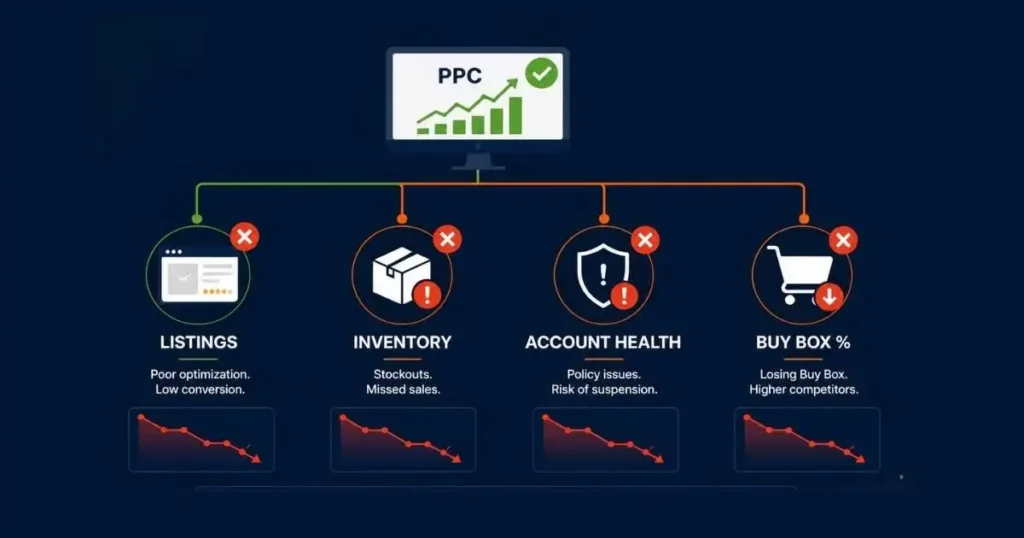
The listing has not been updated; branded advertising may be capturing sales that would have occurred organically; inventory is becoming limited; and nobody is monitoring Featured Offer performance. Each issue affects advertising decisions, but none of them sits clearly inside the freelancer’s assigned scope.
The PPC work may be technically correct. The problem is that the seller hired for one task while expecting ownership of the complete business result. The opposite can also happen. A simple account may hire an expensive agency and receive unnecessary meetings, templated reports, and limited attention from senior specialists.
The wrong choice is not always a freelancer instead of an agency. It is any provider whose scope and operating model do not match what the account actually needs.
Quick Tip: If ACoS looks healthy while total sales remain flat, review branded versus non-branded advertising, TACoS, organic positions, conversion, pricing, and inventory before assuming PPC is working correctly. Some paid sales may be capturing existing demand rather than creating additional sales. Related read: Cannibalization in Amazon Ads.
How to Decide Before You Hire
Use this Amazon agency vs freelancer checklist to match your situation to the right option instead of guessing.
| If This Describes Your Account | Lean Toward |
|---|---|
| You need one clearly defined deliverable | Freelancer |
| An internal manager already owns strategy and coordination | Freelancer or hybrid |
| You are testing a product before committing to broader management | Freelancer |
| PPC, listings, inventory, and account health affect each other | Agency |
| No qualified internal person can coordinate multiple specialists | Agency |
| You need continuous monitoring and documented backup coverage | Agency |
| You need broad strategy but occasional specialist creative work | Hybrid model |
| The account is simple but requires rare technical expertise | Specialist freelancer |
None of these are absolute rules. A low-revenue account can still be technically complex, while a larger account may be manageable with strong internal systems. Use this table as a starting point, not a final hiring rule.
If your account fits more than one column, start with a focused audit or short diagnostic before committing to a long-term retainer.
When a Hybrid Model Works Better
Some sellers do not need to choose exclusively between an agency and a freelancer.
A hybrid model may work when:
- An agency manages PPC and overall account strategy
- A freelancer handles photography, design, video, or specialist catalog work
- An internal brand manager controls pricing, inventory, and approvals
- Each provider has a clearly separated scope
The most important requirement is one accountable owner.
Document who sets strategy, who applies changes, who approves creative work, who monitors performance, and who responds to urgent issues. Without that structure, a hybrid model can create duplicate work and conflicting recommendations.
Amazon Agency vs Freelancer: The Bottom Line
There is no universal winner in the Amazon agency vs freelancer decision. A freelancer is often the better choice when you need one clearly defined task, already have internal strategic ownership, and can manage the work without creating coordination gaps.
An agency becomes more useful when PPC, listings, inventory, catalog issues, and account health must be monitored together. Even then, you should verify who will perform the work, how many accounts they manage, and what the agreement actually includes.
A hybrid model may be the strongest option when you need coordinated account strategy but prefer specialist freelancers for selected projects.
The real question is not, “Which provider is better?”
It is, “Which operating model matches what my Amazon account needs right now?”
If your account has outgrown single-task execution, ScaleA2Z can review whether you need focused PPC support, coordinated Full Account Management, or a hybrid setup. We use AI-assisted data analysis and automation tools to support human-led bid adjustments, campaign optimization, and wider account decisions.
Frequently Asked Questions
Is a freelancer or agency better for Amazon PPC?
A skilled freelancer can manage PPC effectively when the account is relatively simple, and the seller already owns listing, inventory, and business strategy. In an Amazon agency vs freelancer decision, an agency usually makes more sense once advertising must be coordinated with conversion, catalog, inventory, and account health.
How do Amazon freelancer and agency pricing models differ?
Freelancers may charge hourly rates, fixed project fees, or monthly retainers. Agencies may use a flat retainer, a percentage of ad spend, or a hybrid model. Compare the full scope, exclusions, internal supervision, and required extra service fees rather than looking only at the monthly price.
Can a freelancer manage my complete Amazon account?
Some experienced freelancers provide broader account management. The main question is whether one person has the capacity and expertise to monitor PPC, listings, catalog issues, inventory, pricing, and account health consistently. Review the actual scope instead of deciding based on the freelancer label alone.
Why does Amazon account access matter when hiring external help?
Amazon account owners should not share the primary Seller Central password. External service providers should use Amazon’s Authorized Partners access process, and sellers should grant only the permissions required for the agreed work.
When should I move from a freelancer to an agency?
Consider broader support when several Amazon functions are affecting each other, nobody internally can coordinate specialists, delays create significant risk, or one person no longer has enough capacity to monitor the account consistently.
Can I use an agency and freelancers at the same time?
Yes. A hybrid model can work when an agency owns the wider strategy, and freelancers handle clearly defined specialist projects. Responsibilities, approvals, access, reporting, and emergency ownership should be documented to prevent overlap.