Amazon FBA vs FBM: What Should You Choose?
If you sell on Amazon, the choice between FBA and FBM quietly shapes almost everything else: your margins, your daily workload, your delivery speed, and how easily you can scale. And in 2026, that choice carries more weight than it used to. Amazon’s fee structure has changed enough that a model that printed money two years ago might be eating your margins today without you noticing.
The frustrating part? Most advice treats Amazon FBA vs FBM like a personality quiz — pick the one that “feels right” and move on. That’s how sellers end up overpaying on storage fees or losing the Prime traffic they needed to compete. This guide does the opposite. We’ll break down how the two main Amazon fulfillment methods work, what they really cost in 2026, when each one wins, and how to make the call per product instead of betting your whole catalog on a single answer. If you’re setting this up for a brand-new product, it pairs closely with our guide to launching a new product on Amazon. By the end, you’ll have a framework you can apply to your own SKUs today.
Table of Contents
Should You Choose FBA or FBM?
Here’s the short version before we go deep. Choose FBA (Fulfillment by Amazon) if you sell small, lightweight, fast-moving products in competitive categories where the Prime badge and the speed of Amazon’s network drive your sales. Choose FBM (Fulfilled by Merchant) if you sell oversized, heavy, slow-moving, custom, or thin-margin items where Amazon’s fulfillment and storage fees would swallow your profit.
But the honest answer most guides won’t give you is this: the smartest Amazon sellers don’t choose at all. They run both, routing each product to whichever model fits its size, velocity, and margin. So if you’re weighing Amazon FBA vs FBM as an either/or decision, you may be asking the wrong question. The right one is which model for which product — and that’s exactly what the rest of this guide helps you answer.
What Is Amazon FBA (Fulfillment by Amazon)?
Fulfillment by Amazon is the model most people picture when they think of selling on Amazon. You send your inventory into Amazon’s fulfillment network, and from there, Amazon does the heavy lifting: storing your products, picking and packing each order, shipping it to the customer, and handling returns and customer service on your behalf. It’s order fulfillment as a fully managed service.
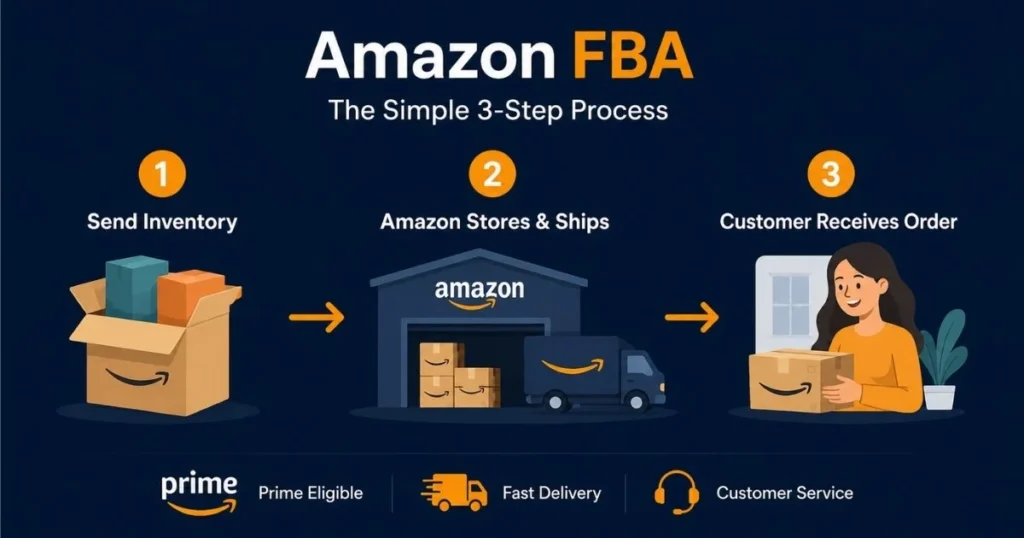
How FBA Works
The flow is straightforward. You create your listings inside Amazon Seller Central, prep your inventory to Amazon’s labeling and packaging requirements (FNSKU labels, poly-bagging where needed), and ship it to the fulfillment centers Amazon assigns. Once your stock is checked in, your products become Prime-eligible automatically. When an order comes in, Amazon’s systems handle everything end-to-end. You’re essentially renting Amazon’s world-class logistics operation, and in exchange, you pay a stack of fees for the privilege.
FBA Pros and Cons
The upside of FBA is real, and it’s why most sellers use it. The headline benefit is Prime badge eligibility. Prime members shop with their wallets already half open, and products carrying the badge convert noticeably better — studies and seller data consistently point to a conversion lift of 20–30% over comparable non-Prime offers. FBA listings are also far more likely to win the Featured Offer (what most sellers still call the Buy Box), which is where the overwhelming majority of Amazon sales actually happen. On top of that, FBA is genuinely hands-off. Amazon absorbs the warehousing, the packing labor, the carrier relationships, and the customer service tickets, which frees you to focus on sourcing, listings, and ads.
The downside is cost and control. FBA fees have climbed steadily, and they now include fulfillment fees, monthly storage fees, inbound placement fees, low-inventory penalties, and aged-inventory surcharges. Once your inventory is inside Amazon’s network, you also give up control over how it’s stored and shipped — and you’re exposed to storage limits tied to your IPI score. For the wrong product, those fees turn a healthy margin into a loss. We’ll put real 2026 numbers on this shortly.
What Is Amazon FBM (Fulfilled by Merchant)?
Fulfillment by Merchant flips the responsibility. You still list and sell on Amazon, but you handle the fulfillment yourself — or hand it to a third-party logistics (3PL) partner. You keep possession of your inventory, you pack the orders, and you choose the carrier.
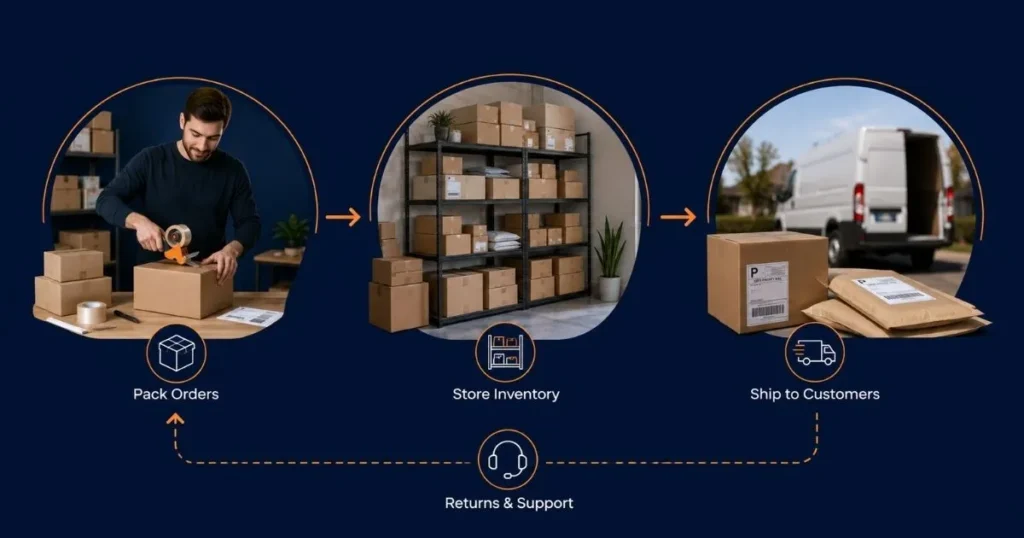
How FBM Works
With FBM, your products live in your own warehouse, your garage, or a 3PL facility instead of Amazon’s network. When a customer orders, you (or your 3PL) pick, pack, and ship it, then upload tracking to Seller Central. You’re responsible for hitting Amazon’s performance metrics — on-time delivery, valid tracking rate, and a low cancellation rate — because Amazon holds FBM sellers to the same standards it enforces across the platform. Miss those targets and your account health takes the hit, regardless of how good your products are. The trade-off for that responsibility is freedom: with FBM shipping, you control the carrier, packaging, shipping speed, returns handling, and the entire customer experience.
FBM Pros and Cons
The biggest draw of FBM is cost control. You skip Amazon’s fulfillment and storage fees entirely (you still pay referral fees — those are unavoidable on either model), which can be the difference between profit and loss on large, heavy, or slow-moving items. Independent storage is also dramatically cheaper than Amazon’s, and a 3PL won’t punish you with escalating aged-inventory surcharges the way FBA does. FBM also hands you packaging control — branded boxes, inserts, and a real unboxing experience — which matters for premium and artisan brands. And because your inventory isn’t locked inside Amazon, multi-channel sellers can fulfill Amazon, Shopify, and other marketplaces from a single inventory pool.
The cost is operational weight and lost Prime traffic. FBM listings don’t get the Prime badge automatically, and without it you can lose visibility and conversions to FBA competitors offering faster delivery. You’re also now running a fulfillment operation: storage, packing, carriers, returns, and customer service all sit on your shoulders (or your 3PL’s). For sellers without the systems or the volume to support it, that complexity can quietly become a margin drain through late shipments and support tickets.
Amazon FBA vs FBM: Key Differences
The fastest way to see the contrast is side by side. Here’s how the two Amazon fulfillment methods stack up across the factors that actually move your numbers:
| Factor | FBA (Fulfillment by Amazon) | FBM (Fulfilled by Merchant) |
|---|---|---|
| Who fulfills | Amazon stores, packs, ships, and handles returns | You or your 3PL handles everything |
| Prime badge | Automatic | Only via Seller Fulfilled Prime with strict requirements |
| Featured Offer / Buy Box | Strong algorithmic advantage | Possible, but harder to win |
| Fee structure | Fulfillment fees, storage fees, and surcharges | Referral fees only, but you cover your own shipping |
| Cost control | Low — Amazon sets the fees | High — you negotiate carriers and storage |
| Customer service | Handled by Amazon | Handled by you |
| Best for | Small, light, fast-moving products | Oversized, slow, custom, or thin-margin products |
| Scaling | Easy and largely automated | Requires operational infrastructure |
| Packaging control | None or limited control because Amazon handles packaging | Full control over branded packaging, inserts, and presentation |
The pattern in that table is the whole game. FBA trades money and control for speed, reach, and convenience. FBM trades convenience for control and lower fees, but asks you to do the work. Neither is universally “better” — which is exactly why the cost section below matters so much, because fees are where most sellers make the wrong call. Keep this FBA vs FBM pros and cons snapshot in mind as we move into the numbers that decide it.
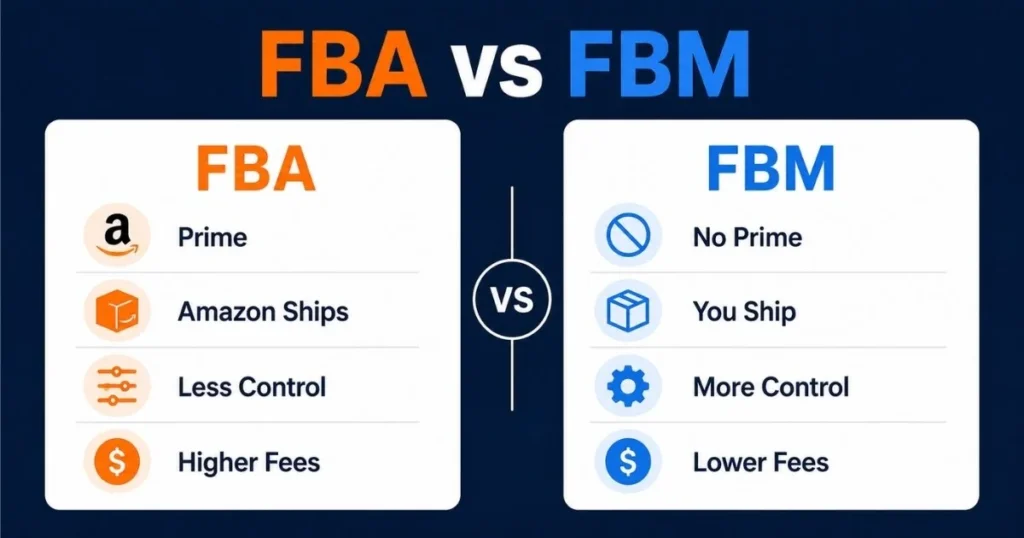
FBA vs FBM Cost: Don't Decide by Fees Alone
This is the section that separates a good fulfillment decision from an expensive guess. Most sellers compare Amazon FBA vs FBM by glancing at the per-unit fulfillment fee and stopping there. That’s how you lose money. The real FBA vs FBM cost picture is a stack of charges, and several of them got heavier in 2026.
Here’s what FBA actually costs you per unit today, beyond the obvious:
- Referral fee — charged on every sale, typically 15% of the sale price. This one is identical under FBA and FBM, so it’s a wash.
- Fulfillment fee — charged per unit based on size and weight, now on a price-tiered structure. Amazon has said the average FBA fee rose by roughly $0.08 per unit in 2026 — small on paper, but it compounds across thousands of units.
- Monthly storage fees — standard-size items run about $0.87 per cubic foot from January through September, then spike to roughly $2.40 per cubic foot in Q4 for the holiday surge. For comparison, independent 3PL storage averages closer to $0.46 per cubic foot.
- The 3.5% logistics surcharge — a fuel-and-logistics surcharge that took effect in April 2026, applied to FBA fulfillment fees (not the sale price) on US and Canadian orders, including Multi-Channel Fulfillment.
- Inbound placement fees — introduced in 2024 and still in force, these can run up to roughly $6.50 per unit depending on how you split shipments across Amazon’s network.
- Low-inventory-level fee — if your stock drops below a historical days-of-supply threshold (around 28 days for most items), Amazon charges you for running lean.
- Aged inventory surcharge — this one tightened hard. The surcharge now starts kicking in at around 181 days, down from the old 271-day threshold, and it escalates steeply the longer the slow stock sits.
Stack those together, and FBA’s true cost per unit in 2026 is meaningfully higher than it was in 2022 or 2023. If you benchmarked your FBA economics a couple of years ago and never recalculated, you’re almost certainly underestimating what FBA costs you now.
FBM costs look lower per unit on the surface, but carry their own hidden weight. You’ll pay for your own storage (your space, a warehouse, or a 3PL), your own shipping (carrier rates depend on product size and weight and destination), labor for picking and packing, and packaging materials. The catch with FBM is that these are fixed and variable costs you have to manage actively — rent, utilities, software, and your own time — which don’t show up in a simple per-unit comparison. And once you layer ad spend on top, the picture changes again; our guide on scaling Amazon ads without killing your profit margins walks through how fulfillment cost and ACoS interact.
A Worked Example (Run Your Own Numbers Too)
Let’s make this concrete. Treat these figures as illustrative — always verify your own product in Amazon’s FBA Revenue Calculator before deciding. Plug in your ASIN, and it estimates the Amazon fulfillment cost side by side for FBA and self-fulfillment.
Product A: a 12-oz supplement selling for $24.99. Under FBA, you’d pay roughly $3.75 in referral fees (15%), around $4.25 in fulfillment fees, plus the small logistics surcharge and a sliver of monthly storage — call it about $8.30 in Amazon costs before your cost of goods. Fulfilling that same small, light item yourself would mean paying $3.75 in referral fees plus $5–$7 to ship a one-pound package on your own carrier rates, before packaging and labor. For a small, fast-moving product like this, FBA usually wins — Amazon’s negotiated shipping rates beat what most sellers can get, and the Prime badge lifts conversion on top.
Product B: a 25 lb oversized item selling for $79.99. Now the math flips. FBA’s fulfillment and oversize fees climb fast, storage eats cubic feet, and if the item moves slowly, the aged-inventory surcharge starts circling. The same product shipped via a 3PL on FBM — with flat storage and no age-based penalties — can be dramatically cheaper per unit, even after you factor in your own labor. For oversized or slow-moving inventory, FBM (or a 3PL) frequently wins.
The lesson isn’t “FBA is cheaper” or “FBM is cheaper.” It’s that the answer changes per product, and the only way to know is to run the full stack of costs — not just the headline fulfillment fee — for each SKU.
When Should You Choose Amazon FBA?
FBA is the right call when the model’s strengths line up with your product. Reach for FBA when your products are:
- Small and lightweight. Amazon’s fee structure and bulk shipping discounts reward compact items. The smaller and lighter the product, the more FBA’s economics work in your favor.
- Fast-moving. High inventory turnover means your stock cycles before storage and aged-inventory fees can bite. FBA is built for high-velocity winners.
- In competitive, Prime-driven categories. If your competitors are all Prime-eligible, you may need FBA just to stay visible. Many shoppers filter out non-Prime offers entirely, so without the badge, you’re invisible to a chunk of the market.
- Healthy-margin. You need enough margin to absorb FBA’s fee stack and still profit. If fees would eat more than about a quarter of your sale price, pause and run the numbers.
- Tied to rapid scaling. If you want to grow fast without building warehouse infrastructure, FBA lets Amazon’s network scale with you automatically — which is why it’s the default we recommend for most sellers in our new product launch guide.
In short, FBA shines for the products at the heart of your business — your bestsellers, your competitive commodities, anything where Prime conversion and the Featured Offer advantage justify the fees. For those SKUs, the convenience and the sales lift usually pay for themselves.
When Should You Choose Amazon FBM?
FBM earns its place when FBA’s fees or constraints would work against you. Lean toward FBM (often through a 3PL) when your products are:
- Oversized or heavy. Large, heavy, and bulky items rack up steep FBA fulfillment and storage fees. Shipping these low-volume products yourself, especially with negotiated carrier rates, frequently costs less.
- Slow-moving. Inventory that sits is inventory that bleeds money under FBA’s tightened aged-inventory surcharge. A 3PL with flat storage rates removes that penalty entirely.
- Custom, handmade, or made-to-order. Products requiring personalization, engraving, assembly, or special handling don’t fit FBA’s standardized process. FBM is often the only option.
- Thin-margin. When FBA fees would erase your contribution margin, FBM’s lower fee load can be the difference between profit and loss.
- Multi-channel. If you sell across Amazon, your own site, and other marketplaces, FBM lets you fulfill everything from one inventory pool instead of locking stock inside Amazon.
- Brand-experience-driven. When custom packaging, inserts, and a memorable unboxing are part of your value, FBM gives you the control FBA can’t.
FBM is also the smarter choice when Amazon’s storage limits, tied to your IPI score, cap how much inventory you can hold. A 3PL removes that ceiling and lets you stock to your actual sales velocity. The common thread: FBM wins where control and cost matter more than Amazon’s fulfillment muscle.
Why Many Sellers Use Both FBA and FBM
Here’s the strategy the most profitable sellers have quietly settled on: they stop choosing. Roughly a third to 40% of high-volume and six-figure sellers now run a hybrid model, routing each product to whichever method fits its economics. It’s not indecision — it’s optimization.
The Hybrid / Per-SKU Strategy
In a hybrid setup, you treat fulfillment as a per-SKU decision rather than a catalog-wide one — a true SKU-level fulfillment strategy. Your top 20% of products — the bestsellers, the competitive commodities, anything where Prime conversion and the Featured Offer matter most — go into FBA. Your long-tail variants, oversized items, slow-movers, and thin-margin SKUs go to FBM or a 3PL, where they avoid the storage and placement fees that would quietly erode their margins. You manage both through Seller Central and let your performance data decide which SKUs belong where. This is where a good 3PL fulfillment relationship pays off, because it lets you run both models without building your own warehouse operation.
FBM as a Stockout Safety Net
One of the most underused hybrid tactics: keep an active FBM listing on your FBA products as a backup. If your FBA stock runs out — or a shipment gets stuck in Amazon’s network — your FBM offer keeps the listing live. That means you don’t lose sales, and just as importantly, you don’t lose hard-won organic search rank during a stock out. For sellers who’ve ever watched a hero SKU go dark for a week, this safety net alone can justify a hybrid approach.
Where 3PLs and Seller Fulfilled Prime Fit In
A 3PL is the engine that makes hybrid practical. The right partner can handle both sides — prepping and shipping inventory inbound to Amazon for your FBA SKUs, and storing and fulfilling your FBM orders direct to customers. For sellers who want FBM’s cost control and the Prime badge, Seller Fulfilled Prime (SFP) is the bridge: it lets you display the Prime badge while fulfilling from your own warehouse or 3PL. The catch is that SFP is demanding — Amazon requires a high on-time delivery rate (around 93.5% or better), strict shipping cutoffs, weekend handling, and consistent volume. It’s best suited to operationally mature sellers with higher-priced products, not beginners.
Common FBA vs FBM Mistakes Sellers Make
After working with sellers across categories, the same costly mistakes show up again and again. Avoiding these is often worth more than picking the “perfect” model in the first place.
- Choosing one model for the entire catalog. This is the single most common error. Your products aren’t identical, so why would one fulfillment method serve all of them? Forcing oversized, slow-moving items into FBA — or pushing your fast-moving bestsellers into FBM and losing Prime — both leave money on the table.
- Comparing only the fulfillment fee. Sellers see one number, decide, and miss the storage fees, placement fees, surcharges, and aged-inventory penalties stacked behind it. Always compare the total cost of ownership, not the headline rate.
- Never recalculating after fee changes. Amazon’s fees move, sometimes significantly. A model that was profitable in 2023 may not be in 2026. If you haven’t re-run your FBA economics since the recent surcharge and aged-inventory changes, you’re likely flying blind — the same discipline we apply when we structure Amazon PPC for profit by tying every decision back to true margin.
- Underestimating FBM’s operational load. FBM looks cheaper until late shipments, support tickets, and slipping seller metrics start costing you. If you don’t have the systems or a reliable 3PL, that “cheaper” model can quietly damage your account health.
- Ignoring slow inventory in FBA. Aged-inventory surcharges now start far earlier than they used to. Letting slow stock sit is one of the fastest ways to turn a profitable SKU into a losing one. Monitor it weekly and move or liquidate before the penalties hit.
- Treating the decision as permanent. Fulfillment isn’t a one-time choice. As your volume, margins, and product mix shift, the right model shifts too. Revisit it regularly.
Your FBA vs FBM Decision Checklist
When you’re staring at a product and can’t decide, run it through these five questions. They cut through the noise fast.
- How big and heavy is it? Small and light leans FBA. Large and heavy leans FBM, where you sidestep oversize fees.
- How fast does it sell? Fast-moving leans FBA — your stock cycles before storage fees bite. Slow-moving leans FBM, where a 3PL’s flat storage avoids aged-inventory penalties.
- How healthy is the margin? Strong product margins can absorb FBA’s fee stack. Thin margins often survive only under FBM’s lower fee load.
- How much do you depend on Prime? If your category is Prime-dominated and you need the badge to convert and stay visible, FBA (or SFP) wins. If Prime matters less for your buyer, FBM frees you from the fees.
- What’s your operational capacity? If you have the systems, space, or a reliable 3PL, FBM is viable. If you’d rather Amazon handle the logistics so you can focus on growth, FBA is the cleaner path.
Score each product across these five, and the answer usually becomes obvious — and you’ll often find different SKUs pointing to different models. That’s not a problem to solve; it’s the hybrid strategy working as intended. At Scale A2Z, this is exactly the kind of SKU-level analysis we run for sellers who want their margins protected rather than guessed at.
So, Which Is Better: FBA or FBM?
After all of it, here’s the honest verdict on Amazon FBA vs FBM: there’s no universal winner, and any guide that hands you a one-size-fits-all answer is doing you a disservice. FBA is the better choice for small, fast-moving, Prime-driven products with margins healthy enough to carry the fees — it gives you reach, conversion, and a hands-off operation that scales. FBM is the better choice for oversized, slow, custom, or thin-margin items where Amazon’s 2026 fee stack would quietly drain your profit, and where control over cost and brand experience matters more than convenience.
But the real answer, the one that separates sellers who scale profitably from sellers who just stay busy, is to use both. Route each product to the model, its size, velocity, and margin demand. Keep FBM as a safety net under your FBA bestsellers. Recalculate when fees change. Treat fulfillment as a living strategy, not a one-time switch you flip and forget. Do that, and you stop losing margin to the wrong model — and start using fulfillment as the profit lever it’s meant to be.
How Scale A2Z Helps You Choose the Right Fulfillment Model
Getting the FBA vs FBM call right across an entire catalog takes time, current fee data, and SKU-level math that most sellers don’t have hours to run. That’s where we come in. As a full-service Amazon management agency, Scale A2Z analyzes your products one by one — size, velocity, margin, Prime dependence, and the full 2026 fee stack — to map each SKU to the fulfillment model that protects your profit. We help you build a hybrid setup that captures Prime traffic where it counts and cuts fee waste where it doesn’t, so your margins are designed, not left to chance. If you’d rather grow than spend your weekend in the Revenue Calculator, book a free consultation, and we’ll walk through your catalog together.
FAQs About Amazon FBA vs FBM
Is FBA or FBM cheaper?
It depends on the product. FBA is usually cheaper for small, lightweight, fast-moving items because Amazon’s negotiated shipping rates beat what most sellers can get on their own. FBM is usually cheaper for oversized, heavy, or slow-moving products, where FBA’s fulfillment, storage, and aged-inventory fees would eat your margin. Always compare the full cost stack, not just the per-unit fulfillment fee.
Can you use both FBA and FBM?
Yes, and many of the most successful sellers do. You can route different products to different models based on each one’s economics, and you can even keep an FBM offer as a backup on your FBA listings to avoid lost sales during a stockout. This hybrid approach is increasingly the default for high-volume sellers.
Does FBM get the Prime badge?
Not automatically. Standard FBM listings aren’t Prime-eligible, which can reduce visibility and conversions. The exception is Seller Fulfilled Prime (SFP), which lets you display the Prime badge while fulfilling orders yourself — but it carries strict performance requirements, including a high on-time delivery rate and fast shipping cutoffs.
Is Amazon FBA still worth it in 2026?
For the right products, yes. FBA still delivers a real conversion lift through Prime and a strong Featured Offer advantage. But it’s no longer the automatic best choice it once was. With the 2026 logistics surcharge, tightened aged-inventory penalties, and inbound placement fees, the math matters more than ever — so monitor your fees closely and reassess any SKU where they exceed about a quarter of your sale price.
Which is better for new sellers?
For most new Amazon sellers, FBA is usually the easier starting point because Amazon handles storage, packing, shipping, customer service, and returns. This reduces the operational workload and helps new sellers focus on product research, listing optimization, pricing, and ads. However, FBM can still work for new sellers who already have reliable storage, packaging, shipping, and customer support systems in place.
Which is better for oversized products?
For oversized, heavy, or bulky products, FBM is often the better choice because FBA fulfillment and storage fees can become expensive. With FBM, sellers can use their own warehouse or a 3PL to control shipping costs, packaging, and inventory handling. Still, the final decision should be based on product margin, shipping rates, sales velocity, and total fulfillment cost.