Search Term Mining SOP: Real Step-by-Step Workflow to Scale Amazon PPC Profitably
Most Amazon sellers open their search term report once a month, skim through it, add a few keywords, and move on. Then they wonder why their campaigns keep bleeding budget without improving. The issue is not the data — it is the lack of a system. Amazon search term mining works when raw PPC data is turned into clear, repeatable actions that reduce wasted spend and scale profitable keywords.
A documented Search Term Mining SOP turns a reactive habit into a growth engine. Instead of guessing which terms to act on, you follow a structured workflow that tells you exactly what to promote, what to suppress, and what to watch.
If your campaigns are already live but not profitable, If your campaigns are already live but not profitable, read our guide on why Amazon PPC is not profitable and how to fix it.
Not sure where your search term data is leaking budget? ScaleA2Z offers a free PPC audit to find exactly what needs fixing in your campaigns.
Table of Contents
What Is Search Term Mining in Amazon PPC?
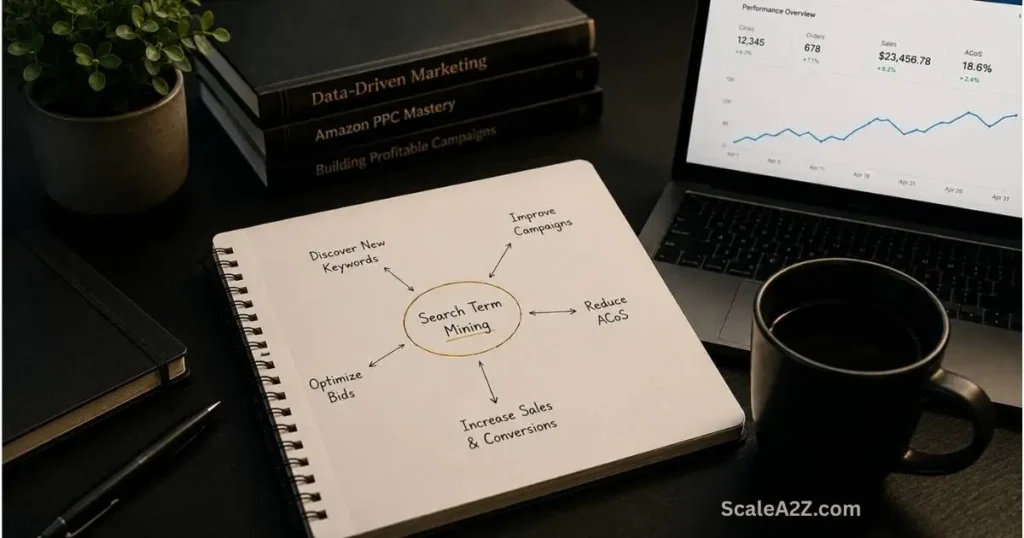
Search term mining is the process of analyzing what shoppers typed into Amazon before clicking your ad, then deciding whether each term should be promoted, negated, or monitored. That second part is what most sellers skip entirely.
Amazon search term mining is not a passive read-through. It is an active workflow with three outputs every single session:
- Promote — terms with enough clicks and conversions to earn exact match targeting
- Negate — search terms wasting spend without generating sales
- Monitor — relevant terms showing early signals, but not enough data yet to act on
Without this three-output structure, you are reading data without acting on it. A proper Search Term Mining SOP forces all three outputs every session — no skipped decisions, no half-measures.
Why Most Sellers Get Search Term Mining Wrong
Before building the right system, it helps to understand what breaks the wrong one. These three mistakes show up in accounts of every size — from new sellers running their first auto campaign to brands spending five figures per month on Amazon advertising.
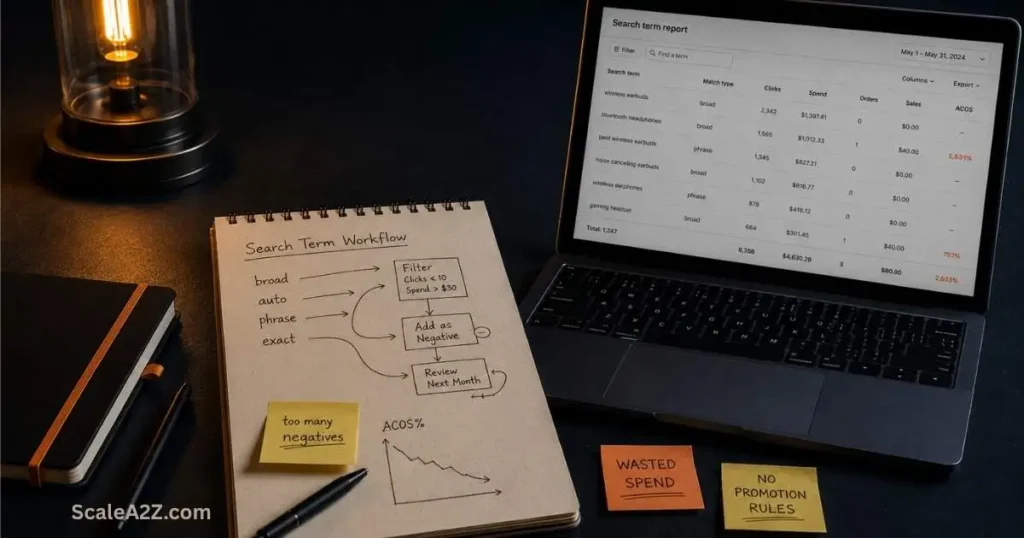
Pulling Data Too Infrequently
Waiting four weeks between mining sessions means irrelevant search terms are draining your budget for an entire month before you catch them. High-spend campaigns need weekly attention. Lower-spend campaigns can run biweekly — but waiting too long between sessions allows wasted spend to compound far beyond what is necessary.
The data does not wait for you. Competitors are bidding on the same search terms, Amazon’s algorithm is updating relevance signals in real time, and your budget is being allocated every single day.
No Promotion Criteria
“This term looks good” is not a criterion for promotion. Good Amazon search term mining requires clear rules, a minimum number of clicks, a maximum ACoS, and a minimum number of orders before a term moves into a targeted campaign. Without defined thresholds, every decision is inconsistent. The same keyword may be promoted one week and ignored the next.
If you want to understand how campaign structure supports consistent promotion decisions, see our breakdown of how to structure Amazon PPC for profit.
Ignoring Negatives Until It's Too Late
Most sellers only add negatives after they have already lost significant spend. Negative keyword mining should be treated as equally important as finding winners. Every session needs both promotions and negatives, or the workflow is incomplete.
The Search Term Mining SOP — 5-Step Workflow
Follow these five steps in sequence every mining session, and you will never leave a session without clear, actionable decisions.
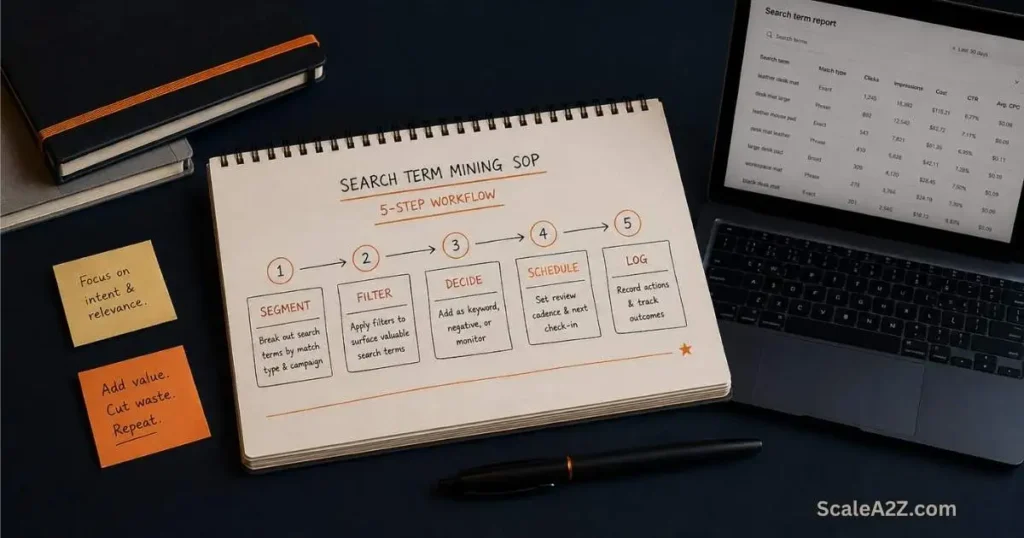
1- Segment by Campaign Type (Auto, Broad, Phrase)
Never mine all campaigns together. Auto, broad match, and phrase match campaigns generate search term data differently and require different decision logic. Auto campaigns are your discovery layer. They cast the widest net and surface terms you would never have thought to target manually. Mine these first and most aggressively.
Broad match campaigns produce a mix of relevant and tangential terms. Apply tighter promotion thresholds here because the match logic is looser. Phrase match campaigns generate more predictable data. Mining sessions here are usually faster with fewer surprises.
Segmenting before you start prevents you from applying the wrong criteria to the wrong campaign type, a common mistake that leads to missed promotions and wrongly placed negatives.
2- Apply the Promotion Filter
Not every converting term deserves promotion. A solid promotion filter looks like this:
Minimum 10 clicks, at least 1 confirmed order, ACoS at or below your target threshold. Term appears across 2 or more sessions (one-time converters rarely repeat)
Promotion should be based on consistent data, not a single lucky conversion. When a term clears all four criteria, it moves into a dedicated exact match campaign with its own bid.
3- Negative Keyword Decision Logi
This is where most SOPs fall apart. Sellers either negate everything that did not convert or negate nothing at all. Neither approach protects profitability.
Use this three-tier logic instead:
- 15+ clicks, zero orders, ACoS significantly above target → Cut immediately 5–14 clicks, no orders yet, term is relevant → Monitor Under 5 clicks, not enough data → Ignore for now
- This prevents over-negation, which can block future profitable search terms too early. Apply negatives at the right level:
- Irrelevant terms in auto campaigns → negative exact at the ad group level Broader irrelevant patterns → negative phrase at the campaign level
Consistent negative keyword mining using this logic protects your budget without cutting terms before they have a fair chance to perform.
4- Build Your Mining Cadence
The spend level in your account determines how often you mine:
$50+ per campaign per day → Weekly sessions $20–$50 per day → Biweekly sessions Under $20 per day → Biweekly to monthly
Your mining schedule should follow spend velocity, not guesswork. Stick to the schedule. Ad hoc mining produces inconsistent results because your data windows keep changing. When you mine on a fixed cadence, you start recognizing patterns, terms that consistently underperform, seasonal shifts in search behavior, and emerging keywords before competitors catch them.
5- Maintain a Search Term Log
Every decision made during a mining session should be recorded in a simple spreadsheet. Track the term, the campaign it came from, the action taken (promote, negate, monitor), the date, and the performance data at the time of the decision.
This log serves two purposes. First, it prevents you from re-evaluating the same terms every session. Second, it gives you a historical record to review when performance shifts unexpectedly.
Without documentation, your Search Term Mining SOP lives only in your head, and that is not a system, it is a habit that breaks the moment someone else touches the account.
High-Volume vs High-Converting Keywords — What to Prioritize
Not all winning search terms are equal. Volume and conversion rate pull in opposite directions more often than sellers expect.
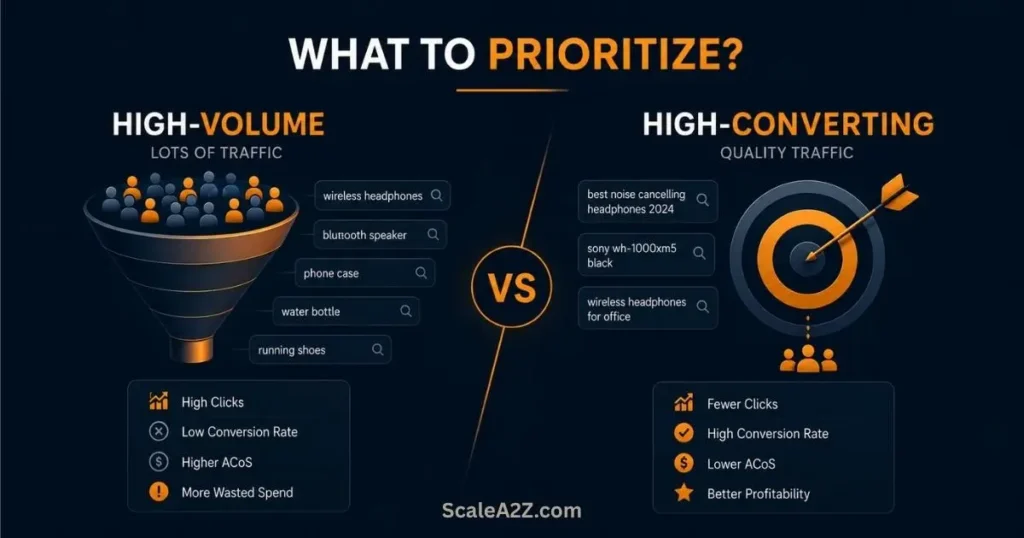
The Volume Trap
High-impression terms feel like opportunities. They drive traffic, they look good in reports, and they create the illusion of momentum. But if those clicks are not converting, they are quietly inflating your spend while your ACoS climbs.
The volume trap is especially dangerous in broad match and auto campaigns where Amazon matches your ads to high-traffic terms that are only loosely related to your product. Before promoting any high-volume term, verify its conversion rate over a meaningful data window — not just its click count.
Low-Volume Gems Most Sellers Miss
Some of the most profitable search terms in any campaign have fewer than 50 monthly searches. They have low competition, low CPCs, and, because they are highly specific, much stronger purchase intent.
When running Amazon search term mining across your auto campaigns, pay close attention to long-tail, specific phrases that have converted even once or twice. These terms are often ignored because they do not look impressive in volume reports. But compounded across dozens of campaigns, low-volume high-converting terms can quietly become a significant portion of your total attributed sales.
Understanding how your Amazon PPC campaign structure supports these low-volume winners is key to scaling without wasted spend.
This is the core of search term to keyword promotion — and the most important output of every mining session.
How Search Term Analysis Tools Speed Up Keyword Mining
Running a Search Term Mining SOP manually across dozens of campaigns is time-consuming. At a certain account size, the volume of data makes purely manual mining impractical — you end up spending more time filtering spreadsheets than making actual decisions.
This is where data analysis tools become valuable. Platforms that centralize search term data, flag anomalies automatically, and allow bulk negative application can cut mining time significantly without sacrificing decision quality.
At ScaleA2Z, our Amazon PPC management process uses AI-driven data analysis and automated bid management as part of every account’s workflow, allowing mining sessions to focus on strategic decisions rather than manual data cleanup. The result is faster cycles, fewer missed opportunities, and more consistent application of promotion and negation criteria — especially in large, multi-SKU account structures.
The principle applies whether you are using dedicated software or building your own process — the goal is to reduce time spent on data handling so more time goes toward actual decisions.
Search Term Mining Mistakes That Kill Profitability
Beyond the three root causes covered earlier, these execution-level mistakes quietly compound over time.
Mining without a spend threshold, acting on terms with only 2 or 3 clicks produces statistically weak decisions. Set minimum data thresholds and hold to them without exception.
Applying campaign-level negatives too aggressively — Negating a term at the campaign level removes it from all ad groups within that campaign. If the term was performing well in one ad group but poorly in another, a blanket campaign-level negative kills the good traffic alongside the bad.
Promoting to existing campaigns instead of new ones — When a search term earns exact match status, it should move into its own dedicated campaign with a controlled bid — not get added to an existing broad or phrase campaign where it will compete with other targeting and produce messy data.
Skipping the monitor category — Binary thinking (promote or negate) leaves money on the table. Terms in the monitor category are often your next wave of winners. Skipping this step means you are either acting too early or walking away from future opportunities entirely.
Quick Action Checklist for Every Mining Session
Use this before, during, and after every session to stay consistent.
Before You Start: Set your data window (7 days for weekly, 14 for biweekly). Segment campaigns by type: auto, broad, phrase. Open your search term log from the last session
During the Session: Apply promotion filter — clicks, orders, ACoS threshold Apply negation logic — cut, monitor, or ignore Record every decision in the log with date and data
After the Session, confirm new exact match campaigns are live with correct bids. Confirm negatives are applied at the correct level (ad group or campaign). Note terms moved to monitor for follow-up next session.
Final Thoughts — Search Term Mining Is a Growth System
A one-time cleanup of your search terms is not a strategy. What builds compounding PPC performance is a documented, repeatable process that runs on a fixed cadence, produces consistent outputs, and gets better every single session.
That is exactly what a well-built Search Term Mining SOP delivers — promotions based on real data, negatives applied with logic, a monitor list that feeds your next wave of winners, and a search term log that turns every session into institutional knowledge.
Sellers who treat search term mining as a system consistently outperform those who do not. Start with the five-step workflow, stick to the checklist, and build the cadence that matches your account size.
If your campaigns generate data but not clear actions, the problem is usually not effort — it is the lack of a real SOP. If you need help building that system, ScaleA2Z can turn raw PPC data into profitable, scalable growth.
Frequently Asked Questions
How often should I run a Search Term Mining SOP for my Amazon campaigns?
Cadence depends on how much your campaigns are spending. High-spend campaigns running $50 or more per day need weekly mining sessions — the data moves fast enough that waiting longer means wasted budget. Lower-spend campaigns can comfortably run biweekly. The key principle is consistency. An irregular mining schedule produces irregular results because your data windows keep changing.
What is the minimum data threshold before promoting a search term?
A reliable starting point is at least 10 clicks and 1 confirmed order, with ACoS sitting at or below your campaign target. If a term has only been converted once in a very short window, move it to your monitor list rather than promoting it immediately. One conversion confirms potential, not a pattern. Give it another session before committing to a dedicated exact match campaign.
What is the difference between a negative exact and a negative phrase in Amazon PPC?
Negative exact blocks only that specific search query. Negative phrase blocks any search that contains that phrase in any order. Use negative exact for one-off irrelevant terms unlikely to appear in other harmful variations. Use a negative phrase when you want to eliminate a broader pattern across an entire campaign, such as a word or phrase consistently attracting the wrong audience.
Should negatives be applied at the ad group level or campaign level?
Apply negatives at the ad group level when a term is irrelevant to one specific ad group but may still be useful elsewhere in the same campaign. Apply at the campaign level when the term is broadly irrelevant to everything running in that campaign. Defaulting to campaign-level negatives without thinking it through is a common mistake that cuts good traffic alongside the bad.
How is Amazon search term mining different from keyword research?
Keyword research happens before your campaigns go live. It is predictive, based on estimated search volume and competitor data. Amazon search term mining happens after your campaigns run, it is based on actual shopper behavior and real conversion data from your own account. Both are necessary, but they serve completely different functions in your PPC workflow.
Can the Search Term Mining SOP be fully automated?
Automation tools can handle data collection, flagging high-spend terms, and bulk negative application, and they are genuinely useful at scale. But the core decisions still require human judgment. Promotion criteria, monitor categorization, and structural changes like launching new exact match campaigns all need a strategic eye. Use automation to speed up the process, not to replace the decision-making that drives actual results.