The Real Cost of Poor Amazon Account Management
Most Amazon sellers treat their Amazon account as an afterthought. They watch total sales, celebrate when numbers go up, and assume the business is doing well. But revenue is not profit. And on Amazon, the gap between the two is almost always management.
Poor Amazon account management is not always obvious. It does not announce itself with a sudden crash. It shows up quietly — in a slowly rising ACoS, in listings that get traffic but never convert, in ad budgets that keep running with nothing to show for it, in account health warnings that get ignored for weeks.
Industry reports consistently show that profitability remains one of the biggest challenges for Amazon sellers, especially when ad costs, fees, and inventory pressure are not managed together. Profitability remains the number one challenge for Amazon sellers — ahead of competition, inventory, and advertising costs. The problem is rarely the product. It is almost always how the account is being managed.
This blog breaks down what poor management costs a seller financially, operationally, and long term, and what it actually looks like to run an Amazon account the right way.
Poor management is not just a PPC issue. It is a connected problem across advertising, listings, pricing, inventory, account health, and profitability.
Is your Amazon account leaking profit?
Get a free audit — we'll tell you exactly where money is going.
Table of Contents
What Poor Amazon Account Management Actually Looks Like
Poor Amazon account management rarely looks like one obvious failure. It looks like a dozen small inefficiencies running at the same time — none of them alarming on their own, all of them expensive together. Most sellers do not recognize the pattern until the numbers force them to look.
No Clear Strategy Across PPC, Listings, and Pricing
Most sellers running into trouble are not making one big mistake. They are making dozens of small ones — and none of them connect to a strategy.
PPC campaigns run because ads need to run. Listings stay the same because they look fine. Pricing decisions get made on gut feel rather than margin data. Each piece operates in isolation, with no one asking how they work together.
Amazon rewards sellers who manage every layer of their account intentionally. When PPC, listings, pricing, and inventory are not aligned, the result is an account that burns money in some areas while starving others.
Reactive Decisions Instead of Consistent Optimization
Good account management runs on a weekly cadence. Bids get reviewed. Search terms get analyzed. Budgets get adjusted based on performance data, not assumptions.
What most struggling sellers have instead is a reactive loop: they pause a campaign when ACoS spikes, increase the budget when sales slow down, and make changes in a panic rather than from a plan. By the time the problem is visible, the damage is already done.
Treating Amazon Like a Set-It-and-Forget-It Platform
Amazon is not a passive channel. The algorithm shifts. Competition changes. Seasonality affects everything. A listing or campaign that performed well three months ago may be quietly underperforming today.
Sellers who log in once a week to check revenue without digging into what is driving or hurting it are flying blind. And on Amazon, flying blind is expensive.
The Direct Financial Cost Sellers Never Calculate
Sellers track revenue. Very few track what remains after Amazon takes its share. The real financial damage from poor management does not show up in total sales — it shows up in margins, and by the time it is visible, months of profit have already been lost.
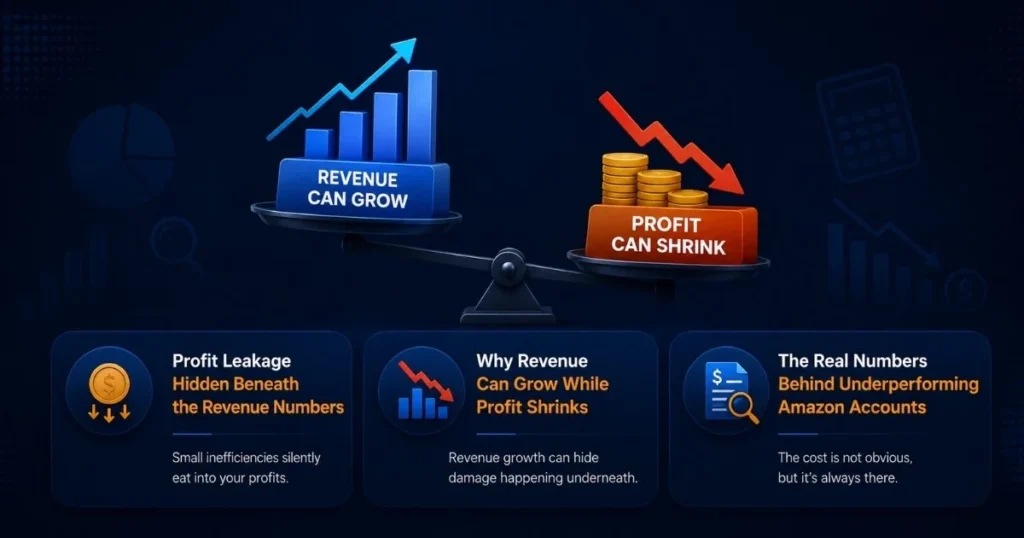
Profit Leakage Hidden Beneath the Revenue Numbers
Revenue growth can hide a lot of damage. A seller doing $50,000 a month in revenue might be netting only $3,000 after ad spend, FBA fees, COGS, and returns, and not realize it until they run a proper margin analysis.
This is what Amazon profit leakage looks like. It is not always a single draining cost. It is a combination of inefficient ad spend, poor listing conversion, unmonitored pricing, and unchecked fees, all quietly pulling from the same pool. Storage fees, referral fees, and rising CPC compound this further, and most sellers do not see the full picture until margins have already been damaged.
Why Revenue Can Grow While Profit Shrinks
This happens more often than sellers expect. When ad spend scales without improving ROAS, when inventory builds up and triggers long-term storage fees, or when pricing drops to compete without adjusting for margin, revenue numbers go up while profit quietly disappears.
Amazon seller revenue loss at this scale is not always dramatic. It compounds slowly over months, and by the time it becomes obvious in the numbers, a significant amount of capital has already leaked out.
The Real Numbers Behind Underperforming Amazon Accounts
The sellers who struggle most are those without systems for monitoring performance across all dimensions. Every area of poor management has a measurable cost, and most of them are interconnected.
| Cost Area | Poor Management Signal | Business Impact |
|---|---|---|
| PPC | High spend with weak ROAS | Margin loss |
| Listing | Traffic but low CVR | Wasted clicks |
| Inventory | Stockouts or overstock | Lost sales or locked capital |
| Account Health | Warnings ignored | Suppression or account risk |
| Pricing | No margin control | Profit leakage |
| TACoS | Total ad dependency rising | Profit shrinking despite sales |
| Reporting | Data reviewed but no action taken | Slow, invisible decline |
How Poor Amazon PPC Management Drains Your Margins
Advertising is where poor management becomes most expensive, most quickly. The budget keeps running, the spend keeps growing, and the return quietly shrinks — often without a single clear moment where something obviously went wrong.
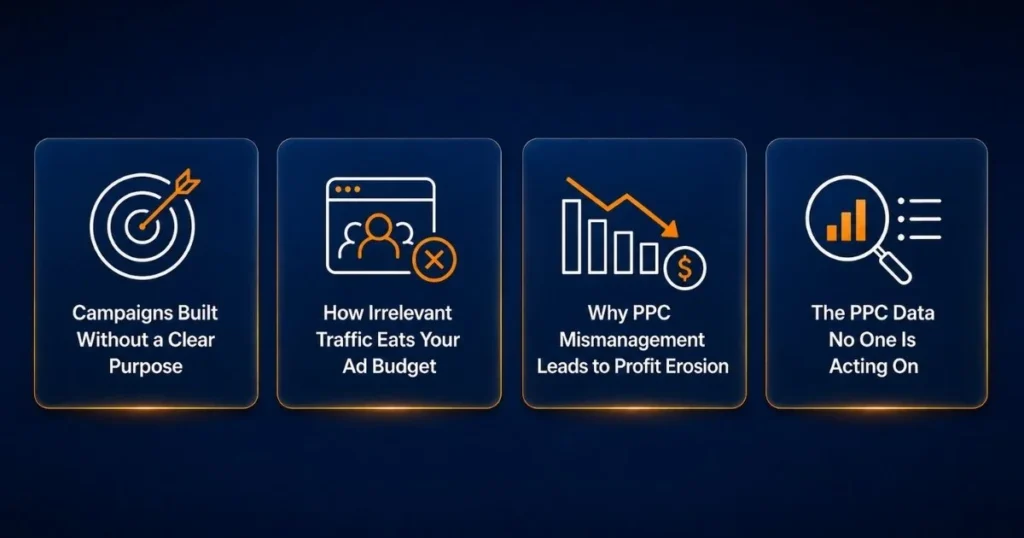
Campaigns Built Without a Clear Purpose
One of the most common Amazon advertising mistakes is building campaigns without a defined goal. Auto campaigns run indefinitely without harvesting or converting search terms. Manual campaigns target broad keywords with no structure, sponsored Brands and Sponsored Display run without testing creatives.
The result is ad spend scattered across dozens of targets, with no clear picture of what is driving sales and what is simply burning through the budget.
How Irrelevant Traffic Eats Your Ad Budget
When negative keywords are not maintained, Amazon shows ads for search terms completely unrelated to the product. A seller advertising a yoga mat might be spending on rubber mats for garage or gym flooring, paying for clicks that will never convert.
This is one of the most direct ways margins erode quietly. The spend is real. The return is not.
Why PPC Mismanagement Leads to Profit Erosion
PPC does not exist in isolation. Every dollar spent on ads that do not convert is a dollar that could have gone toward profitable keywords, better listing assets, or inventory replenishment. Over time, PPC mismanagement does not just hurt ad efficiency, it starves the rest of the account of resources.
CTR might look acceptable. Impressions might seem healthy. But if ROAS is weak and CPC keeps climbing, the account is moving in the wrong direction regardless of what the surface metrics suggest.
ACoS alone does not show the full picture. A campaign can look acceptable on ACoS, but if TACoS is rising, it means the business is becoming more dependent on ads to generate the same level of sales. A proper Amazon PPC review should compare ACoS, TACoS, ROAS, CPC, CVR, and break-even ACoS together.
The PPC Data No One Is Acting On
Most Amazon seller accounts have more data than they know what to do with. Search Query Performance, Brand Analytics, campaign-level placement data — all of it sits inside Seller Central, unused.
The problem is not a lack of information. It is the absence of consistent analysis and action. Data without decisions is just noise.
What Bad Management Does to Organic Rankings
Most sellers think of PPC and organic rank as separate problems. They are not. Everything that affects advertising performance eventually affects organic visibility too, and the damage compounds faster than most sellers expect
How Weak Sales Velocity Hurts Ranking Momentum
Sales velocity is widely understood to influence organic ranking momentum on Amazon. When PPC campaigns underperform, sales slow down. When sales slow down, organic rank drops. When organic rank drops, even more sales are lost. This is a compounding problem, and it almost always starts with poor campaign management.
Why Low Conversion Rate Slows Organic Growth
A weak conversion rate can limit organic growth because Amazon wants to show products that shoppers are more likely to buy, to determine how prominently a listing should appear in search results. A listing with strong traffic but a weak conversion rate tells Amazon that buyers are not finding what they expected, and the algorithm responds by reducing visibility.
Poor listing management, weak images, and unclear bullet points all feed this problem. And every time Amazon seller revenue loss is linked to an organic rank decline, the recovery timeline gets longer.
The Buy Box Problem That Silently Kills Sales
Losing the Buy Box on a competitive ASIN does not always feel like a crisis, but the impact is immediate. Sponsored Ads may become less efficient, and organic sales can drop because the Buy Box strongly affects purchase behavior.
Pricing strategy, account health, and fulfillment method all affect Buy Box ownership. Sellers who ignore these variables often do not realize they have lost the Buy Box until they check a report weeks later.
Account Health — The Silent Killer of Amazon Businesses
Account health does not get the same attention as advertising or listings — and that is exactly why it causes so much damage. Warnings sit unresolved. Metrics drift outside acceptable ranges. And by the time the account is flagged, the options for a clean recovery are already limited.
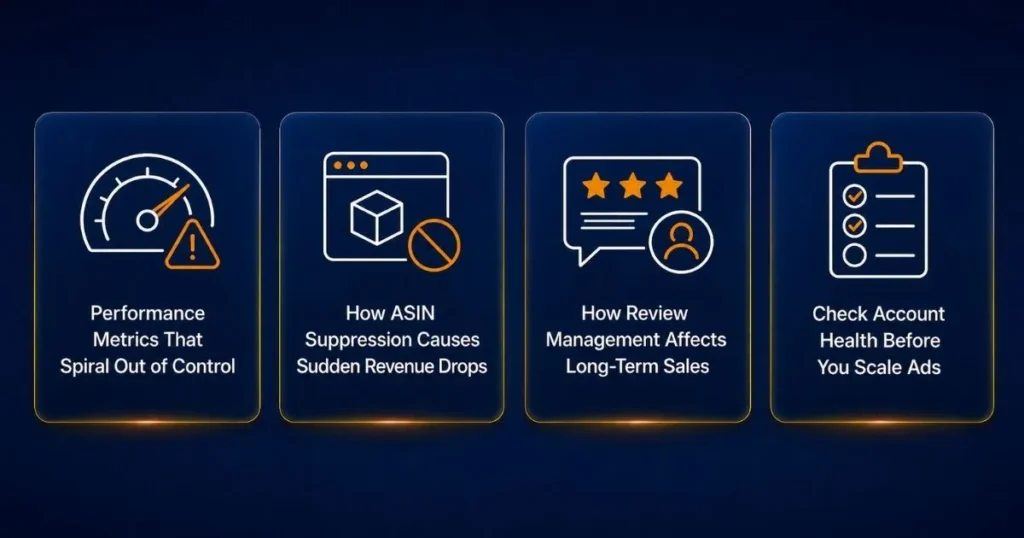
Performance Metrics That Spiral Out of Control
Amazon tracks a set of performance metrics for every seller: Order Defect Rate, Late Shipment Rate, Valid Tracking Rate, and others. These numbers matter more than most sellers realize.
When account management is poor, these metrics slip. Not because the seller is making deliberate mistakes, but because no one is watching them closely enough to catch problems before they escalate.
How ASIN Suppression Causes Sudden Revenue Drops
Listing suppression is one of the fastest ways an account can lose revenue overnight. Amazon suppresses ASINs for a range of reasons, such as missing required attributes, policy violations, image quality issues, or pricing anomalies.
Sellers with proper account oversight catch these suppressions within hours. Sellers without it may not notice for days or weeks, losing all organic rank and ad visibility in the meantime.
How Review Management Affects Long-Term Sales
Reviews are a direct conversion signal. A product with 500 reviews and a 4.6-star rating converts at a fundamentally different rate than the same product with 80 reviews and a 3.9-star rating.
Poor management means review velocity slows, negative feedback goes unaddressed, and the trust signals that drive long-term sales never get built. Over time, this compounds into a conversion problem that no amount of ad spend can fix.
Check Account Health Before You Scale Ads
Scaling ad spend on an account with unresolved account health warnings is one of the most expensive decisions a seller can make. Ads drive traffic. Underlying problems kill the conversion. The Budget is wasted, and the account health issues get worse as pressure increases.
Before increasing any ad budget, the account needs to be clean: suppressed ASINs resolved, within Amazon’s acceptable range. Policy warnings addressed, and performance metrics within Amazon’s acceptable range.
The Listing Problem — Amazon Listing Optimization Failures
A listing is not a one-time setup task. It is a live asset that affects every click, every conversion, and every dollar spent on advertising. Sellers who treat it as something to build once and leave alone are paying for that decision every single day.
A+ Content Left Untested and Outdated
A+ Content has a measurable impact on conversion. According to Amazon’s own seller resources, A+ Content can increase sales by an average of 5 to 10 percent. But many sellers set it up once and never revisit it.
Products evolve. Competitors sharpen their messaging. Customer questions change. A+ Content built two years ago may no longer address what buyers need to see before making a purchase decision.
Keyword Gaps That Kill Organic Discovery
Amazon listing optimization is not just about writing good copy. It is about making sure the right search terms are indexed in the backend and reflected naturally across the title, bullets, and description.
Sellers who skip this step or who set it up once without revisiting it leave consistent organic discovery on the table. Competitors who actively manage keyword coverage in their listings outrank them steadily over time.
Weak Images, Bullets, and Poor Page Conversion
The best PPC campaign in the world cannot save a listing with poor images and unclear bullets. If a buyer lands on a product page and does not immediately understand what the product does, why it is better, and whether it suits their needs, they leave.
Product page conversion is where revenue is either captured or lost. It is also one of the areas most consistently neglected in underperforming accounts.
How Poor Listing Management Increases Ad Costs
There is a direct connection between listing quality and advertising efficiency. Amazon’s ad algorithm rewards listings that convert well with lower CPCs and stronger placements. Listings that convert poorly cost more to advertise and receive less competitive visibility over time.
This is another Amazon advertising mistake that compounds poor listings, drives up ad costs, which tightens margins, which leaves less budget for the listing improvements that would fix the problem in the first place.
Inventory Mismanagement — The Cost Sellers Underestimate
Of all the areas where poor management shows up, inventory tends to be the least visible until it becomes a crisis. A stockout or an overstock problem does not just affect fulfillment — it affects rank, ad performance, and cash flow simultaneously.
How Stockouts Damage Sales Velocity and Rankings
Running out of stock is not just a lost sales event. It is a ranking event. When an ASIN goes out of stock, Amazon removes it from search results. The sales velocity that took months to build drops to zero. Sponsored Ads stop. Organic rank falls.
When inventory is replenished, the listing does not return to where it was. The seller has to rebuild rank from a lower starting point, which takes time, ad spend, and patience.
How Inventory Performance Affects Sponsored Ads
Amazon’s Inventory Performance Index (IPI) determines how much FBA storage space a seller has access to. A low IPI score can result in storage limits that prevent sellers from sending in enough inventory to sustain sales velocity.
Poor inventory management is one of the most underappreciated contributors to weak Amazon PPC performance because there is little point in optimizing campaigns for a product that cannot stay in stock.
Overstock Problems and Capital Getting Locked In
Overstock creates the opposite problem. When too much inventory sits in FBA warehouses, long-term storage fees accumulate. Capital tied up in slow-moving SKUs could have gone toward new product launches or listing improvements, but gets tied up in slow-moving stock.
Effective account management balances both sides, maintaining enough inventory to sustain velocity without unnecessarily locking up capital.
Inventory Planning Must Connect to Ad Scaling
This is a rule most sellers only learn after making a mistake. Scaling ad spend without confirming that inventory can support increased sales velocity results in stockouts, wasted ad spend, and rank loss all simultaneously.
Inventory planning and PPC planning need to happen together, not in separate conversations.
Agency Mistakes vs In-House Management Failures
Poor Amazon account management does not only happen when sellers go it alone. It happens with agencies, too. The difference between the two is usually in where the blind spots are — but the outcome is often the same: an account that is being maintained rather than grown.
What Bad Amazon Management Services Look Like
Not all Amazon account management services deliver the same outcomes. If you are evaluating options, it helps to understand what full account management actually includes before making a decision. Some agencies take on more accounts than they can properly manage. They run surface-level reports, send monthly summaries, and make basic bid adjustments — but they are not truly optimizing.
The clearest signal is a lack of transparency. No consistent reporting cadence, no explanation of what changed and why, no proactive communication when performance begins to slip.
Where In-House Teams Usually Fall Short
In-house management has its own set of challenges. Teams without deep Amazon expertise tend to focus on the metrics they understand, revenue and total ad spend, without examining the underlying drivers.
Amazon advertising mistakes made in-house often go uncorrected for months because there is no external benchmark for what strong account management actually looks like.
Signs You Need an Amazon Account Audit
If ACoS has been rising for more than 60 days without a clear cause, if organic rank has been declining, if account health warnings have been sitting unresolved, or if revenue has flatlined despite consistent ad investment, an Amazon account audit is overdue.
An audit is not an admission of failure. It is a diagnostic tool — a structured review of every layer of the account to identify what is working, what is not, and what needs to change.
The Real Difference Between Managing and Optimizing
Managing an Amazon account means keeping it running. Optimizing means actively improving it — testing creatives, refining bids based on placement data, improving listing conversion, monitoring account health, and planning inventory around sales velocity targets.
The difference between the two is the difference between an account that slowly declines and one that compounds growth over time.
What Effective Account Management Looks Like
Understanding what poor management costs is only half the picture. The other half is knowing what good management actually looks like in practice — not in theory, but in the specific decisions, systems, and habits that separate accounts that grow from accounts that drift.
Proactive Optimization Across Every Layer
Proper Amazon account management is not reactive. It runs on a defined cadence — weekly bid reviews, monthly listing audits, regular inventory checks, and consistent account health monitoring. Problems get caught before they become expensive.
Building an Amazon Growth Strategy That Compounds
The best-managed accounts treat every element as interconnected. PPC drives traffic. Listings convert it. Account health protects it. Inventory sustains it. Pricing protects the margin through all of it.
When these layers work together, growth compounds each improvement, reinforces the others, rather than operating in isolation.
Connecting PPC, Listings, Inventory, and Account Health
Most sellers manage these areas separately, which is exactly why problems go unnoticed. A connected approach means that an inventory warning triggers a review of ad budgets. A conversion rate drop triggers a listing audit. An account health flag pauses scaling decisions until the issue is resolved.
Everything informs everything else.
How ScaleA2Z Approaches Full Account Management
At ScaleA2Z, full account management is built around data-driven decisions across every layer — PPC, listings, inventory, pricing, and account health. The goal is not just to manage an account but to build a system where every decision connects to a measurable outcome.
How to Fix Poor Amazon Account Management
Recovery is possible for most accounts — but only when the fixes happen in the right order. Jumping straight to scaling ads or overhauling listings without first understanding the root cause is how sellers waste time and budget twice. Start with clarity, then move with intention.
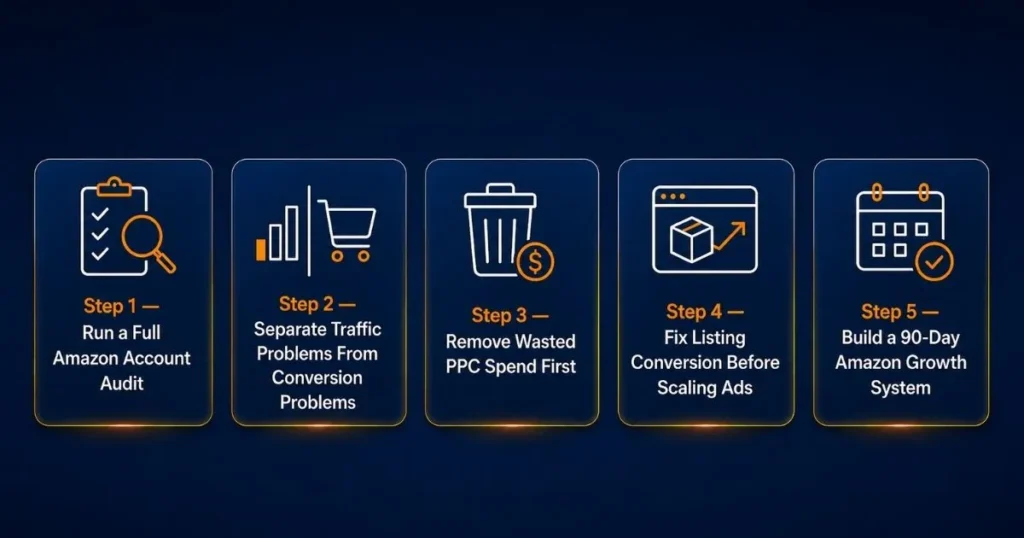
1- Run a Full Amazon Account Audit
Start with a complete Amazon account audit. Review campaign performance, listing quality, account health metrics, inventory levels, and pricing margins. The goal is to understand the current state of every layer before making any changes.
2- Separate Traffic Problems From Conversion Problems
This is a critical distinction. A traffic problem means ads and organic rank are not delivering enough visitors to the listing. A conversion problem means visitors are arriving but not buying. The solutions are different, and confusing the two wastes time and budget.
3- Remove Wasted PPC Spend First
Before scaling anything, remove spending that is not working. Add negative keywords. Pause underperforming targets. Consolidate campaigns that are cannibalizing each other. This frees up budget to reinvest where results are actually coming from.
4- Fix Listing Conversion Before Scaling Ads
Increasing ad spend on a listing with a weak conversion rate is one of the fastest ways to burn through budget without results. Fix the listing first — images, bullets, A+ Content, pricing — then scale ads with confidence that traffic will convert.
5- Build a 90-Day Amazon Growth System
Recovery from poor management does not happen in a week. Set a 90-day plan with clear milestones — account health resolved in the first 30 days, listing and conversion improvements in the next 30, and scaling decisions in the final 30 based on data, not assumptions
Conclusion
The real cost of poor Amazon account management is not just a line item in an ad report. It is lost organic rank, suppressed listings, and real Amazon seller revenue loss that compounds quietly over time. Revenue can mask all of it until it cannot.
Sellers who build durable Amazon businesses treat account management as a system, not a task. They optimize consistently, act on data, and address problems before they become expensive to fix.
If your account has been drifting without direction, the first step is understanding exactly where it stands. An Amazon account audit is where that process begins.
Not Sure Where Your Amazon Account Is Losing Money?
We audit PPC, listings, account health, inventory, and pricing — and tell you exactly what to fix first. No fluff. No generic report.
Get Your Free Amazon Account Audit →Frequently Asked Questions
What does poor account management cost an Amazon seller?
The cost varies, but it typically shows up as a combination of inefficient ad spend, lost organic rank, lower conversion rates, and revenue lost from suppressed listings or stockouts. For many sellers, the real cost runs into thousands of dollars per month — most of it invisible until a structured review is done.
How do I know if my Amazon account needs an audit?
If your ACoS has been rising without explanation, your organic rank is declining, you have unresolved account health warnings, or your sales have plateaued despite consistent ad investment, your account needs an Amazon account audit.
What is included in Amazon account management services?
A full Amazon account management service typically covers PPC campaign management, listing optimization, account health monitoring, inventory planning, pricing strategy, and regular performance reporting across all key metrics.
How does bad PPC management affect organic rankings?
Poor PPC management reduces sales velocity, which Amazon’s algorithm uses as a core ranking signal. Lower velocity leads to lower organic rank, which reduces visibility, which further reduces sales. It is a compounding cycle that begins with inefficient advertising.
What is the difference between Amazon PPC management and full account management?
Amazon PPC management focuses on advertising campaign structure, bids, keywords, and spend efficiency. Full account management covers everything: PPC, listings, inventory, pricing, account health, and overall growth strategy.
How long does it take to recover from poor Amazon management?
Recovery depends on how long the account has been underperforming and which areas are affected. Most sellers begin to see measurable improvement within 60 to 90 days of consistent, structured optimization — provided the underlying issues are addressed in the right sequence.