Branded vs Non-Branded Ads: Where Should Your Amazon Budget Go?
A large National Bureau of Economic Research field experiment on paid search, conducted on a major e-commerce marketplace rather than Amazon specifically, found that brand-keyword ads produced little measurable short-term lift, because many shoppers shifted to organic results when paid ads were removed. The platforms differ, but the lesson carries over. Branded ads can look profitable while simply taking credit for demand you already own.
That does not mean branded ads are useless. It means you need to separate real brand defense from paid clicks that would have turned into organic sales anyway.
Yet branded ads still post the cleanest numbers in your account. Low ACoS. High conversion. The report looks great, while your profit quietly leaks out the side.
So the real question is not whether branded ads “work.” It is where each dollar actually grows your business. That is the whole fight in branded vs non-branded ads, and getting the split wrong is one of the most expensive habits we fix when we audit accounts. If your ad spend keeps climbing while total sales stay flat, our PPC management team sees this pattern almost every week.
Table of Contents
Branded vs Non-Branded Ads
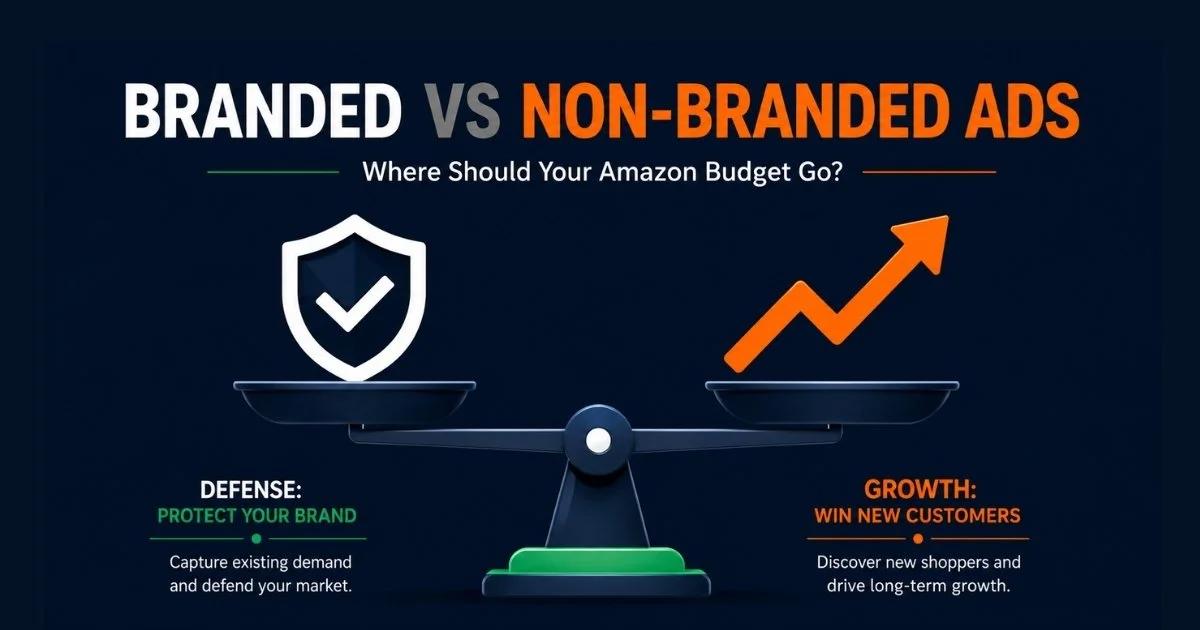
Branded ads are best for protecting shoppers who already know your brand, while non-branded ads are better for reaching new customers and growing category visibility. Branded campaigns usually have lower ACoS because buyer intent is already high. Non-branded campaigns often cost more, but they help you win new keywords, improve organic rank, and scale beyond existing demand.
Most Amazon sellers need both. The right budget split depends on brand stage, margin, organic rank, competitor pressure, and whether branded ads are creating incremental sales or just taking credit for organic orders.
What Branded and Non-Branded Ads Mean
Before you decide where to spend, you need a clear line between the two. Most sellers blur it, and blurred data leads to blurred decisions.
The split is simple once you see it. One group reaches people who already know you. The other reaches people who do not.
In Amazon Advertising, this split matters because branded, non-branded, and competitor keywords should not be judged by the same criteria. Each keyword type plays a different role in your Amazon PPC budget, keyword strategy, and campaign segmentation.
Branded Keywords, Defined
Branded keywords contain your brand name, your product line, or a trademark you own. If you sell protein powder under the name “PeakFuel,” then “PeakFuel protein” and “PeakFuel whey” are branded keywords.
The shopper typing those words already knows your brand. They are far down the funnel, so branded search intent is high, cost per click is usually lower, and conversion rate is stronger than generic keyword traffic. On Amazon, branded keywords often include your brand name, product line, common misspellings, and terms shoppers use when they are already looking for you.
Non-Branded Keywords, Defined
Non-branded keywords describe the product, not the brand. “Whey protein powder,” “vanilla protein for women,” and “low sugar protein” all sit here. The shopper has a need but no brand in mind yet.
These are often called generic keywords because they describe a product category, problem, feature, or use case rather than a specific brand.
This is where most of Amazon’s search volume lives. It costs more and converts lower, but it puts you in front of buyers who have never heard your name.
The Competitor Keyword Middle Ground
There is a third bucket that trips people up. Competitor keywords are branded, just not your brand. If you bid on “Optimum Nutrition protein” to pull their shoppers, that is competitor conquesting.
It behaves like a hybrid. Intent is high, but loyalty is not yours yet, so conversion sits lower and CPCs run hot. Treat it as its own line, never mixed into your branded numbers.
Why the Two Behave So Differently
You cannot manage branded vs non-branded ads with one mental model. They run on different economies, and treating them the same is how budgets get wasted.
The gap shows up in two numbers that every seller already tracks.
The CPC and Conversion Gap
Branded terms convert highly because the buyer already wants you. Cost per click stays low because few competitors outbid you on your own name. A branded campaign might run at a single-digit ACoS.
Non-branded terms flip that picture. On a busy category term like “protein powder,” you compete with dozens of funded brands at once. CPCs can run several dollars, and conversion drops because the shopper is still comparing.
This is why non-branded Sponsored Products and Sponsored Brands campaigns need tighter targeting, stronger listings, and cleaner search term data before you scale the budget.
The Margin Math Sellers Skip
Here is where the decision gets real. Say your protein powder sells for 35 dollars, with about 10.50 left after product cost and Amazon fees.
A non-branded click at 2 dollars with a 10% conversion rate means you spend 20 dollars to win one sale. That sale only had 10.50 of room. On the surface, you lost money.
But that buyer was brand new. If your branded ACoS is 8% on the repeat purchase they make next month, the first sale starts to pay off over time. Judge non-branded spend on the customer it creates, not the single order.
Quick Tip: Never compare branded and non-branded ACoS side by side as if they mean the same thing. Branded ACoS measures efficiency on the demand you already have. Non-branded ACoS measures the cost of buying a new customer. Hold each to its own goal.
The Hidden Trap in Branded Ads
Branded ads feel safe. They are the comfort food of any Amazon account. That comfort is exactly what hides the problem.
When a campaign looks efficient but barely grows the business, branded spend is usually the reason.
Cannibalization in Plain Terms
You already rank first organically for “PeakFuel protein.” A loyal buyer searches for it, sees your sponsored ad at the top, clicks it, and buys. Amazon attributes those sales to your ad.
But that buyer was going to scroll one inch down and buy from your free organic listing anyway. You just paid for a click you would have gotten for nothing. That is ad cannibalization, and it inflates ad-attributed revenue without adding a cent to total revenue.
We wrote a full breakdown of how this drains accounts in Cannibalization in Amazon Ads, and it is worth reading alongside this guide.
When Brand Defense Still Earns Its Keep
This does not mean you kill branded ads. There are real reasons to hold that ground.
- Competitors bid on your name. If a rival shows up above your organic listing on “PeakFuel protein,” they can siphon shoppers who meant to buy you. A modest branded bid pushes them out.
- You are launching a new product. Branded terms let you show a fresh item to people who already trust the brand but have not seen it yet.
- You do not rank first organically. If your organic spot is weak, the branded ad is not stealing a free click. It is winning a placement you would otherwise lose.
- A promotion or peak season is live. During a push, a branded ad keeps your full shelf in front of warm buyers.
The rule is simple. Spend the minimum needed to protect the turf, not a dollar more. Brand defense is a cap, not a growth lever.
Why Non-Branded Ads Drive Real Growth
If branded ads protect what you have, non-branded ads build what you do not have yet. This is where the real growth comes from.
It costs more upfront. It also reaches every buyer who does not know you exist.
New Customers and Demand Creation
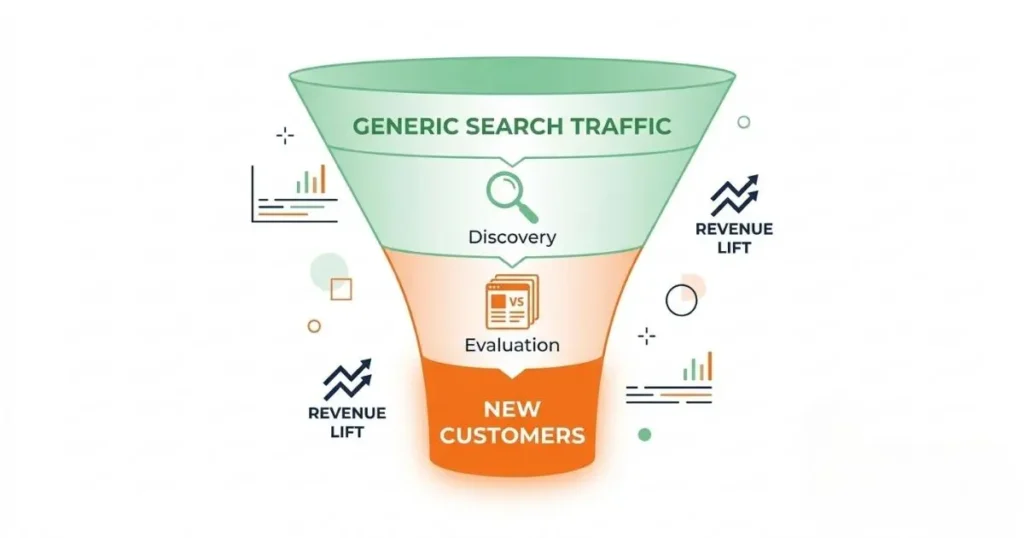
Non-branded keywords are pure demand expansion. The shopper searching for “low sugar protein powder” has no brand loyalty. Win that click and you may have a customer for years.
The metric that helps prove this is your new-to-brand rate, the share of orders coming from first-time buyers. This helps you see whether non-branded ads are bringing new customers or only recycling shoppers who already know your brand.
Non-branded campaigns should run a materially higher new-to-brand rate than branded ones, often 40% or more for pure discovery, against a 20 to 30% account-wide norm. A higher rate means you are taking market share instead of recycling buyers you already had.
Using Ad Spend to Lift Organic Rank
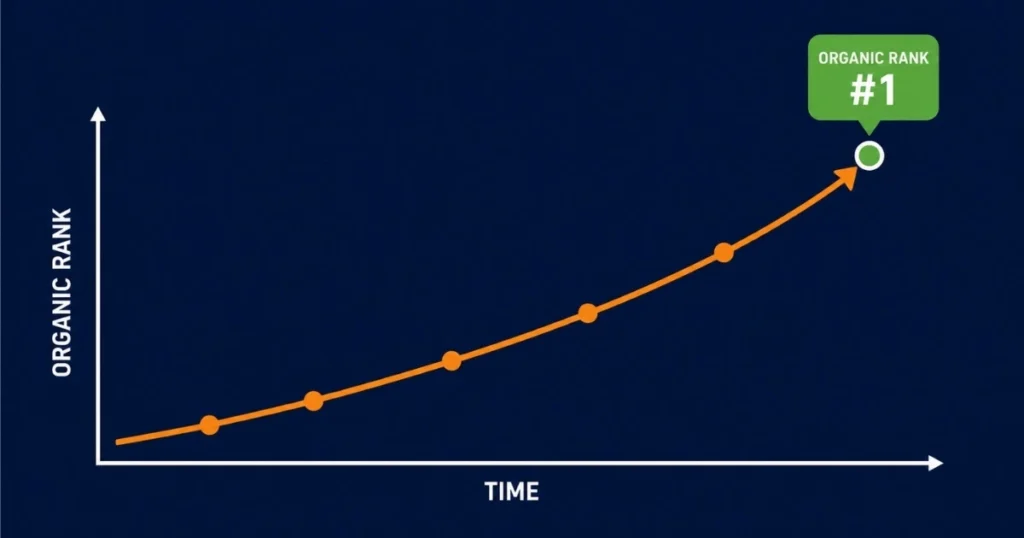
There is a second payoff most sellers miss. When non-branded ads drive sales on a target keyword, Amazon reads that as relevance and sales velocity. Over time, your organic rank on that term climbs.
You can track this movement through Brand Analytics, the Search Query Performance report, Amazon Seller Central search term data, and your own keyword rank tracking.
So a non-branded campaign that looks break-even on paper can still be a win. It is buying an organic position that you keep for free later. That is why we judge these campaigns on rank movement and new customers, not just first-touch ACoS.
Quick Tip: Track your new-to-brand rate per campaign, not just account wide. A branded campaign with a 5% new-to-brand rate is doing its job. A non-branded campaign with the same number is a red flag that your targeting is too narrow.
Branded vs Non-Branded Ads Budget Framework
Here is the answer most guides skip. “Balance both” is not a plan. Your split between branded vs non-branded ads should move with your brand’s awareness and the market you sell in.
Use these ranges as a starting point, then adjust with your own data.
| Brand Stage | Branded Ads | Non-Branded Ads | Main Goal |
|---|---|---|---|
| New Brand | 10–20% | 80–90% | Discovery and Keyword Growth |
| Growing Brand | 20–30% | 70–80% | New Customers + Light Brand Defense |
| Established Brand | 30–40% | 60–70% | Protect Brand While Still Growing |
| Competitor-Heavy Niche | 40–50% | 50–60% | Defense Plus Market Share |
| Profit Recovery Mode | 20–30% | 70–80% | Reduce Waste and Fund Winners |
These are not fixed rules. They are starting points. Your final ad budget split should move based on profit margin, organic rank, branded search volume, competitor pressure, and how much Amazon ad spend is actually creating incremental sales.Lorem ipsum dolor sit amet, consectetur adipiscing elit. Ut elit tellus, luctus nec ullamcorper mattis, pulvinar dapibus leo.
New Product Launch
When you launch a fresh product, almost nobody searches for its name yet. There is no branded demand to defend, so branded ads have little to do.
Put 85 to 90% of your spend into non-branded and competitor keywords. Say you launch a new vanilla protein powder. Shoppers are typing “vanilla protein powder” and “low sugar protein,” not your product name. Your whole job here is discovery.
Hold back a small branded layer only if your wider brand already has loyal buyers who might search for the new item by name.
Growing Brand
Once your name starts showing up in search, the picture shifts. Branded search volume is rising, which means you now have demand worth protecting.
Move toward a 70/30 split favoring non-branded. Keep pouring the majority into discovery, but add a light branded layer to guard the demand your non-branded ads are creating. This is the stage where competitors first notice you and start testing your name.
Established Brand
With strong organic rank and steady branded search, most of your branded sales will close on their own. That changes the math.
Settle near 60/40 or 65/35 toward non-branded, and keep branded spend lean and defensive. Cap your branded budget to what actually blocks rivals, since paying for clicks you would win organically is wasted money. Growth still comes from non-branded, even at this stage.
If you are not sure which stage you sit in, or your split has drifted without anyone deciding it, a quick PPC audit will show how much of your spend is defending sales you already own.
Competitor-Heavy Category
This one is not a stage. It sits on top of whichever stage you are in. If you sell in a crowded category where rivals aggressively bid on each other’s names, treat it as an overlay on the splits above.
Two adjustments apply.
- Protect your brand harder. Even as a growing brand, lift your branded spend if competitors are showing above your listing for your own name. Losing a warm buyer to a rival costs more than the defensive click.
- Fund a competitor line. Carve out a dedicated competitor-conquesting budget separate from both branded and non-branded. Bidding on a rival’s name works best when you have a clear price edge, or they go out of stock often.
So a growing protein brand in a brutal category might still run 70/30 toward non-branded, but with a firmer branded floor and a small competitor budget running alongside.
Quick Tip: In a competitor-heavy category, check your branded click share in the Brand Analytics search query performance report. If you hold 90% click share on your own name, your defense is working. If it drops near 40%, someone is taking your buyers, and you need to raise your branded bid fast.
Splitting Your Campaigns the Right Way
Getting your budget split right on paper means nothing if your campaign structure does not match it. Most sellers set the right intentions and then undo them by mixing keyword types inside the same campaign.
None of these splits work if branded and non-branded keywords share a campaign. Amazon sets budgets at the campaign level, so mixing them means you cannot control either one.
Build separate campaigns for branded, non-branded, and competitor terms. Add your brand name as a negative keyword in non-branded campaigns, move winning generic keywords into exact match campaigns, and keep competitor targeting in its own budget line. Now you can cap branded spend, fund non-branded winners, and read clean data for each campaign type.
How to Test Before You Comm
You do not have to guess your split. You can prove it. The strongest move in managing branded vs non-branded ads is a controlled test that shows what your branded spend is really worth.
This is the part competitors describe in theory and never hand you a method for. Here it is.
The Branded Pause Test
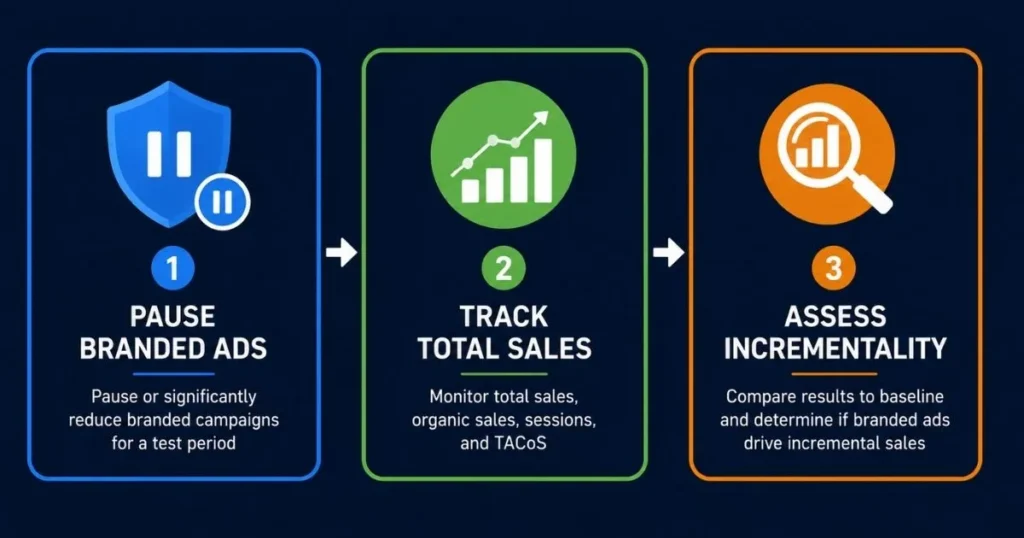
A holdout test helps you see whether branded ads are truly incremental or only taking credit for organic sales. The logic is simple. If branded ads create real sales, pausing them should drop your total sales. If they only recapture organic buyers, total sales hold steady.
Run it like this.
- Pick one clean window. Choose a two to three week stretch with no promo, no price change, and steady demand.
- Reduce or pause branded campaigns carefully. If competitor pressure is high, lower bids first rather than pause completely. Leave non-branded and competitor campaigns running so you isolate the variable.
- Watch total revenue, not ad revenue. Track organic sales and total sales for your branded terms, not just the ad dashboard.
- Read the result. If total sales hold, those branded ads were mostly cannibalizing organic. If sales drop, the ads were doing real defensive work, and you keep them.
One caution. When you pause branded ads, Amazon’s own placements and competitors can step into that space. Watch for rivals filling the gap, and restart fast if they do.
Metrics That Tell the Truth
ACoS and ROAS reward whatever gets attributed, even if it was not incremental. Lean on metrics that reveal real impact instead.
- TACoS. Total ad spend against total sales. Falling TACoS means your ads are building organic momentum, not just renting it. Our TACoS reduction guide digs deeper here.
- New-to-brand rate. The share of first-time buyers. High on non-branded, naturally low on branded.
- Long Term Sales. Where available, Amazon’s Long Term Sales metric can help estimate the 12-month value created when new-to-brand shoppers move through the funnel. It is useful for understanding discovery value, especially when non-branded campaigns bring first-time buyers.
Quick Tip: Run a branded pause test once a quarter, not once ever. Your organic rank, competitor pressure, and seasonality all shift. The right split in spring may be the wrong split during Q4.
Mistakes That Quietly Drain Your Budget
Even sellers who understand the theory lose money on execution. These are the slips we catch most often.
- Mixing branded and non-branded in one campaign. You lose budget control and clean data in one move. Separate them first, always.
- Judging non-branded by branded ACoS. You will pause your best growth campaigns because they look “expensive” next to the demand you already have.
- Letting branded spend grow on autopilot. Branded ACoS looks great, so nobody questions it. Meanwhile, it eats into the budget that could buy new customers.
- Ignoring competitor defense. If you pull branded ads completely without checking, a rival may be sitting right above your listing.
- Never testing incrementality. Without a pause test, you are guessing how much of your branded spend is real. Most of it usually is not.
- Forgetting organic rank in the math. A non-branded campaign that breaks even on ads but lifts you to page-one organic is a winner you might wrongly pause.
Fix even three of these, and most accounts find that they can redirect spending toward growth without adding a dollar to the budget. We cover the wider list in 7 Amazon PPC Mistakes Killing Your Profit.
Putting It All Together
The honest answer to branded vs non-branded ads is this. Non-branded spend grows your business. Branded spend protects it. Most sellers have those two jobs backwards in their budget.
Lead with non-branded to win new customers and climb organic rank. Keep a lean branded layer to block competitors and cover weak organic spots. Separate every bucket into its own campaign so you can read the truth.
Then prove it. Run a branded pause test, watch total revenue instead of ad revenue, and let the data set your split. Revisit it every quarter as your brand and your category move.
Do that, and your ad spend stops defending sales you already had and starts buying the ones you do not.
If you want a clear read on how your branded vs non-branded ads are really splitting your budget, the team at ScaleA2Z can audit your campaigns and show which spend protects your brand, which spend grows new demand, and which spend is quietly wasting profit.
Book a call with our PPC team, and we will show you where your next Amazon PPC budget should go.
Frequently Asked Questions
What is the difference between branded and non-branded ads on Amazon?
Branded ads target keywords containing your brand or product name and reach shoppers who already know you. Non-branded ads target generic category terms and reach shoppers who have no brand in mind. Branded ads capture existing demand, while non-branded ads create new demand.
Should I bid on my own brand name on Amazon?
Sometimes, but with a cap. Bid on your brand when competitors are showing above your listing, when you launch a new product, or when your organic rank is weak. If you already rank first organically and no rival is intruding, much of that branded spend may be recapturing sales you would win for free.
Why do non-branded ads cost more than branded ads?
Non-branded keywords face far more competition and lower buyer intent. Shoppers searching generic terms are still comparing options, so conversion is lower, and many funded brands bid on the same words, which pushes cost per click higher.
How should I split my budget between branded and non-branded ads?
It depends on your brand stage. New brands should put 80 to 90% into non-branded discovery. Growing brands move toward 70/30, favoring non-branded. Established brands settle near 60/40 and keep branded spend lean and defensive. Non-branded usually stays the majority.
How do I know if my branded ads are wasting money?
Run a controlled pause test. Stop your branded campaigns for two to three weeks during a stable period and watch total sales, not ad sales. If total revenue holds steady, those ads were mostly cannibalizing organic traffic. If sales fall, the ads were doing real defensive work.
What metrics show whether my ad spend is actually growing the business?
Look beyond ACoS and ROAS, which reward attributed sales even when they are not incremental. Track TACoS for organic momentum, new-to-brand rate for real customer acquisition, organic rank movement, total revenue, and, where available, Amazon’s Long Term Sales metric for the future value of new shoppers you bring in.