How to Scale Amazon Ads Without Increasing Wasted Spend
Scaling Amazon ads is a common goal for sellers who want to increase sales and grow their brand. However, many sellers notice that when they try to scale their campaigns, advertising costs start rising faster than revenue. Instead of improving profitability, this often results in a higher ACoS and wasted ad spend.
The main reason behind this problem is scaling campaigns without first optimizing them. Increasing budgets or bids too quickly can expose inefficient keywords, irrelevant search terms, and weak campaign structures. As a result, sellers may see more traffic but not enough conversions to justify the additional spend.
To scale Amazon ads without increasing wasted spend, sellers need a data-driven optimization strategy. By analyzing search term reports, refining keyword targeting, and making smarter bid adjustments, campaigns can grow more efficiently. This approach is part of a strong Amazon advertising strategy that focuses on optimization before scaling budgets.
Table of Contents
Why Scaling Amazon Ads Often Increases Wasted Spend
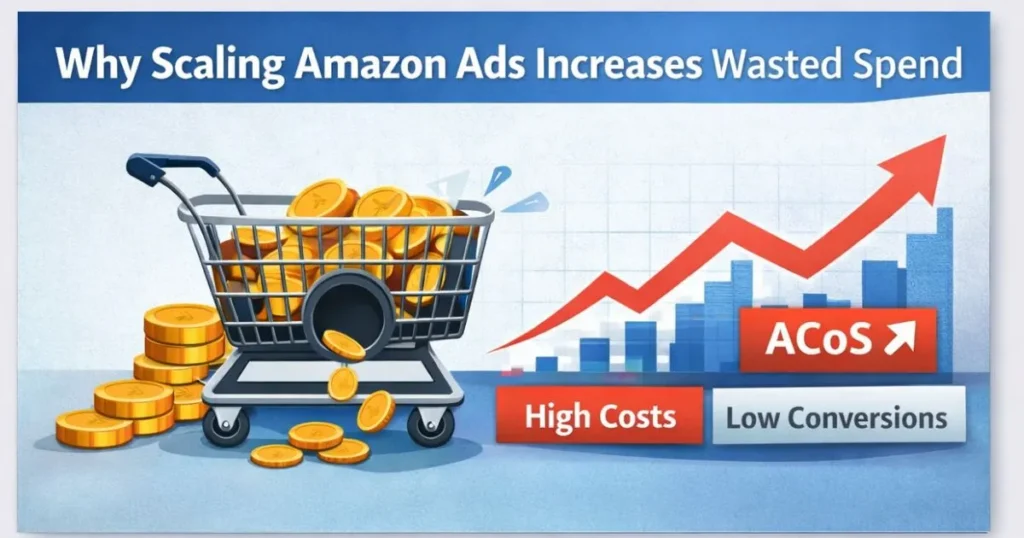
Scaling Amazon advertising is not just about increasing budgets or raising bids. Many sellers believe that spending more on ads will automatically generate more sales, but without proper optimization, scaling can quickly lead to higher costs and inefficient campaigns. When campaigns grow without a clear strategy, weaknesses in targeting, bidding, and campaign structure become more visible.
As a result, ad spend can grow faster than revenue, raising ACoS and reducing overall profitability. Many sellers struggle to reduce wasted ad spend on Amazon because campaigns are expanded before fixing targeting and keyword issues.
The real goal of scaling is to increase visibility and sales without allowing wasted ad spend to grow at the same pace. However, sellers who expand campaigns too quickly often see declining returns. This usually happens because inefficient keywords, irrelevant search terms, and poorly organised campaigns consume a larger share of the advertising budget. If these issues are not addressed before scaling, increasing budgets amplifies existing inefficiencies rather than improving performance.
Increasing Budget Without Data
One of the most common mistakes sellers make is increasing campaign budgets without analyzing performance data. When budgets are expanded blindly, Amazon continues delivering impressions based on the existing campaign setup. If underperforming keywords or weak targeting already exist, the extra budget pushes more traffic toward those inefficient areas. This often results in more clicks but very few additional conversions.
Scaling Before Profitability
Another major reason for wasted spending increases is scaling campaigns before they become profitable. If a campaign already has a high ACoS or inconsistent conversion performance, increasing the budget will usually increase losses rather than improve sales. Sellers should first identify profitable keywords and targets, then gradually scale those segments for better control over ad spend.
Ignoring Search Term Reports
Search term reports provide valuable insights into the exact queries shoppers use before clicking on an ad. Many sellers ignore this data when scaling campaigns, allowing irrelevant or low-performing queries to continue consuming budget. Regularly reviewing search term reports helps identify profitable queries and reduce wasted spend by using negative keywords.
Poor Campaign Structure
Campaign structure also plays a key role in scaling efficiency. When different match types, keywords, and targeting strategies are combined within a single campaign, it becomes difficult to control bids and allocate budget effectively. A structured campaign setup that isolates high-performing keywords and separates match types gives advertisers better control over scaling while keeping wasted ad spend in check.
Step 1: Eliminate Wasted Spend Before Scaling
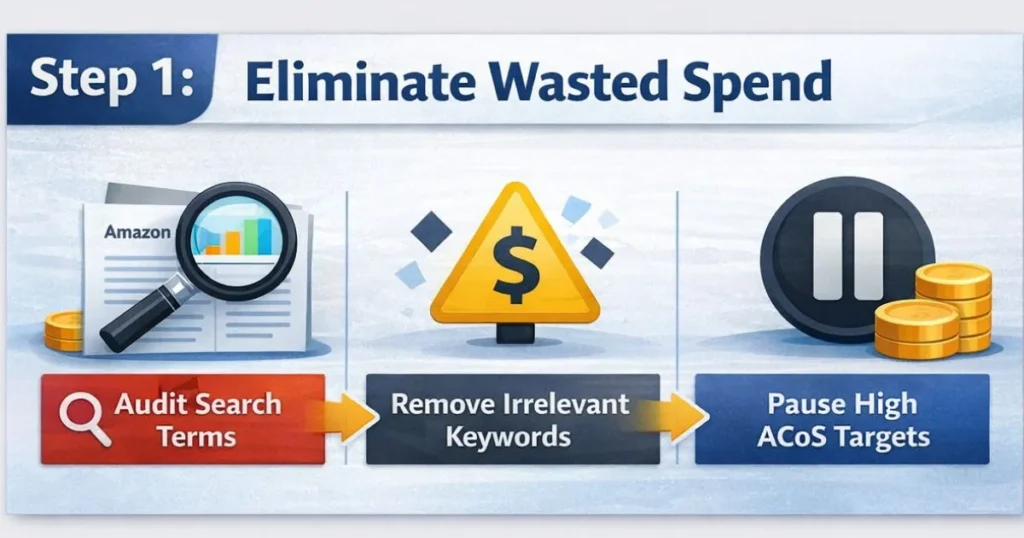
Before increasing budgets or expanding campaigns, the priority should be reducing inefficiencies in existing advertising data. Many sellers try to scale their campaigns while hidden problems persist, leading to wasted ad spend that grows along with the budget. If campaigns are not optimized first, scaling simply multiplies the same issues.
The best way to scale Amazon ads without increasing wasted spend is to identify where the budget is being lost. This usually involves analyzing search term data, removing irrelevant traffic, and adjusting targets that incur high costs but yield few conversions. Once these inefficiencies are controlled, campaigns become more stable and easier to scale profitably. This process is a key part of effective Amazon ads optimization, helping advertisers remove inefficient traffic before scaling.
Audit Your Search Term Report
The search term report is one of the most important tools for Amazon ad optimization. It shows the actual queries shoppers used before clicking on your ad. By regularly reviewing this data, sellers can see which search terms drive conversions and which waste budget. A proper audit helps identify patterns in customer behavior and highlights areas where ad spend is being lost. It also allows advertisers to move profitable search terms into dedicated campaigns while blocking irrelevant ones.
Identify High Spend, Low Conversion Terms
When reviewing search term reports, one key area to check is keywords that generate many clicks but few or no sales. These terms often consume a large portion of the ad budget while producing little return. Such keywords usually indicate weak buying intent or poor product relevance. Lowering bids or pausing these targets helps reallocate the budget to search terms with stronger conversion potential.
Spot Irrelevant Queries
Another important step is identifying search queries that are not relevant to the product. For example, a premium product may receive clicks from shoppers searching for cheaper alternatives or different variations. These irrelevant queries rarely convert and often become a major source of wasted ad spend. Blocking them early can significantly improve targeting accuracy and campaign efficiency.
Implement Negative Keyword Strategy
After identifying inefficient queries, the next step is adding negative keywords. Negative keywords prevent ads from appearing for search terms that are unlikely to convert. This helps eliminate low-quality traffic and ensures that the advertising budget focuses on relevant searches.Regularly managing negative keywords is essential for maintaining efficient campaigns, especially when preparing to scale.
Negative Exact vs Negative Phrase
Amazon provides two main negative match types: negative exact and negative phrase.Negative exact blocks ads when the search query exactly matches the blocked keyword. This is useful when a specific term repeatedly generates clicks but no sales.Negative phrase block ads for any search query containing a specific phrase. This option is helpful when multiple related queries consistently perform poorly.
When to Add Negatives
Negative keywords should be added based on consistent performance data, not a few clicks. If a search term repeatedly drives clicks without conversions, it is usually a strong candidate for a negative keyword. Regularly updating negative lists keeps campaigns efficient as new search data appears and helps maintain better control over ad spend.
Pause or Reduce High ACoS Targets
Before scaling campaigns, it is also important to review targets with consistently high ACoS. These may include keywords or product targets that generate sales but at an unprofitable cost. Instead of removing them immediately, sellers can first reduce bids to see if performance improves. If ACoS remains too high, pausing the target may be the better option. This prevents inefficient targets from consuming budgets that could be used for more profitable opportunities.
Step 2: Identify Profitable Scaling Opportunities
After reducing wasted spend, the next step is identifying which parts of your campaigns are already performing well. Successful Amazon advertising is not about scaling everything at once. Instead, it focuses on scaling the keywords and targets that consistently generate profitable results. The goal at this stage is to find the search terms that drive conversions and allocate more budget toward them. By focusing on proven traffic sources, sellers can increase sales while maintaining advertising efficiency.
Find Winning Keywords
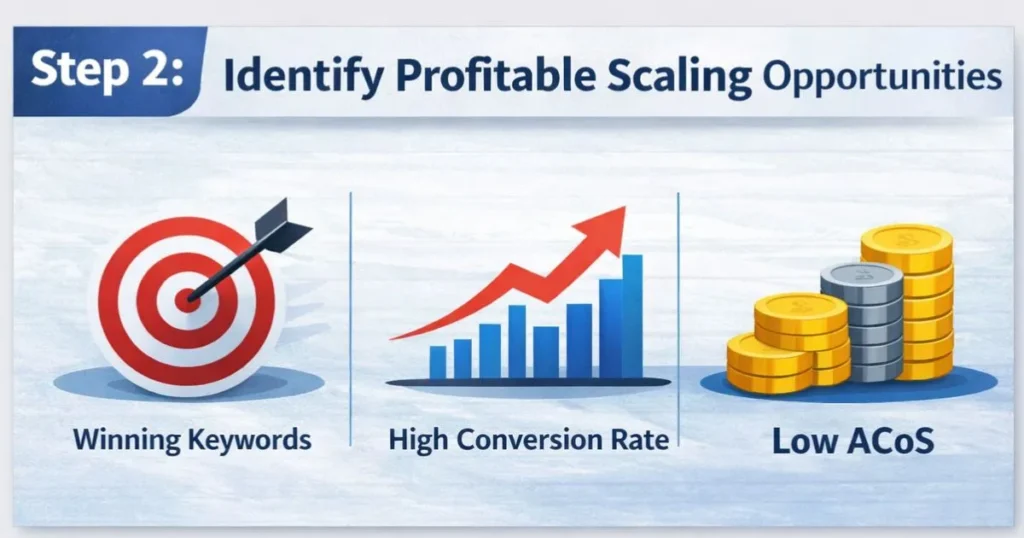
Winning keywords are the search terms that consistently generate engagement and conversions. These keywords typically indicate strong purchase intent and directly drive sales. Identifying them allows advertisers to scale campaigns more strategically. When reviewing campaign data, several key metrics help identify high-performing keywords.
High Conversion Rate
A high conversion rate means shoppers who click on the ad are more likely to buy the product. This usually indicates that the keyword matches the shopper’s search intent and the listing is relevant. Keywords with strong conversion rates are ideal for scaling because they already demonstrate consistent performance.
Low ACoS
Another important indicator is a low Advertising Cost of Sale (ACoS). When a keyword drives sales while keeping ad costs low, it contributes positively to campaign profitability. These keywords often perform well with higher bids or increased budgets, making them strong candidates for scaling.
Strong CTR
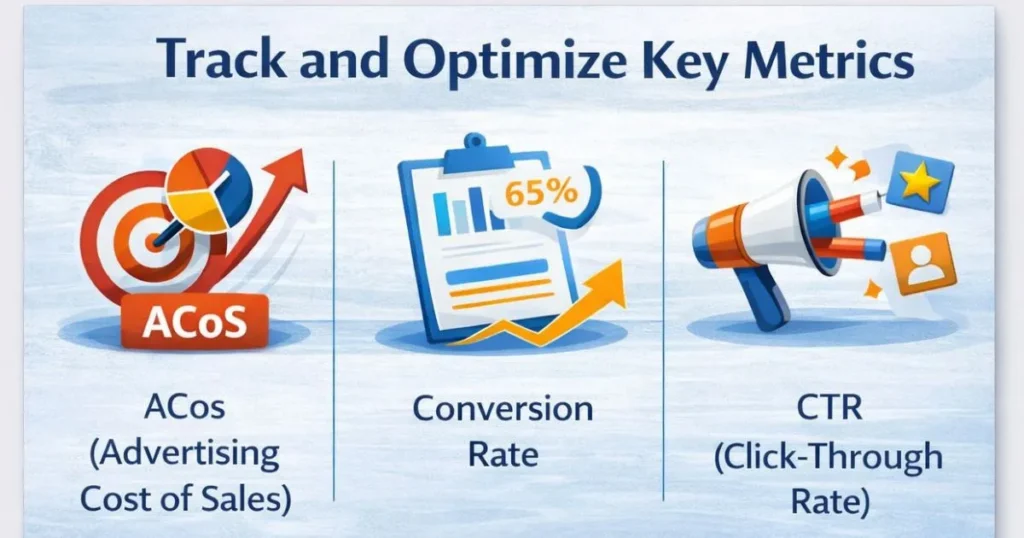
Click-through rate (CTR) measures how often shoppers click on an ad after seeing it. A strong CTR suggests that the ad is relevant to the search query and attracts customer attention. When a keyword shows both strong CTR and good conversion rates, it usually indicates strong potential for scaling.
Isolate Top Performers Into Dedicated Campaigns
After identifying profitable keywords, the next step is isolating them into dedicated campaigns or ad groups. This provides better control over bids, budgets, and performance tracking. When high-performing keywords are mixed with exploratory targets, it becomes harder to manage them effectively. Separating them allows advertisers to allocate budget more efficiently.
Single Keyword Campaign Strategy
Many experienced advertisers use a single keyword campaign strategy. In this setup, each campaign focuses on one primary keyword. This allows advertisers to clearly track performance and optimize bids based on each keyword’s results.
Match Type Segmentation
Another effective strategy is separating match types into different campaigns. Broad, phrase, and exact match keywords should be managed separately. Exact match campaigns capture high-intent searches, while broader match types help discover new keyword opportunities. This structure allows sellers to scale profitable keywords while still exploring new traffic sources without increasing wasted spend.
Step 3: Smart Bid Scaling Strategy
After identifying profitable keywords and campaign segments, the next step is scaling them through smart bid adjustments. Bids determine how often your ads appear in search results and which placements they win. However, increasing bids too aggressively can quickly raise advertising costs. A better approach is to scale bids gradually based on performance data.
A smart bidding strategy focuses on controlled adjustments rather than sudden increases. This allows sellers to gain more visibility for high-performing keywords while keeping advertising costs under control. A well-planned Amazon PPC bid strategy allows advertisers to scale visibility while protecting campaign profitability.
Increase Bids Gradually (10–20%)
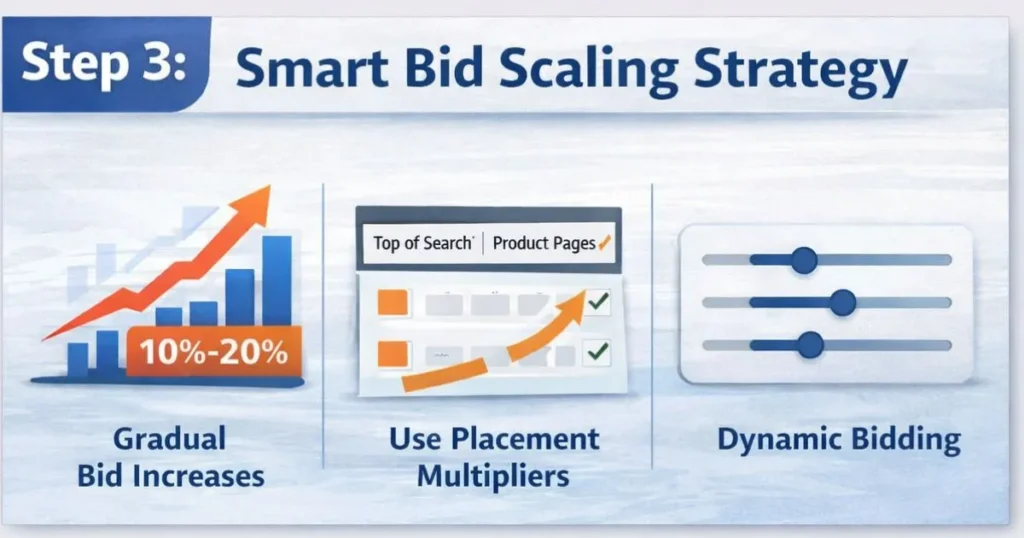
One of the safest ways to scale Amazon ads is by increasing bids gradually. Small adjustments, usually around 10–20%, let advertisers test how increased visibility affects performance without taking unnecessary risks. When bids increase slowly, advertisers can monitor changes in impressions, clicks, conversion rate, and ACoS. If performance improves or remains stable, bids can be increased further. If costs rise without more sales, adjustments can be made before a significant budget is lost.
Use Placement Multipliers
Amazon also allows advertisers to adjust bids based on ad placement. These adjustments, known as placement multipliers, help increase bids for placements that perform better. By reviewing placement reports, advertisers can see which positions generate stronger conversions and allocate higher bids to those areas. This improves visibility in high-performing placements without increasing overall bids too much.
Top of Search
Top of Search is often one of the most valuable placements because ads appear at the top of search results. These positions receive strong visibility from shoppers actively searching for products. Since buyer intent is usually higher in this placement, increasing bid multipliers here can help capture more high-quality traffic.
Product Pages
Ads can also appear on product pages, often on competitor listings or related products. This placement allows sellers to reach shoppers who are comparing similar items. Although conversion rates may vary, product page placements can be useful for competitive targeting and expanding reach.
Dynamic Bidding Strategy Selection
Amazon also offers dynamic bidding options that automatically adjust bids based on the likelihood of conversion. These strategies increase bids when a sale is more likely and decrease them when conversion chances are lower. Combining dynamic bidding with performance monitoring helps advertisers scale campaigns more efficiently while keeping wasted ad spend under control.
Step 4: Budget Optimisation Framework
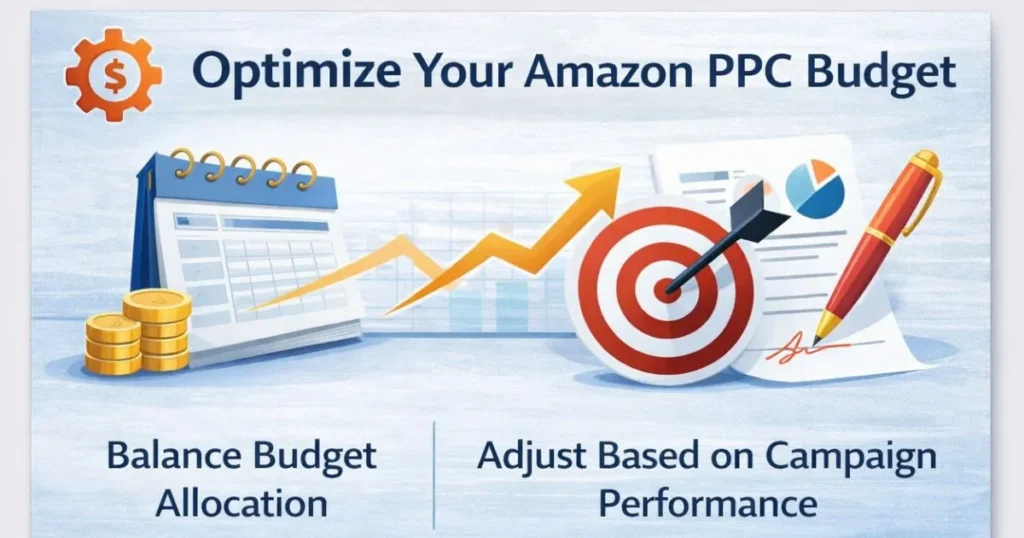
Scaling Amazon ads is not only about increasing bids or adding new keywords. Budget allocation plays a major role in how efficiently campaigns grow. Without a clear budget strategy, profitable campaigns may run out of budget while weaker ones continue to spend unnecessarily. A structured approach to budget management ensures that advertising spend is directed toward campaigns delivering the best results. Proper Amazon ad budget optimization ensures profitable campaigns receive the majority of the advertising investment.
Portfolio Budget Strategy
Using portfolio budgets helps organize campaigns into groups based on their goals or performance. Amazon portfolios allow advertisers to manage multiple campaigns under a shared budget or category.
For example, campaigns can be grouped into branded, non-branded, product-targeting, or keyword-discovery portfolios. This structure makes it easier to track spending patterns and allocate budgets based on each portfolio’s performance. Portfolio management also gives advertisers better visibility into which campaign groups are driving the most sales, making it easier to scale successful segments.
Allocate Budget to Profitable Campaigns
Once high-performing campaigns are identified, they should receive priority in budget allocation. Campaigns that consistently deliver strong conversion rates and maintain a healthy ACoS are ideal candidates for increased investment.Instead of distributing budgets equally, advertisers should focus resources on campaigns already producing reliable results. Increasing budgets for these campaigns can help capture more impressions and sales from high-intent shoppers.
Reduce Budget From Exploratory Campaigns
Exploratory campaigns, such as broad targeting or keyword discovery campaigns, help identify new opportunities. However, they often produce inconsistent results and may generate higher wasted spend. When optimizing budgets for scaling, sellers should review these campaigns and adjust their budgets accordingly. While they remain useful for discovering new keywords, they usually do not require the same level of budget as proven campaigns.
By gradually shifting budget toward high-performing campaigns, sellers can maintain a balanced strategy that supports both discovery and profitability.
Step 5: Lower ACoS While Increasing Volume
Scaling Amazon ads is not only about driving more traffic. The real goal is to increase sales while maintaining strong advertising efficiency. Many sellers focus only on getting more clicks, but if conversion rates and organic rankings are not optimized, more traffic can lead to higher ACoS. A more sustainable strategy is improving the factors that influence conversions and organic visibility. When product listings convert better and rank higher in search results, advertising becomes more efficient. Improving listings is one of the most reliable ways to lower ACoS on Amazon ads while scaling campaigns.
Improve Listing Conversion Rate
A strong conversion rate plays a major role in ad performance. When more visitors become buyers, the same advertising traffic drives more sales, improving overall campaign efficiency. Several listing elements influence conversion rate, including product images, titles, bullet points, pricing, and reviews. High-quality images and clear, benefit-focused descriptions help shoppers quickly understand the product’s value. Optimizing these elements increases the chances that ad traffic will convert into sales.
Improve Organic Ranking
Improving organic ranking also helps lower ACoS during scaling. As products move higher in Amazon search results, they begin to generate more organic traffic alongside paid traffic. Advertising campaigns often support this process because increased sales can signal relevance to Amazon’s algorithm. As rankings improve, organic sales grow, and paid ad dependence decreases.
Monitor TACoS Instead of Only ACoS
While ACoS measures ad spend compared to ad-generated sales, it does not show the full picture. TACoS (Total Advertising Cost of Sale) compares ad spend with total revenue, including both organic and ad-driven sales. When campaigns scale effectively, TACoS often decreases over time as organic sales grow. Tracking TACoS helps sellers understand whether their advertising strategy is supporting long-term business growth.
Advanced Scaling Strategies
Once the basics of Amazon advertising, such as keyword targeting, campaign structure, and budget allocation, are optimized, sellers can start using more advanced scaling strategies. These strategies help expand reach, capture additional high-intent traffic, and strengthen a brand’s competitive position on Amazon. These techniques help advertisers improve Amazon ad performance while expanding campaign reach.Advanced scaling focuses on expanding targeting opportunities while maintaining efficiency. Instead of relying solely on keyword campaigns, advertisers can use a range of targeting methods and ad formats to reach more shoppers and protect their brand presence.
ASIN Targeting Expansion
ASIN targeting allows sellers to place ads directly on competitor product listings or related product pages. This helps reach shoppers who are already comparing similar products and are closer to making a purchase. By targeting competitor ASINs with similar pricing, features, or audiences, sellers can present their products as alternatives. It can be especially effective when a product has better reviews, stronger features, or more competitive pricing. ASIN targeting can also be applied to complementary products, helping advertisers reach shoppers interested in related items.
Defensive Branded Campaigns
Defensive branded campaigns help protect a brand’s visibility in Amazon search results. When shoppers search for brand names or branded product keywords, these campaigns ensure the brand’s ads appear prominently. Without defensive campaigns, competitors may bid on branded keywords and capture potential customers. Running branded campaigns helps maintain control over branded traffic and protects market share.
Sponsored Brands + Sponsored Display Layering
Using multiple ad formats together can increase reach and brand visibility. Combining Sponsored Products, Sponsored Brands, and Sponsored Display ads creates multiple touchpoints throughout the customer journey. Sponsored Brands appear at the top of search results and often lead shoppers to a storefront or product collection. Sponsored Display ads can retarget shoppers who previously viewed similar products, both on and off Amazon.
Dayparting Strategy
Dayparting involves adjusting ad activity based on the time of day when campaigns perform best. By analyzing performance data, advertisers can identify peak hours that generate higher conversions.
For example, bids or budgets can be increased during high-conversion periods and reduced during low-performing hours. Although Amazon has limited built-in dayparting features, many advertisers use performance data and automation tools to apply time-based bid adjustments.
Metrics to Track While Scaling
Scaling Amazon advertising requires continuous performance monitoring. Without tracking the right metrics, it becomes difficult to know whether higher ad spend is improving profitability or simply increasing costs. Monitoring key performance indicators helps sellers understand how efficiently their campaigns are scaling and where adjustments may be needed. Tracking these indicators helps sellers evaluate overall Amazon advertising efficiency during scaling. By regularly analysing campaign data, advertisers can identify performance trends, optimise bidding strategies, and ensure scaling efforts remain profitable.
ACoS
Advertising Cost of Sale (ACoS) measures the percentage of ad spend compared to the revenue generated from ads. A lower ACoS generally indicates better advertising efficiency, as less money is spent to generate each sale. When scaling campaigns, tracking ACoS helps ensure that increasing bids or budgets does not lead to excessive advertising costs. However, ACoS should always be evaluated based on product margins and business goals.
TACoS
Total Advertising Cost of Sale (TACoS) compares total advertising spend with overall product revenue, including both organic and ad-driven sales. Unlike ACoS, TACoS shows how advertising contributes to overall business growth. When campaigns scale effectively, TACoS often decreases as organic sales increase alongside ad-driven sales.
ROAS
Return on Ad Spend (ROAS) measures the revenue generated for every dollar spent on advertising. For example, a ROAS of 4 means that each dollar spent on ads generates four dollars in revenue. Monitoring ROAS helps advertisers identify which campaigns are delivering the best returns and deserve more budget during scaling.
Conversion Rate
Conversion rate measures the percentage of ad clicks that result in purchases. A high conversion rate indicates that the listing aligns with shopper intent and attracts relevant traffic. If conversion rates drop as campaigns scale, it may signal issues with targeting, listing quality, or product competitiveness.
Impression Share
Impression share shows how often an ad appears relative to the total available search results. This metric helps advertisers understand their visibility against competitors. A low impression share may indicate that bids are too low or budgets are limiting exposure. Strategically adjusting bids or budgets can increase visibility and capture more potential sales.
Common Scaling Mistakes to Avoid
Scaling Amazon advertising can drive strong growth when done correctly, but many sellers make mistakes that increase costs and reduce efficiency. These issues usually occur when advertisers focus solely on increasing budgets without improving campaign structure or analysing performance data. Understanding common scaling mistakes helps sellers avoid unnecessary ad spend and maintain better control over campaign profitability.
Scaling Too Fast
One of the most common mistakes is scaling campaigns too quickly. When bids and budgets increase aggressively, campaigns may attract large volumes of traffic that do not convert well. This sudden increase in traffic can expose weaknesses in targeting and keyword selection. Keywords that previously generated a few clicks may start consuming large budgets without producing additional sales, causing ACoS to rise. A better approach is to scale gradually. Small bid increases and controlled budget adjustments allow advertisers to monitor performance and maintain campaign stability.
Ignoring Data Trends
Another mistake is ignoring campaign performance data. Amazon ads generate valuable insights, including impressions, clicks, conversions, and keyword performance. Without regularly analyzing this data, inefficiencies can easily go unnoticed. For example, a keyword that performed well initially may lose effectiveness as competition increases. Monitoring trends helps advertisers identify these changes early and adjust bids or targeting accordingly.
Increasing Budget Instead of Structure
Many sellers believe scaling means increasing campaign budgets. While higher budgets increase exposure, they do not guarantee better performance. If campaigns are poorly structured, such as mixing different match types or combining high-performing and exploratory keywords, larger budgets can lead to more inefficient spending. Improving campaign structure first gives advertisers better control over bids, targeting, and budget allocation, making scaling more effective and predictable.
Conclusion
Scaling Amazon advertising successfully requires more than simply increasing budgets or raising bids. Sustainable growth comes from building a strong campaign structure that allows advertisers to control targeting, bidding, and budget allocation effectively. When campaigns are properly structured, sellers can expand their reach without wasted spend, growing at the same pace. Many sellers struggle with rising advertising costs because they scale before optimizing the core elements of their campaigns. The most effective approach is to scale Amazon ads without increasing wasted spend by focusing first on eliminating inefficiencies, identifying profitable keywords, and organizing campaigns to support controlled growth.
Efficiency should always come before expansion. By auditing search term data, implementing negative keyword strategies, optimizing bids, and allocating budgets strategically, advertisers create a stable foundation for scaling. Once campaigns consistently produce profitable results, increasing bids and budgets becomes far more predictable and sustainable. Ultimately, profitable scaling on Amazon is a continuous process of testing, analyzing data, and refining campaign performance.
Sellers who prioritise efficiency and data-driven optimisation can expand their advertising reach, improve return on ad spend, and achieve long-term growth in an increasingly competitive marketplace. Long-term success requires continuous Amazon PPC campaign optimization and data-driven improvements.
FAQs
How do I scale Amazon PPC without increasing ACoS?
To scale Amazon ads without increasing ACoS, sellers should focus on optimizing campaign efficiency before increasing budgets. This includes analyzing search term reports, removing irrelevant traffic with negative keywords, and identifying high-performing keywords that consistently drive conversions. Once profitable targets are isolated, advertisers can gradually increase bids and budgets for those segments.
Should I increase bids or budgets first?
In most cases, adjusting bids should come before increasing campaign budgets. Bids determine how competitive your ads are in auctions and directly influence ad placement and visibility. If bids are too low, increasing the budget alone may not generate additional impressions or clicks. By first optimizing bids for high-performing keywords and placements, advertisers can ensure their campaigns capture more relevant traffic. Once profitable traffic sources are identified, increasing budgets can help scale those campaigns further.
What is a healthy ACoS while scaling?
A healthy ACoS when you scale Amazon ads depends on your product margins and business goals. Ideally, ACoS should remain below your profit margin. During scaling, it may increase slightly, but the goal is to maintain profitability while growing sales volume.
How do negative keywords reduce wasted ad spend?
Negative keywords help prevent ads from appearing for search queries that are unlikely to generate sales. By blocking irrelevant or low-performing search terms, advertisers ensure their budget is focused on more relevant customer searches. This improves targeting accuracy and reduces clicks from shoppers who are not interested in the product. Over time, a well-managed negative keyword strategy can significantly reduce wasted ad spend and improve overall campaign efficiency.