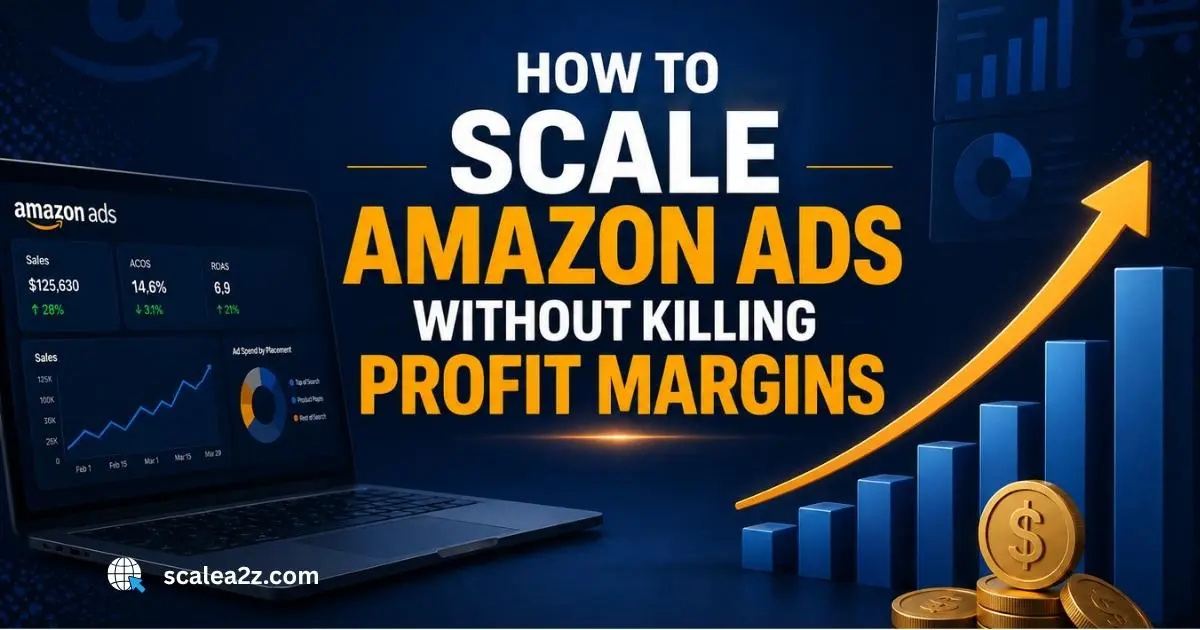
How to Scale Amazon Ads Without Killing Profit Margins
Every Amazon seller reaches a point where they want to grow faster. The obvious move? Spend more on ads. But here is what most sellers discover the hard way — more ad spend does not automatically mean more profit. In fact, scaling the wrong way can quietly destroy your margins while your revenue numbers look great on the surface. The real challenge is not just how to scale Amazon ads, but how to scale Amazon ads without killing profit margins in the process.
This guide breaks down exactly that — from setting profit guardrails and fixing campaign structure to smarter bidding, keyword control, and budget management—everything you need to grow your Amazon PPC profitably.
Table of Contents
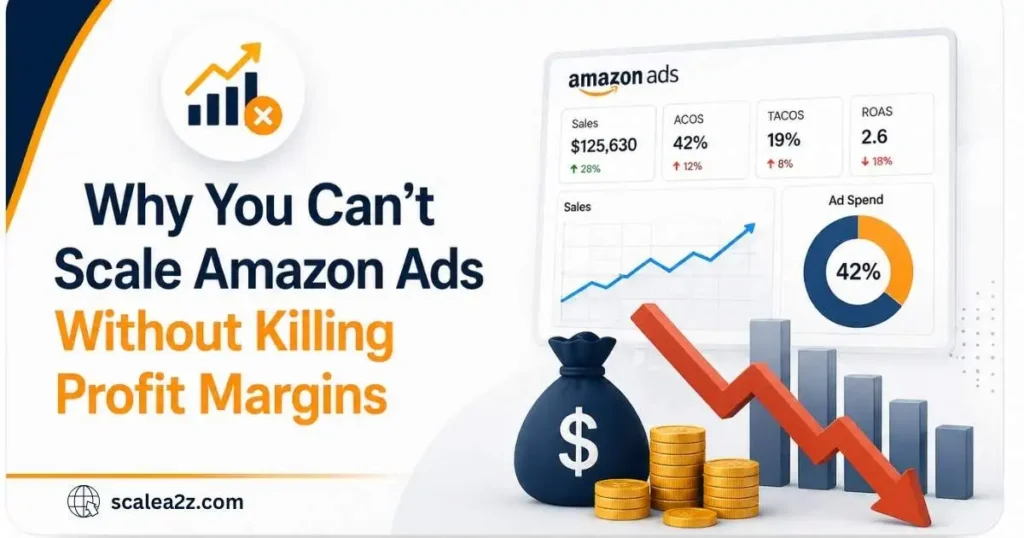
Why You Can’t Scale Amazon Ads Without Killing Profit Margins
Most sellers assume that scaling ad spend will proportionally grow their profits. It rarely works that way.
The Real Reason More Ad Spend Does Not Always Mean More Profit
When you increase your budget without fixing the underlying campaign structure, you are not scaling a profitable system — you are scaling a broken one. Every inefficiency gets amplified. Wasted clicks cost more. Irrelevant keywords eat deeper into your budget. The result is higher revenue on paper and thinner margins in reality.
The Difference Between Revenue Growth and Margin Growth
Revenue and profit are not the same thing. A campaign can generate $50,000 in sales while your actual margin after ad costs, fees, and COGS is barely positive. Sellers often celebrate top-line growth while ignoring that their TACoS is creeping up every single week.
Why Amazon PPC Becomes Expensive at Scale
As you push into broader audiences and higher-volume keywords, competition increases and CPC rises. You start paying more per click for traffic that converts less efficiently than your core terms. Without tight controls, your ACoS climbs fast.
Define Profit Guardrails Before You Scale Anything
Scaling without profit guardrails is like driving fast with no brakes. Before you touch budgets or bids, you need clear numbers in front of you.
Calculate Break-Even ACoS for Every Product
Break-even ACoS is the point where your ad spend equals your profit margin — meaning you are not making or losing money on ads. The formula is simple:
Break-Even ACoS = (Profit Margin / Sale Price) × 100
Every product has a different number. A product with a 30% margin has a break-even ACoS of 30%. If your current ACoS is above that, you are losing money on every ad sale. Know this number before scaling anything.
Set Target ACoS, TACoS, and Minimum Conversion Thresholds
Your target ACoS should sit comfortably below break-even — typically 5 to 10 points lower depending on your growth goals. TACoS tells you how ads are affecting your total business, not just ad-driven sales. Set a maximum TACoS threshold per product and treat it as a hard limit. Also define a minimum conversion rate — if a campaign falls below it, pause before scaling.
Prioritise Products by Contribution Margin, Not Just Sales Volume
High-volume products are not always high-margin products. Before scaling, rank your catalogue by contribution margin — revenue minus COGS, FBA fees, and ad spend. Scale the products that actually make you money first.
Build a Campaign Structure That Can Scale Profitably
A weak campaign structure is the number one reason scaling becomes expensive. Before increasing a single dollar in spend, your structure needs to be clean, logical, and built for control.
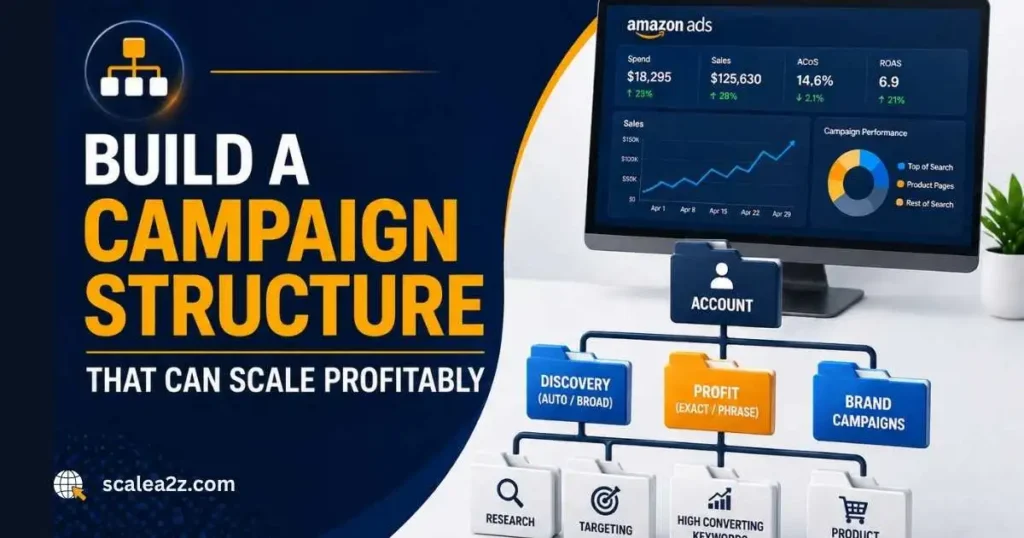
Separate Discovery Campaigns from Profit Campaigns
Discovery campaigns — typically auto or broad match — are for finding new converting search terms. Profit campaigns are where your proven, high-converting keywords live. Mixing both in the same campaign means your budget gets split between exploration and execution. Keep them separate so you always know where your money is going.
Split Branded, Non-Branded, and Product Targeting Campaigns
Branded keywords convert differently from non-branded ones. Product targeting behaves differently from keyword targeting. Lumping them together makes it impossible to control bids or budgets accurately. Split them into dedicated campaigns so each one can be managed and scaled on its own terms.
Use Match Type Isolation for Better Budget Control
Match type isolation means running the same keyword in separate campaigns by match type — broad, phrase, and exact. This gives you full visibility into which match type is actually driving conversions and lets you shift budget toward what is working without the other match types bleeding your spend.
Segment Portfolios by Margin Tier or Product Priority
Use Amazon’s portfolio feature to group campaigns by product margin or priority level. High-margin products get their own portfolio with aggressive budgets. Lower-margin products sit in a controlled portfolio with stricter limits. This makes budget allocation clean and scalable.
Scale Winning Keywords Without Increasing Wasted Spend
Scaling keywords is not about adding more — it is about doubling down on what already works and cutting everything that does not.
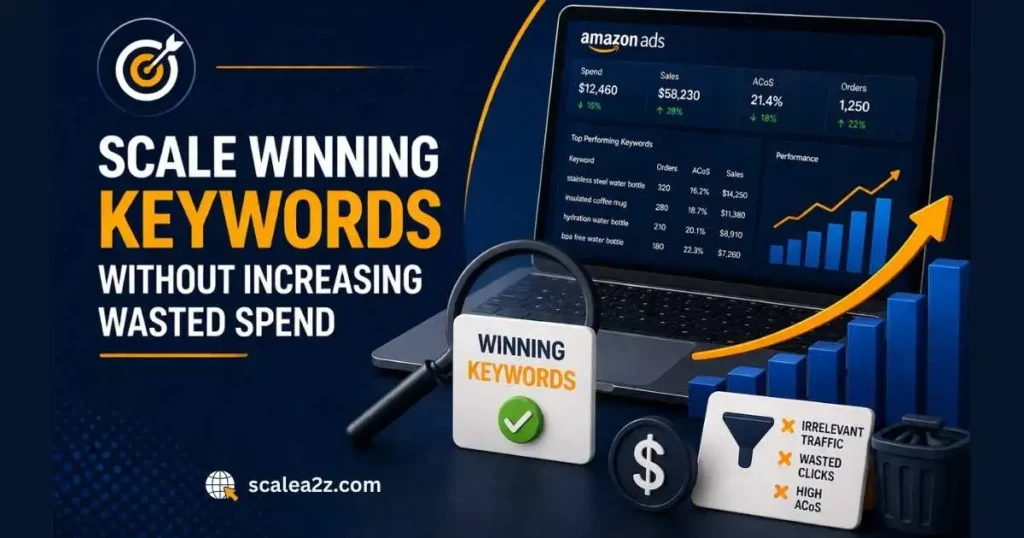
Use Search Term Reports to Identify Profitable Winners
Your Search Term Report is one of the most valuable tools in Amazon PPC. Pull it weekly and filter by conversions, ACoS, and spend. Look for search terms that consistently convert at or below your target ACoS. These are your winners — the ones worth isolating and scaling.
Move Converting Terms from Broad to Phrase to Exact
This is the match type progression every serious seller should follow. Start with broad discovery, move to converting terms into phrases to tighten relevance, then graduate to top performers for an exact match for maximum control. Exact match keywords give you the cleanest data and the most predictable ACoS.
Isolate High-Converting Keywords into Dedicated Campaigns
Once a keyword proves itself, give it its own campaign. This lets you set a specific bid, control its budget independently, and scale it without other keywords interfering. Isolation is what separates structured scaling from guesswork.
Add Negative Keywords to Protect Margin as Spend Grows
As budgets grow, irrelevant clicks grow with them. Regularly mining negatives from your Search Term Report is non-negotiable. Every irrelevant click you block is a margin you keep.
Bid Smarter When You Scale Amazon Ads
To truly scale Amazon ads without killing profit margins, your bidding strategy must focus on efficiency, not aggression. Bidding is where most sellers either protect their margins or destroy them. The goal is not the highest bid — it is the most efficient one.
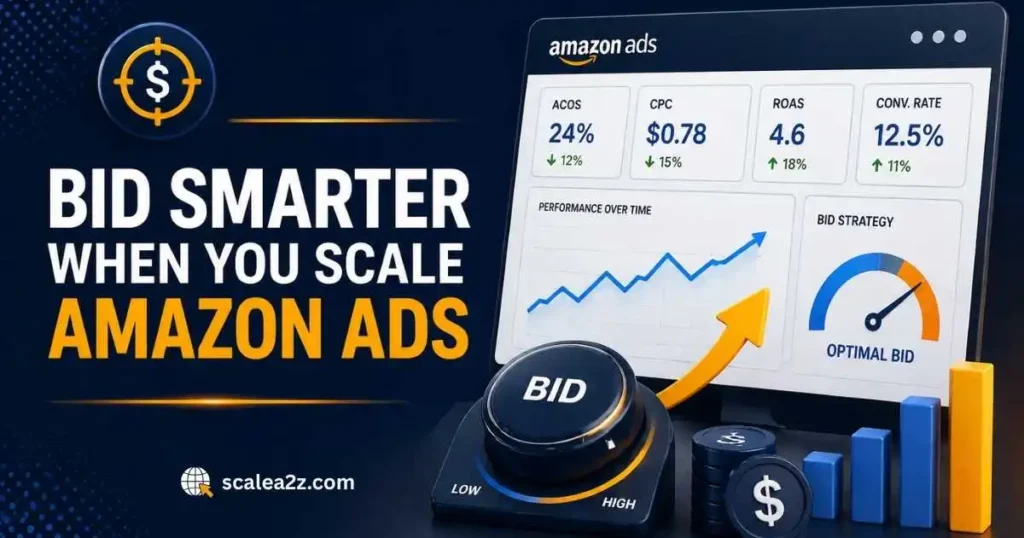
When to Use Dynamic Bids — Down Only
Down Only bidding tells Amazon to lower your bid in real time when a click is less likely to convert. This is the safest option when you are still building data or running campaigns on broad match. It protects your budget from low-quality traffic without requiring constant manual adjustments.
When Up and Down Bidding Makes Sense
Up and down bidding allows Amazon to raise or lower bids based on conversion likelihood. Use this only on well-established campaigns with a strong conversion history. On new or unstable campaigns, Up and Down can spike your CPC fast and quietly inflate your ACoS.
How to Use Placement Adjustments Without Overpaying
Top of search placements convert well but cost more. Before applying a placement multiplier, check your placement reports to confirm that the top of search is actually outperforming other placements for that specific campaign. Apply multipliers only where data supports it — not as a default setting.
Dayparting Strategies to Reduce Unprofitable Spend
Dayparting means running your ads during hours that historically convert better and reducing spend during low-conversion windows. Review your hourly performance data and adjust accordingly. This alone can meaningfully improve efficiency without touching bids.
Bid Changes Should Be Incremental, Not Aggressive
Whether raising or lowering, change bids by 10 to 15 percent at a time. Aggressive bid changes disrupt campaign learning and make it impossible to track what actually caused a performance shift.
Increase Budgets the Right Way to Protect Profit Margins
Throwing more budget at campaigns before they are ready is one of the fastest ways to kill profitability. Budget scaling needs to be deliberate and data-driven.
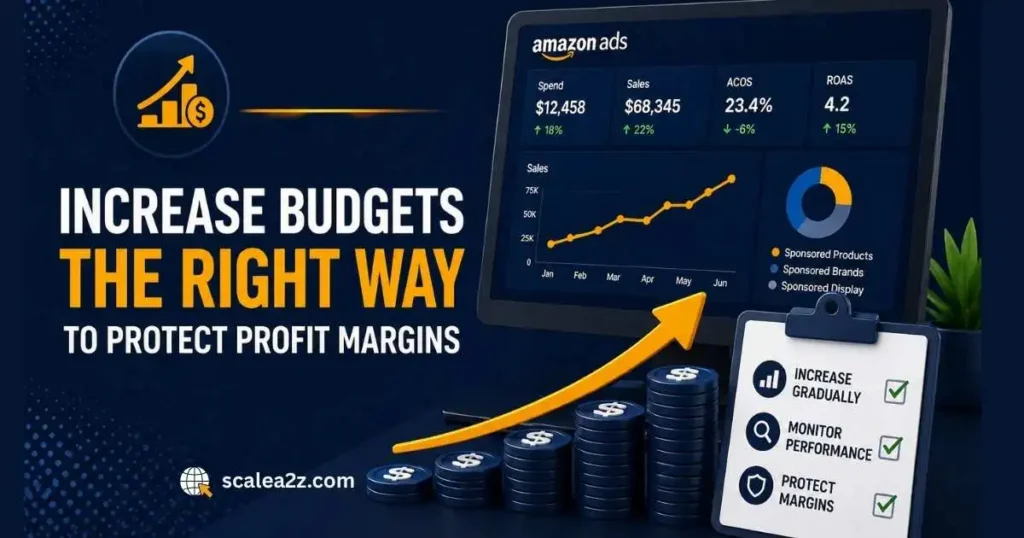
The 10 to 20 Percent Budget Increase Rule
Never increase a campaign budget by more than 10 to 20 percent at a time. A sudden jump disrupts campaign performance, inflates CPC, and makes it nearly impossible to identify what changed. Small, steady increases let you monitor the impact at each step and pull back quickly if margins start slipping.
Scale Budget Only After Stable Conversion Data
Before increasing the budget on any campaign, make sure it has at least two to three weeks of stable conversion data. Scaling a campaign that is still finding its footing will amplify inconsistency, not performance. Stable CVR and a consistent ACoS below your target are the green lights you need.
Shift Budget Toward High-Margin Campaigns First
Not all campaigns deserve equal budget increases. Prioritise campaigns running products with the strongest contribution margins. Scaling a low-margin product just because it has high sales volume will grow your revenue while quietly compressing your profits.
Portfolio Budgets vs Campaign Budgets
Portfolio budgets cap total spend across a group of campaigns, which prevents any single campaign from burning through your daily limit. Campaign-level budgets give more granular control but require more active monitoring. For scaling, use portfolio budgets to manage overall spend limits while using campaign-level budgets to fine-tune individual performance.
Optimize Your Listing Before You Push More Traffic
Sending more ad traffic to a weak listing is like pouring water into a leaking bucket. More clicks will not fix a conversion problem — they will just make it more expensive.
Why Low Conversion Rates Destroy PPC Profitability
When your CVR is low, you are paying for clicks that do not convert. Your ACoS rises, your ROAS drops, and no amount of bid adjustments will fix it. A listing problem will always look like a PPC problem until you fix the root cause.
Improve CTR with Better Main Image and Title
Your main image and title determine whether a shopper clicks at all. A weak image loses the click before the ad even gets a chance. Test your main image regularly and make sure your title leads with the most relevant keyword and the strongest product benefit.
Improve CVR with Better Copy, A+ Content, and Reviews
Once a shopper lands on your listing, your bullet points, A+ content, and reviews close the sale. Thin copy, poor visuals, and low review counts push shoppers away. Fix these before scaling traffic, or your ad spend will keep bleeding.
Metrics You Must Monitor While Scaling Amazon Ads
Scaling without tracking the right numbers is guesswork. These are the metrics that tell you whether your growth is actually profitable.
ACoS vs TACoS vs ROAS — Which Metric Matters Most?
ACoS measures ad efficiency in isolation. TACoS measures how your ad spend affects your total business revenue — including organic sales. ROAS tells you the return generated per dollar spent. When you scale Amazon ads, TACoS is the most honest metric because it captures the full picture, not just ad-attributed sales.
Watch CVR, CPC, and Click Quality Together
A rising CPC is not always a problem if your CVR holds steady. But when CPC climbs, and CVR drops at the same time, your margins are being squeezed from both ends. Monitor these three together as a unit, not in isolation.
Measure Incremental Profit, Not Just Ad Revenue
Ad revenue looks great on dashboards. Incremental profit — what you actually keep after ad spend, COGS, and fees — is what matters. Build a simple weekly tracker that shows net margin per campaign, not just total sales.
How to Tell Whether Scaling Is Actually Working
If TACoS is stable or improving while revenue grows, scaling is working. If TACoS keeps climbing with no organic lift, you are buying revenue, not building profit.
Common Amazon Ads Scaling Mistakes That Kill Profit Margins
Most sellers do not lose margin all at once. It happens gradually through repeated small mistakes that compound over time.
- Scaling Before the Listing Is Conversion-Ready:More traffic to a weak listing means more wasted clicks. If your CVR is below average, fix the listing first. Scaling ad spend on top of a conversion problem only accelerates the loss.
- Raising Bids and Budgets at the Same Time: Changing two variables at once makes it impossible to know which one caused a performance shift. Raise bids first, stabilise, then adjust budgets — or vice versa. Never both together.
- Ignoring Negative Keywords During Expansion: As campaigns grow, irrelevant search terms multiply. Sellers who skip negative keyword maintenance watch their ACoS climb without understanding why. Regular search term audits are not optional at scale — they are essential.
- Scaling Low-Margin Products Like High-Margin Products: Every product has a different margin ceiling. Applying the same aggressive scaling strategy across your entire catalog regardless of margin, is a fast way to grow revenue while shrinking profit.
- Copying Competitor Bids Without Margin Data: What works for a competitor may destroy your margins. Their cost structure, margins, and goals are different from yours. Always base bid decisions on your own data.
A Simple Profit-First Framework to Scale Amazon PPC
Structure before speed. Efficiency before volume. This five-step framework keeps your margins protected at every stage of growth.
Fix Campaign Structure
Before anything else, make sure your campaigns are properly separated — discovery from profit, branded from non-branded, and match types isolated. A clean structure is the foundation on which everything else builds.
Cut Wasted Spend
Pull your Search Term Report and remove every irrelevant, non-converting term. Add negatives aggressively. Every dollar saved from wasted clicks is a dollar available to scale winning campaigns.
Scale Proven Winners Only
Identify your top-performing keywords and campaigns using ACoS, CVR, and conversion volume as filters. Only scale what the data confirms is working. Scaling unproven campaigns burns the budget without building profit.
Increase Budgets Gradually
Follow the 10 to 20 percent rule. Increase budgets incrementally, monitor performance for one to two weeks, then decide the next move. Patience here protects margins.
Track Profit Margins Weekly
Set up a simple weekly review — TACoS, ACoS, CVR, and net margin per campaign. What gets tracked gets managed. Weekly visibility keeps small margin slips from turning into serious losses.
Real Example — Scaling Amazon Ads Without Hurting Margins
Sometimes the clearest way to understand a strategy is to see it applied. Here is a straightforward example of how a seller successfully scaled Amazon ads without sacrificing profit margins.
Starting Point: A seller in the home and kitchen category was spending $8,000 per month on ads with an ACoS of 42% and TACoS creeping up to 19%. Revenue looked healthy, but net margins had dropped below 8%.
Changes Made: The approach was simple. First, a full search term audit removed over 200 irrelevant keywords through negative targeting. Second, bids were reduced incrementally on underperforming campaigns. Third, the budget was reallocated toward three high-margin campaigns that consistently hit below target ACoS.
Result: Within six weeks, ACoS dropped to 27%, TACoS stabilised at 13%, and net margin recovered to 14%. Ad spend actually decreased by 15% while total revenue held steady — proof that scaling Amazon ads profitably is about efficiency, not just volume.
How ScaleA2Z Helps Brands Scale Amazon Ads Profitably
Profitable scaling requires consistent execution — and that is exactly what ScaleA2Z delivers.
- PPC Management Built Around Profit, Not Vanity Metrics: ScaleA2Z manages Amazon PPC campaigns with a clear focus on margin protection and sustainable growth, not just on top-line revenue.
- Smarter Bid Adjustments and Search Term Analysis: Using AI-driven data analysis, ScaleA2Z handles bid adjustments and search term optimisation to improve campaign efficiency continuously.
- Scaling Strategy Based on Margin, Conversion, and Growth Goals: Every scaling decision is guided by your actual margin data and conversion performance — not assumptions.
Start Scaling Amazon Ads the Right Way
The goal was never just to scale Amazon ads — it is to scale Amazon ads without killing profit margins, consistently and predictably. Efficiency first. Then volume. Winning keywords, clean campaign structure, and solid margin guardrails are what separate profitable growth from expensive guesswork.
If you are ready to scale without watching your margins disappear, ScaleA2Z can help. Our team manages Amazon PPC with a profit-first approach — from campaign structure and bid management to full account optimization. Because at the end of the day, scaling Amazon ads without killing profit margins is what separates sustainable brands from struggling sellers.
Get a free Amazon PPC audit from ScaleA2Z today.
Frequently Asked Questions
How do I scale Amazon ads without increasing ACoS?
If you want to scale Amazon ads without killing profit margins, start by fixing your campaign structure and cutting wasted spend through negative keywords. Only scale campaigns that are already hitting below your target ACoS. Increase budgets gradually using the 10 to 20 percent rule and monitor performance weekly. Scaling on top of an already efficient campaign is how you grow without ACoS climbing with you.
What is a good ACoS for scaling Amazon PPC?
A good ACoS depends on your product margin. The safest benchmark is keeping ACoS 5 to 10 points below your break-even ACoS. For example, if your break-even ACoS is 35%, aim to scale at 25 to 30%. Products with higher margins can tolerate a higher ACoS — products with thin margins cannot.
How much should I increase my Amazon ad budget at once?
Never increase a campaign budget by more than 10 to 20 percent at a time. Larger jumps disrupt campaign learning, inflate CPC, and make performance changes difficult to diagnose. Small incremental increases with a one to two week monitoring window between each adjustment is the safest and most effective approach.
What is TACoS, and why is it important for profitable scaling?
TACoS — Total Advertising Cost of Sale — measures your ad spend as a percentage of total revenue, including organic sales. Unlike ACoS, TACoS shows the true impact of your ad spend on your entire business. A rising TACoS with no organic growth is a clear warning sign that your scaling is not sustainable.
Should I scale all Amazon campaigns at the same time?
No. Scale only campaigns that have stable conversion data and are hitting below your target ACoS. Scaling all campaigns simultaneously spreads budget across both winners and underperformers, which dilutes results and compresses margins.
How do I know whether my Amazon ads are profitable at scale?
Track TACoS, net margin per campaign, and incremental profit weekly — not just ad revenue. If TACoS is stable or declining while revenue grows and net margins hold, your scaling strategy is working.