The 90-Day Amazon Growth Plan We Use for Every Brand
Most Amazon brands do not fail because they lack effort. They fail because they lack a structured growth system. You may already be running Sponsored Products, adjusting bids, adding keywords, testing budgets, and watching reports every week. But if your ACoS keeps rising, ROAS keeps fluctuating, and the listing conversion rate stays weak, the problem is usually not activity. The problem is the sequence.
That is why we use a structured Amazon growth plan for every brand we manage at ScaleA2Z. It is not a random checklist or a collection of disconnected PPC tasks. It is a 90-day roadmap that starts by diagnosing what is broken, fixes the foundation, builds a profitable advertising system, and then scales based on data instead of guesswork.
In this blog, we will break down the exact 90-day process: how we audit an account, how we build a PPC system, which metrics matter at each stage, when to scale, and what mistakes usually stop growth before Day 60.
Table of Contents
What is an Amazon Growth Plan?
An Amazon growth plan includes three major stages audit, optimization, and scaling. In the first 30 days, the goal is to understand the account, clean up wasted spend, review listing quality, and establish baseline metrics.
In the next 30 days, the focus shifts to campaign structure, keyword research, negative keywords, bid optimization, ACoS, TACoS, and CPC trends. In the final 30 days, the account is ready for controlled scaling through profitable campaigns, Sponsored Brands, display ads, ROAS-led budget reallocation, and ongoing conversion improvements.
Why Most Amazon Brands Never See Consistent Growth
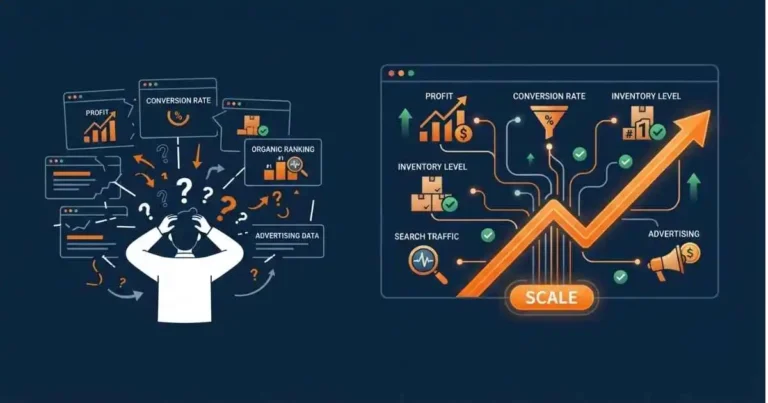
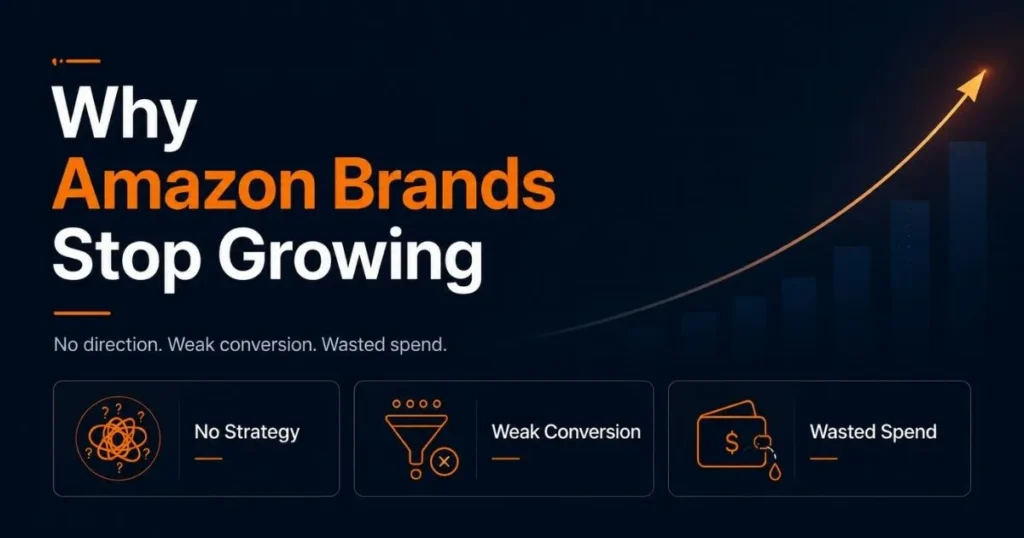
Inconsistent Amazon growth is rarely caused by one single problem. It is usually caused by several small problems working together: weak listing conversion, messy campaigns, unclear keyword targeting, wasted ad spend, unstable inventory, and no clear reporting rhythm.
Many sellers follow the same reactive pattern. Sales drop, so they increase ad spend. ACoS rises, so they pause campaigns. A competitor moves up in search results, so they add more keywords. A product slows down, so they discount without checking whether the issue is traffic, conversion, pricing, or reviews. That is not an Amazon seller growth strategy. That is a daily reaction.
Doing More Without a Direction Does Not Scale
Doing more work inside Seller Central does not always mean the account is moving forward. In many cases, more activity creates more noise.
Here is what unfocused account activity often looks like:
- Campaigns are paused and relaunched based on short-term panic.
- Bids are changed before enough conversion data is available.
- New keywords are added before existing keywords are evaluated.
- Budgets are moved without a clear profitability target.
- Listings are left untouched even when traffic is not converting.
- Search term reports are downloaded but not used to make decisions.
- Branded and non-branded campaigns compete with each other.
- Ranking campaigns and profitability campaigns are treated the same.
Each of these actions may feel useful at the moment. But without a framework, they do not compound. The account keeps moving, but it does not build momentum.
What a Real Amazon Growth Plan Looks Like
A real Amazon growth plan is not a longer to-do list. It is a sequence of decisions. It starts with a full account audit because you cannot fix what you have not diagnosed. Then it moves into listing and conversion readiness, campaign structure cleanup, keyword mapping, bid optimization, and only then controlled scaling. Every action is connected to the phase before it.
That sequence matters. If you scale ad spend before fixing conversion rate, you simply pay more for the same weak result. If you build new campaigns before cleaning old ones, you spread budget across a messy structure. If you chase low ACoS without watching TACoS, you may improve campaign efficiency while total account growth stays flat. Brands that grow consistently do not just work harder. They operate from a clear system.
The 90-Day Amazon Advertising Roadmap Behind Our Growth Framework
Every brand we onboard goes through the same 90-day roadmap. The details change based on product category, margins, competition, review profile, catalog size, and budget. But the order stays the same.
The reason is simple: most Amazon accounts do not need more aggressive scaling first. They need a cleaner foundation. A strong PPC strategy at Day 60 depends on the audit and cleanup completed in the first 30 days. If the data going into the strategy is messy, the decisions coming out of it will also be messy.
The 3-Phase Framework Behind Every Brand We Manage
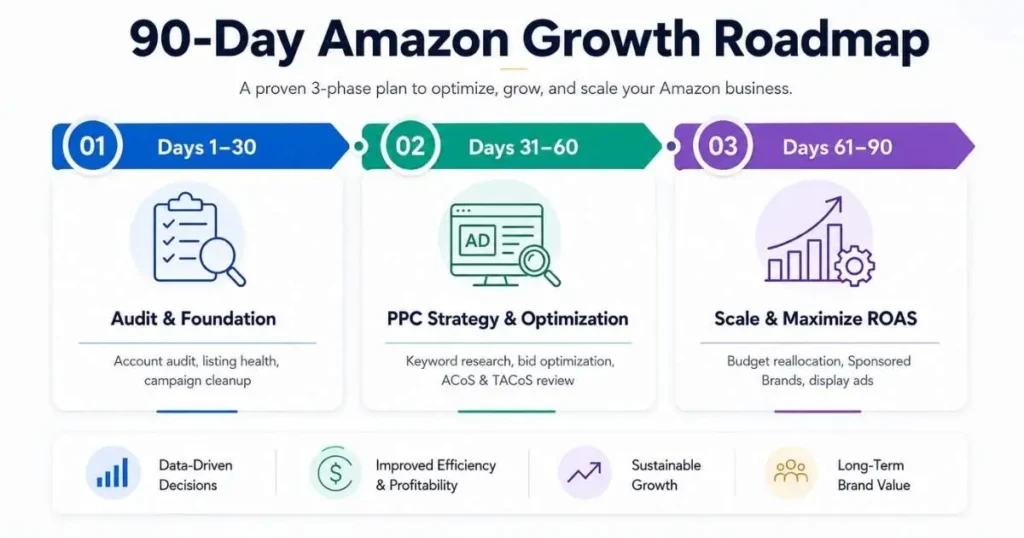
| Phase | Days | Main Focus | Main Outcome |
|---|---|---|---|
| Phase 1 | Days 1–30 | Audit, fix, and build the foundation | Cleaner account and reliable baseline data |
| Phase 2 | Days 31–60 | PPC strategy, keyword control, and bid optimization | Lower waste and stronger targeting efficiency |
| Phase 3 | Days 61–90 | Scaling, budget reallocation, and brand growth | Better ROAS and controlled growth momentum |
Each phase has a different job. Phase 1 is about clarity. Phase 2 is about efficiency. Phase 3 is about scale.
The mistake many brands make is trying to do all three at once. That makes performance harder to read because you no longer know which action caused which result.
Why 90 Days Is the Right Window for Measurable Results
Ninety days gives an Amazon account enough time to move from assumptions to patterns. In the first 30 days, you collect baseline data. This includes ACoS, TACoS, ROAS, CTR, CVR, CPC, keyword performance, listing conversion, and inventory readiness. These numbers show where the account stands before serious optimization begins.
In the second 30 days, you start improving the system. That includes keyword mapping, negative keyword cleanup, match type control, bid optimization, and budget allocation based on actual performance data.
In the final 30 days, you scale what has earned more budget. This is where you increase spending on campaigns with stable conversion, improve Sponsored Brands and display coverage, and reallocate budget toward the strongest growth opportunities.
Some brands see early movement within the first few weeks, especially when wasted spend is removed, or listing issues are fixed. But meaningful trends in TACoS, ROAS, and organic visibility usually need more time.
Phase 1- Audit, Fix & Build the Foundation
Phase 1 is the least glamorous part of growth, but it is the most important. It is where the account stops guessing and starts showing the truth.
Before increasing spend, launching new campaigns, or expanding keywords, we need to know where the current system is leaking money. That means reviewing PPC, listings, creative assets, pricing, Buy Box, inventory, search terms, keyword rankings, and account health.
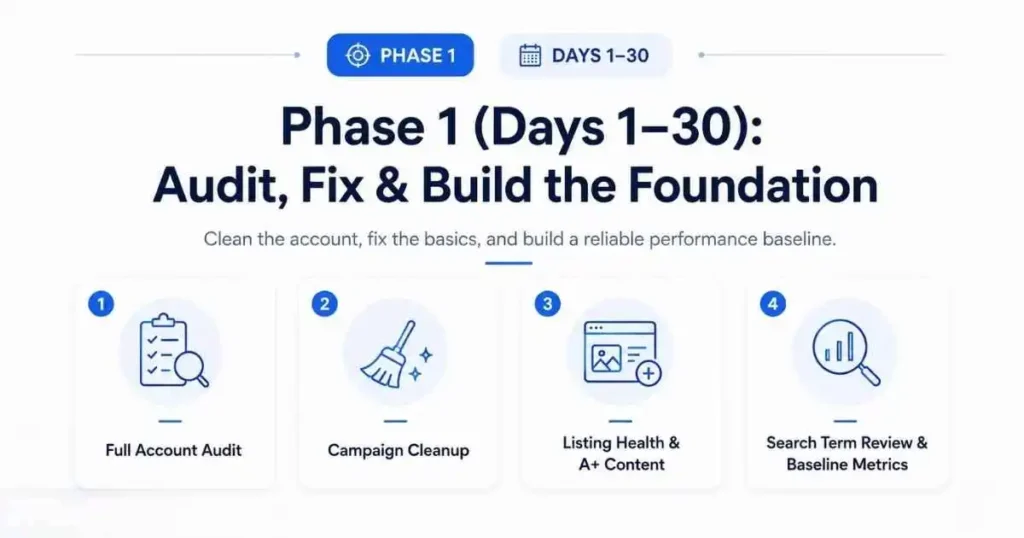
Full Account Audit
A full account audit looks beyond campaign-level ACoS. The goal is to understand why the account is performing the way it is.
We review:
- Ad spend waste: search terms and targets receiving spend without a profitable return.
- High ACoS campaigns: campaigns running above margin without a strategic reason.
- Low CTR products: listings that are visible but not earning enough clicks.
- Low CVR listings: products getting traffic but failing to convert.
- Campaign structure issues: naming, grouping, match type overlap, and budget confusion.
- Search term report quality: converting terms, irrelevant queries, and negative keyword opportunities.
- Creative weaknesses: main images, secondary images, infographics, video, and A+ Content gaps.
- Pricing issues: whether the price is aligned with category expectations and competitor positioning.
- Buy Box stability: whether ads are driving traffic to listings that can actually convert.
- Inventory risk: whether the account has enough stock to support future scaling.
In many audits, wasted search-term spend is one of the first issues we uncover. Money is often spent on terms that do not match buyer intent or have not produced meaningful sales. That is why Phase 1 is not optional. It shows what needs to be fixed before more budget is added.
Cleaning Up Campaign Structure Before Spending More
Once the audit is complete, the next step is campaign structure cleanup. This does not mean rebuilding everything blindly. It means organizing the account so performance becomes easier to read and easier to optimize.
The cleanup usually includes:
- Separating branded and non-branded campaigns.
- Separating auto discovery campaigns from manual control campaigns.
- Grouping SKUs logically instead of mixing unrelated products.
- Moving proven search terms from auto campaigns into manual campaigns.
- Separating exact, phrase, and broad match where budget control matters.
- Adding negative keywords to reduce overlap and wasted spend.
- Cleaning naming conventions so weekly optimization becomes faster.
- Identifying campaigns that should be paused, merged, rebuilt, or isolated.
The goal is not complexity. The goal is control. A clean campaign structure allows you to understand which keywords are driving sales, which terms are wasting money, which SKUs deserve more budget, and which campaigns are supporting ranking versus profitability.
If you want expert help with campaign cleanup, keyword targeting, and bid optimization, explore our Amazon PPC Management services.
Listing Health, A+ Content & Buy Box Check
PPC cannot fix a weak listing. It can only send more traffic to it.
Before Phase 2 begins, every product receiving ad spend should be checked for conversion readiness. That includes:
- Main image: Is it clear, mobile-friendly, and competitive in search results?
- Title: Does it include important keywords naturally without keyword stuffing?
- Bullet points: Do they explain benefits, use cases, objections, and buying triggers?
- Backend search terms: Are they relevant, complete, and non-repetitive?
- A+ Content: Does it communicate trust, differentiation, and product value visually?
- Review profile: Is the rating strong enough to support paid traffic?
- Price: Is the product competitively positioned against similar offers?
- Buy Box: Is the listing eligible and stable enough to receive traffic?
- Inventory: Is there enough stock to support future scaling?
If the conversion rate is materially below the category benchmark, more ad spend will not solve the underlying problem. The listing needs attention first.
For products with weak creative assets, Phase 1 should include image optimization, A+ Content planning, and copy improvements before aggressive PPC expansion begins. Our Amazon Creatives team handles this end to end.
Phase 1 Deliverables
- Full account audit report
- Listing health score per priority ASIN
- PPC waste map
- ACoS, CTR, CVR, and CPC baseline
- Search term report review
- Campaign cleanup recommendations
- First 30-day priority action list
Phase 2- Build Your Amazon PPC Strategy
Phase 2 is where the account moves from cleanup to controlled optimization. The foundation is clearer, the baseline metrics are documented, and the next goal is to build a profitable Amazon PPC strategy around keyword efficiency and budget control.
Amazon Advertising describes Sponsored Products as ads that help promote products, increase sales, and improve visibility. Sponsored Products also connect clicks to product detail pages, which makes campaign structure critical for growth planning.
Keyword Research & Budget Allocation by Match Type
Keyword research is not just about finding more keywords. It is about deciding which keywords deserve a budget, which should be tested, and which should be blocked.
A structured approach usually separates keywords by role:
- Exact match: for proven, high-intent terms that deserve stronger budget control.
- Phrase match: for controlled expansion and close variations.
- Broad match: for discovery, not uncontrolled scaling.
- Auto campaigns: for ongoing search term harvesting with capped budgets.
- Product targeting: for competitor ASINs, category placements, and brand defense.
- Branded campaigns: for protecting your own search demand.
- Non-branded campaigns: for acquiring new customers and expanding reach.
The budget split should follow the role of each campaign. Proven converters should receive a more stable budget. Discovery campaigns should be controlled. Ranking campaigns should be measured differently from profitability campaigns.
This is where Amazon PPC optimization becomes a weekly discipline. You review search term reports, add negative keywords, adjust bids based on CPC and conversion data, and shift budget toward campaigns that support profitable growth.
ACoS & TACoS Benchmarking in the First 60 Days
By Day 60, the account should have enough data to compare performance against realistic targets. ACoS measures the relationship between ad spend and ad revenue, while ROAS helps evaluate the return generated from advertising spend; both are useful, but neither should be read alone.
The benchmarking process should include:
- Target ACoS: the ACoS level you want based on margin and growth goals.
- Break-even ACoS: the point where advertising cost equals profit margin.
- TACoS trend: whether paid ads are supporting total account revenue or creating dependency.
- ROAS trend: whether campaigns are producing a profitable return.
- CPC movement: whether competition is becoming more expensive.
- CVR movement: whether listing improvements are improving paid traffic efficiency.
A low ACoS is not always good. If ACoS is low because campaigns are too conservative, the brand may be missing growth. A higher ACoS may be acceptable during launch, ranking, or category expansion if TACoS and total revenue are moving in the right direction.
That is why professional PPC management does not chase one metric. It reads metrics together.
Bid Optimization Cycles- How Often and How Much
Bid optimization should be consistent, but not impulsive.
A healthy cycle usually includes:
- Reviewing performance every 7 days.
- Waiting for enough clicks before judging a keyword.
- Reducing bids on high-spend targets with weak conversion.
- Increasing bids on keywords with stable CVR and acceptable ACoS.
- Watching CPC trends before increasing daily budgets.
- Adding negatives when search terms show irrelevant intent.
- Avoiding dramatic bid changes that distort the data.
Most accounts do not need daily bid panic. They need a repeatable weekly rhythm. Small, disciplined adjustments create better learning than aggressive changes. Phase 2 is about building control. Phase 3 is where that control turns into scale.
Phase 2 Deliverables
- Keyword map by match type
- Negative keyword list
- Budget allocation plan
- Bid optimization log
- ACoS and TACoS benchmark sheet
- Keyword efficiency report
- Weekly PPC action summary
Phase 3- Scale Your Amazon Brand & Maximize ROAS
Phase 3 is where you scale your Amazon brand, but only after the account has earned that right.
This is the biggest difference between smart scaling and reckless spending. Not every campaign receives more budget. Not every keyword gets a bid increase. Scaling should follow proof.
Scaling Sponsored Brands & Display Ads
Once Sponsored Products are cleaner and more efficient, it becomes easier to expand into brand-building and retargeting formats.
Amazon Advertising explains that Sponsored Brands can help shoppers discover a brand through video, image, or product collections, while display ads, formerly known as Sponsored Display, can help advertisers reach shoppers across the buying journey.
In Phase 3, these formats can be used for:
- Sponsored Brands video campaigns.
- Sponsored Brands product collection campaigns.
- Storefront traffic campaigns.
- Product detail page targeting.
- Retargeting shoppers who viewed but did not purchase.
- Brand defense campaigns around your own ASINs.
- Competitor conquesting where margin and conversion support it.
These campaigns should not replace Sponsored Products. They should support the wider funnel. Sponsored Products often capture high-intent demand. Sponsored Brands can improve discovery. The Display can support retargeting and additional touchpoints.
When these campaign types work together, the account has a better chance of improving CTR, CVR, ROAS, and total revenue without relying on one ad type alone.
ROAS-Driven Budget Reallocation
Phase 3 budget decisions should be based on performance, not comfort.
This means moving the budget away from campaigns that have consumed spend without return and toward campaigns with stronger evidence of performance. It also means separating campaign goals.
For example:
- A profitability campaign should be judged mainly against target ACoS and ROAS.
- A ranking campaign may tolerate higher short-term ACoS if organic rank improves.
- A branded defense campaign should protect existing demand at an efficient cost.
- A discovery campaign should be capped and judged by the quality of harvested terms.
The goal of Amazon’s brand scaling is not to spend the most. It is to grow without letting advertising dependency damage profitability.
That is why TACoS remains important in Phase 3. If revenue grows but TACoS rises sharply, the account may simply be buying more sales. If revenue grows while TACoS stays stable or improves, the account is more likely to be building healthier momentum.
When to Push Spend — and When to Pull Back
Scaling requires discipline. Sometimes the best growth decision is to increase the budget. Other times, the best decision is to slow down before the account becomes inefficient.
Push spend when:
- CVR has been stable for at least two weeks.
- TACoS is stable or trending in the right direction.
- ROAS is consistently above the target threshold.
- Inventory levels can support more demand.
- Buy Box ownership is stable.
- Reviews and ratings are strong enough to support conversion.
- Winning keywords have enough search volume to absorb more budget.
Pull back when:
- CPC rises while CVR drops.
- Inventory is too low to support ranking gains.
- Review rating declines and starts hurting conversion.
- TACoS rises without organic rank improvement.
- Campaigns generate clicks but not profitable sales.
- Budget increases create spend growth without account-level revenue growth.
Phase 3 is not about aggressive spending. It is about controlled expansion.
Phase 3 Deliverables
- Scaling campaign list
- Paused and trimmed campaign list
- ROAS and TACoS trend review
- Budget reallocation plan
- Display and Sponsored Brands expansion plan
- 90-day performance summary
- Next-quarter growth roadmap
Key Metrics to Track at Each Phase of the Plan
Every phase of this Amazon growth plan requires different measurement priorities. If you judge every phase by the same metric, you may make the wrong decision at the wrong time.
In the first 30 days, you need baselines. In the second 30 days, you need efficiency signals. In the final 30 days, you need scaling indicators.
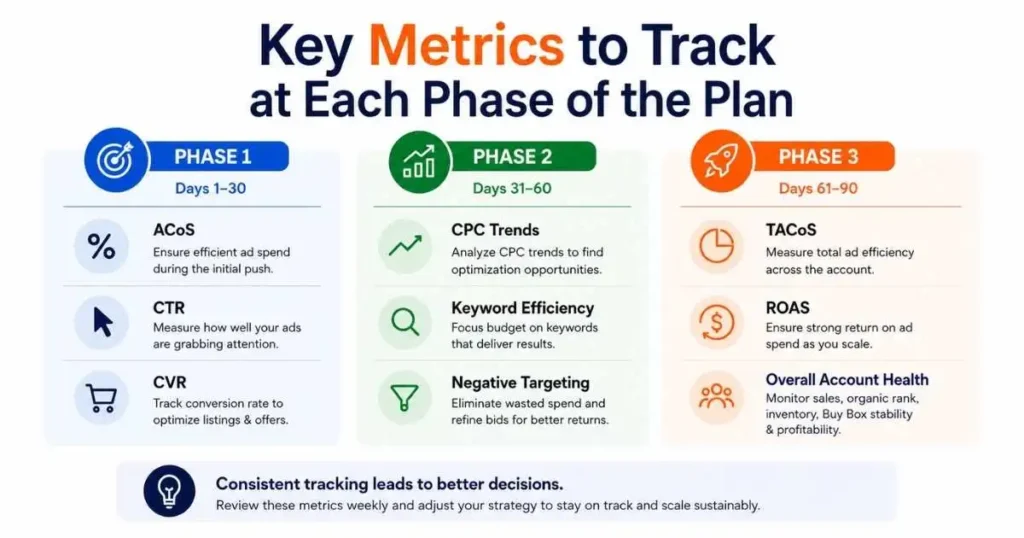
Baseline ACoS, CVR & CTR
During Phase 1, the goal is not to make the account look perfect. The goal is to understand where it stands.
Track:
- ACoS: how efficiently current ad spend is producing revenue.
- CTR: whether your image, price, rating, and title are earning clicks.
- CVR: whether product detail pages are converting the traffic they receive.
- CPC: What are you paying for traffic in the current category environment
- Search term quality: whether traffic is relevant or wasteful.
CTR often points to the first visual problem. CVR points to the listing and the offer problem. ACoS tells you whether the current ad system is efficient enough to support growth.
CPC Trends & Keyword Efficiency
During Phase 2, the account is actively being optimized. That means keyword-level performance matters more.
Track:
- Which keywords generate clicks but fail to produce sales
- Which keywords generate sales at an acceptable ACoS
- Which search terms should be moved into exact match campaigns
- Which search terms should be added as negative keywords
- Which match types deserve more or less budget
- Whether CPC is rising faster than the conversion rate
This is where weak keywords are removed, and strong keywords become more controlled. The goal is not just more traffic. The goal is better traffic.
TACoS, ROAS & Overall Account Health
During Phase 3, account-level health becomes more important.
Track:
- TACoS: whether advertising spend is supporting total revenue efficiently.
- ROAS: Which campaigns produce the best return.
- Total revenue: whether the account is actually growing, not just shifting revenue between paid and organic.
- Organic rank: whether PPC is helping with broader visibility.
- Inventory health: whether stock can support scaling.
- Buy Box stability: whether traffic is being sent to a listing that can convert.
- Profitability: whether growth is improving the margin or only increasing sales volume.
This is where many brands make bad decisions. They celebrate more sales without checking whether profit has improved. A proper growth plan tracks both.
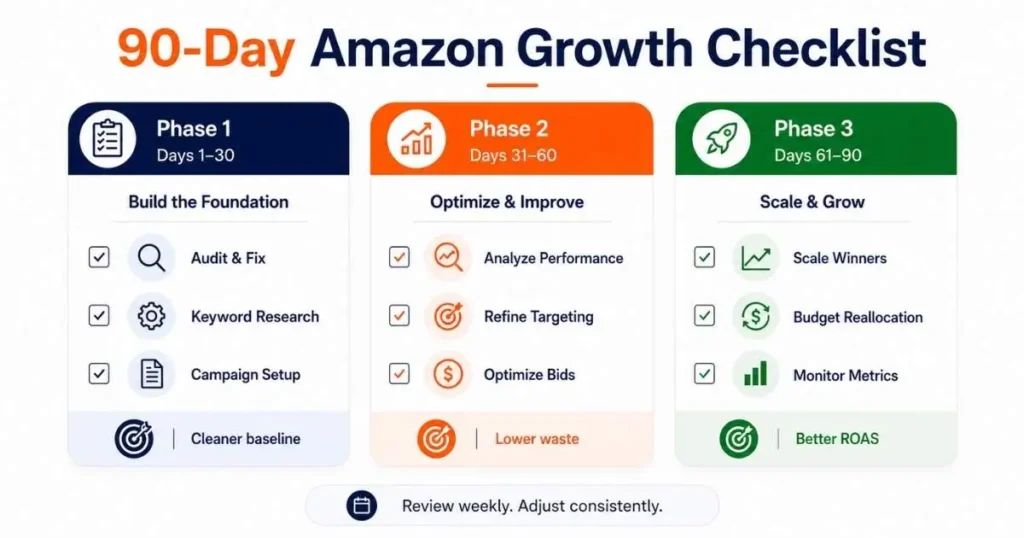
90-Day Amazon Growth Checklist
Use this checklist as a simplified version of the framework.
Days 1–30 Checklist
- Pull campaign performance reports.
- Review search term reports.
- Identify wasted spend.
- Check ACoS, CTR, CVR, CPC, and TACoS baselines.
- Review listing titles, bullets, images, and A+ Content.
- Check Buy Box, inventory, pricing, and reviews.
- Clean campaign naming and structure.
- Build the first 30-day priority roadmap.
Days 31–60 Checklist
- Build a keyword map.
- Separate match types where needed.
- Add negative keywords.
- Move proven search terms into manual campaigns.
- Review CPC and bid efficiency.
- Benchmark target ACoS and break-even ACoS.
- Check TACoS movement against total revenue.
- Run weekly bid optimization cycles.
Days 61–90 Checklist
- Increase the budget only on proven campaigns.
- Expand Sponsored Brands where the brand is ready.
- Test display ads for retargeting and additional reach.
- Reallocate budget by ROAS and margin.
- Review organic rank movement.
- Monitor inventory before scaling.
- Trim weak campaigns.
- Build the next-quarter roadmap.
This checklist keeps execution organized.
Mistakes That Derail an Amazon Growth Plan Before Day 60
Most Amazon growth failures are sequencing failures. Brands do the right activities, but in the wrong order. Here are the mistakes that usually cause the biggest problems.
1- Skipping the Audit Phase Entirely
Scaling without an audit does not speed up growth. It speeds up waste. If the account already has irrelevant search terms, overlapping campaigns, weak listings, and poor keyword control, increasing the budget makes every issue more expensive. The audit phase exists to prevent that.
A clean audit tells you what to keep, what to pause, what to rebuild, and what to test next. Without it, Phase 2 becomes guesswork.
2- Scaling Ad Spend Before Fixing Conversion Rate
More traffic does not fix a listing that shoppers do not trust. If the conversion rate is significantly below category expectations, the product detail page should be reviewed before ad spend increases. That may include the main image, title, bullets, price, reviews, comparison images, A+ Content, coupon strategy, or offer positioning.
A weak Amazon launch strategy often fails for the same reason. Brands push traffic before the product page is ready to convert that traffic.
3- Ignoring TACoS While Chasing ACoS
ACoS is useful, but it is not the whole story. A campaign can show a strong ACoS while total account growth remains flat. That usually means the campaign is efficient inside its own report, but the broader business is not becoming less dependent on paid traffic.
TACoS helps show whether advertising is contributing to total account growth. If TACoS improves while revenue grows, the account is usually getting healthier. If TACoS climbs while revenue grows, the brand may be buying sales without building long-term momentum.
ACoS tells you about efficiency. TACoS tells you whether advertising is helping the whole account grow. Never optimize one while ignoring the other.
How ScaleA2Z Runs This Amazon Account Management Plan for Every Client
ScaleA2Z’s full-account approach is built around the same 90-day structure: diagnose, optimize, then scale.
This is not a set-it-and-forget-it service. Every account needs a weekly review, monthly strategy adjustment, creative testing, keyword expansion, and profitability monitoring. What works in Week 4 may need to be adjusted by Week 8 as competition, CPC, inventory, and conversion rates change.
What Our Onboarding Looks Like in the First 30 Days
When a new brand joins ScaleA2Z, the first 30 days focus on clarity.
The onboarding process includes:
- Account access and permission setup.
- PPC performance audit.
- Listing and creative review.
- Keyword and search term analysis.
- ACoS, TACoS, ROAS, CTR, CVR, and CPC baseline.
- Campaign structure review.
- Category and competitor review.
- Listing health recommendations.
- First 90-day action roadmap.
At this stage, we do not start by spending more money. We start by understanding where the current money is going and why.
That is what separates full Amazon account management from simple ad management. Running ads is one part of the system. Managing growth means connecting ads with listing quality, inventory, pricing, creative assets, catalog health, and profitability.
Ongoing Optimization Beyond Day 90
Day 90 is not the finish line. It is the point where the account should be cleaner, better organized, and ready for long-term growth.
Beyond the first 90 days, ongoing work includes:
- Weekly bid and keyword optimization.
- Monthly KPI and strategy reviews.
- Creative refresh planning.
- A+ Content updates when needed.
- Keyword expansion based on new search term data.
- Inventory and catalog coordination.
- Scaling winning campaigns.
- Trimming weak campaigns.
- Profitability review across priority ASINs.
The brands that continue growing after 90 days are usually the brands that keep the rhythm. They do not return to random changes. They keep improving the system.
When you want to scale your Amazon brand beyond the first growth phase, consistency becomes an advantage.
Want us to review your Amazon account? Get a free audit from ScaleA2Z.
Conclusion
Amazon’s growth does not come from doing more random tasks. It comes from doing the right work in the right order. The 90-day roadmap above follows a clear sequence. Phase 1 removes what is broken. Phase 2 builds what works. Phase 3 scales what is proven. When brands skip ahead, they often multiply their existing problems. When they follow the sequence, every action becomes easier to measure and improve.
A structured Amazon growth plan gives your brand more than a marketing plan. It gives your team an operating system for better decisions: when to spend, when to pause, when to fix conversion, when to scale, and when to protect profitability.
If you want to see what this process would look like for your account, ScaleA2Z can review your current PPC structure, listings, ACoS, TACoS, ROAS, and conversion gaps — then show you what the next 90 days should prioritize.
Frequently Asked Questions
What is an Amazon growth plan, and why does it matter?
It is a structured, phase-based roadmap that moves a brand from account diagnosis to controlled scaling. It matters because random optimization rarely produces consistent growth. A clear plan makes sure every action builds on the one before it.
How long does it take to see results from an Amazon PPC strategy?
Early indicators may appear in the first few weeks, especially when wasted spend is removed, or obvious listing issues are fixed. More meaningful trends in ROAS, TACoS, and organic visibility usually take 60–90 days, as PPC performance depends on data volume, conversion rate, and repeated optimization cycles.
Can I implement this 90-day plan myself, or do I need an agency?
You can handle parts of it yourself if you understand Seller Central, campaign reporting, keyword analysis, and listing optimization. The harder part is consistent execution. Many brand owners know what should be done but lack the time, systems, or category-level context to review the account weekly.
What ACoS should I target in the first 30 days?
There is no universal target. Your target ACoS depends on margin, category CPC, pricing, growth stage, and whether the campaign is built for ranking or profitability. The first step is to calculate break-even ACoS, then establish an account baseline before making aggressive changes.
How does Amazon account management differ from just running ads?
Full Amazon account management covers the account ecosystem: PPC, listings, creative assets, inventory, pricing, Buy Box, catalog health, reporting, and profitability. Running ads is only one part. A full management approach makes sure PPC performance is not weakened by problems elsewhere in the account.
What happens after the first 90 days are complete?
After the first 90 days, the account should have cleaner campaigns, stronger keyword control, better reporting, and clearer scaling rules. The next stage focuses on compounding growth through creative testing, keyword expansion, improved organic visibility, budget reallocation, and ongoing profitability management.