How Fixing Amazon PPC Structure Increased Profit by 47%
Most Amazon sellers blame their ads when their profit drops. They pause campaigns, cut bids, reduce budgets, and nothing changes. The real problem, more often than not, is not how much you’re spending. It’s how your Amazon PPC structure is set up.
A disorganized PPC campaign structure means your ads are competing against each other, your budget is bleeding into irrelevant searches, and you have no clear way to know what’s actually working. We see this with almost every new client who comes to ScaleA2Z after months of frustrating results.
This blog breaks down a real case study of how we audited a seller’s account, identified the exact structural problems killing their profit, rebuilt their Amazon PPC structure from scratch, and helped them rebuild their Amazon advertising around profitability, resulting in a 47% profit increase in 90 days.
If your ACoS looks fine but profit still feels off, this is worth reading carefully.
Table of Contents
How PPC Structure Increased Profit
A well-built Amazon PPC structure separates campaigns by goal, isolates match types, prevents keyword duplication, and gives every dollar a clear job. When your campaigns are organized this way, wasted ad spend drops, ACoS tightens, and profit grows.
Most sellers run three to five campaigns with everything mixed, auto and manual in the same structure, broad and exact keywords in the same ad group, multiple SKUs sharing one campaign. This creates campaign overlap, budget leakage, and zero visibility into what’s driving sales.
The fix is not complicated. It requires an honest PPC audit, proper campaign segmentation, a clear Amazon PPC strategy, and ongoing Amazon PPC optimization to keep things running efficiently. When those three things are in place, the results show up fast.
In the case study below, that’s exactly what happened.
PPC Case Study Snapshot
| Metric | Before | After |
|---|---|---|
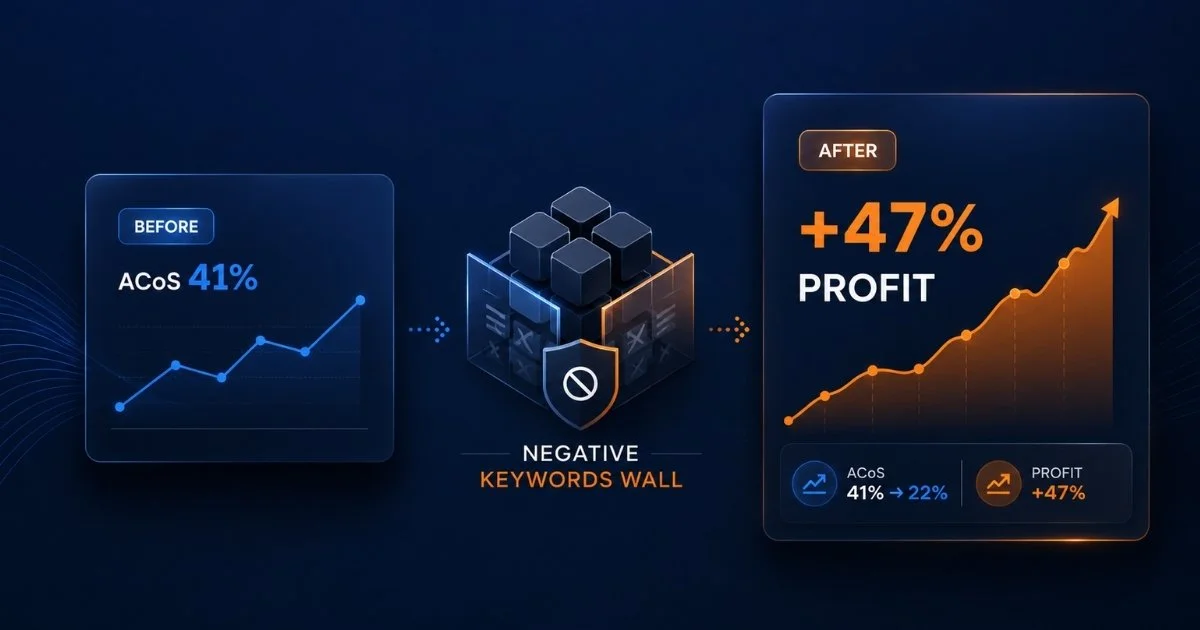
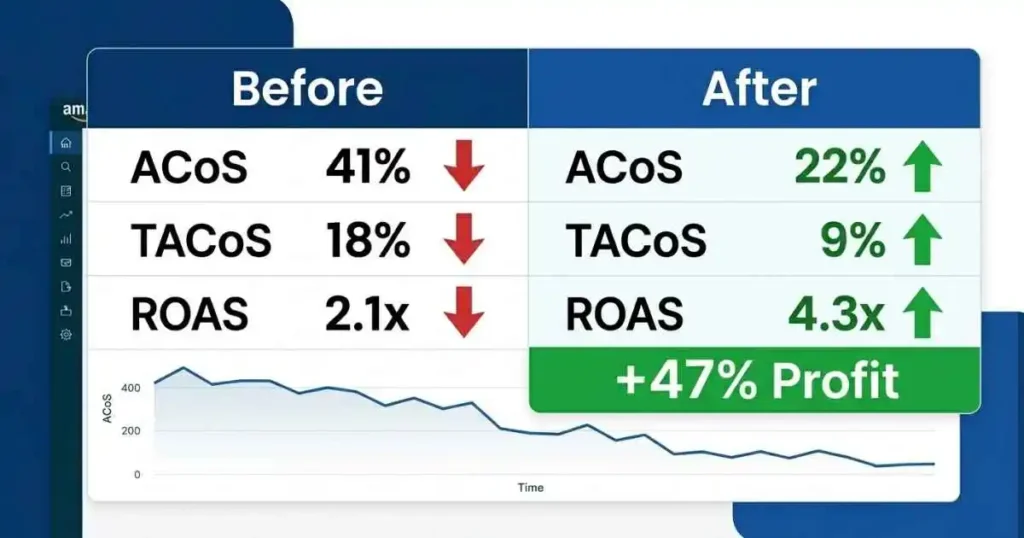
| ACoS | 41% | 22% |
| TACoS | 18% | 9% |
| Monthly Ad Spend | $8,400 | $6,100 |
| Monthly Profit | $11,200 | $16,500 |
| ROAS | 2.1x | 4.3x |
- Product: Home & Kitchen (mid-range, competitive niche)
- Timeline: 90 days
- What changed: Amazon PPC structure rebuilt from scratch — no new products, no listing changes, no budget increase.
A 47% profit increase came purely from fixing how the campaigns were organized. Same products, same listings, same market. Just a better PPC campaign structure doing the right job.
The Real PPC Structure Problem
Most sellers who struggle with Amazon PPC profitability are not running bad ads. They are running ads inside a broken structure. And a broken Amazon PPC structure will drain your budget, no matter how good your keywords are or how competitive your bids are.
The problem is easy to miss because the campaigns look active. Impressions are coming in, clicks are happening, and sales are being attributed. But underneath that activity, the budget is leaking, campaigns are working against each other, and no one actually knows which part of the account is profitable.
Here is what that typically looks like.
What a Broken PPC Campaign Structure Looks Like
When a seller builds campaigns quickly, either at launch or when scaling, structure usually takes a back seat. The result is a mix of auto and manual campaigns running the same keywords, multiple SKUs sharing a single campaign, and ad groups stacked with 30, 40, sometimes 50 keywords. There is no campaign segmentation by goal, no naming convention, and no logical separation between discovery spend and profit spend.
From the outside, it looks like a running account. From the inside, it is a mess that makes optimization almost impossible.
Signs Your Campaigns Are Leaking Profit
You do not always need an Amazon PPC audit to spot structural damage. These signs usually show up first:
- Your ACoS looks acceptable, but profit margins keep shrinking
- You lower bids, and sales drop immediately — no middle ground
- The same keyword appears in three or four campaigns at once
- Your auto campaigns are spending more than your manual campaigns
- You cannot tell which campaign is driving organic rank and which is driving direct sales
- Ad spend goes up every month, but attributed sales do not follow
If three or more of these sound familiar, the issue is almost certainly your PPC campaign structure, not your bids.
What the PPC Audit Revealed
When we took over this account, the first step in our Amazon ads management process was a full Amazon PPC audit before touching a single bid or keyword. This is standard practice in professional Amazon advertising. What we found was not surprising, we see the same pattern in most accounts that come to us after months of frustrating results. The campaigns were active, and the budget was being spent, but the underlying Amazon PPC structure was working against the seller at every level.
Here is exactly what the audit uncovered.

Campaign Overlap and Wasted Ad Spend
The account had 14 active campaigns. Nine of them were targeting the same core keywords. Auto campaigns were running the same ASINs as manual campaigns with no negative keyword separation between them. This means the same search term was triggering ads in multiple campaigns simultaneously, inflating CPC and splitting attribution across the account.
Every time a customer clicked, the seller was potentially paying more than once for the same buyer journey. That is campaign overlap, and it is one of the fastest ways to burn through budget without realizing it. Eliminating this overlap is one of the first steps in cleaning up Sponsored Products campaigns.
Keyword Duplication Across Campaigns
Closely tied to overlap is keyword duplication. In this account, the top 12 converting keywords appeared in an average of 4.3 campaigns each. Broad, phrase, and exact match versions of the same keyword were all live at the same time across different campaigns, with different bids and no coordination.
The result was internal competition. This created internal overlap, where multiple campaigns competed for the same search terms, causing CPC pressure and fragmented data, driving up their own CPC on keywords they already owned.
No Campaign Segmentation by Goal
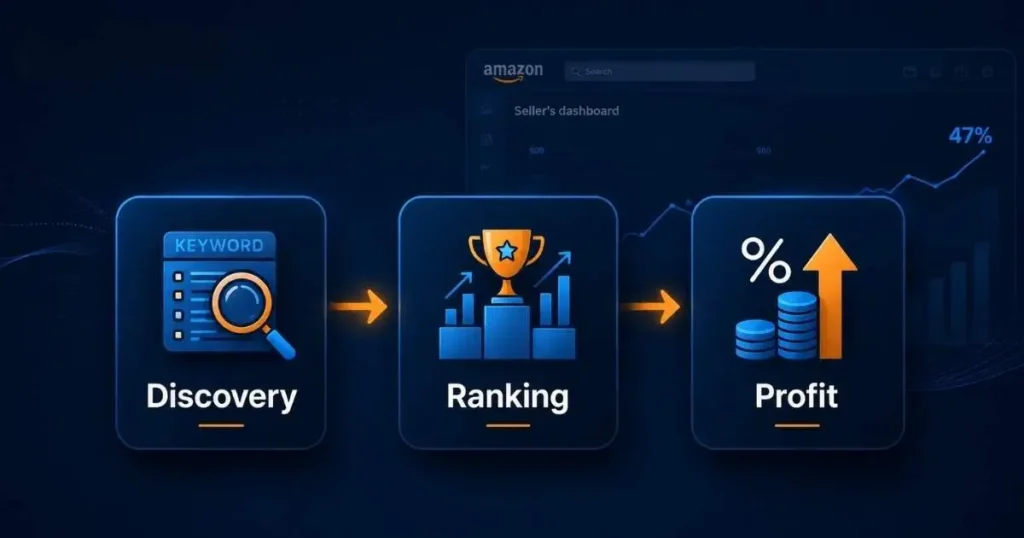
There was no separation among discovery, ranking, and profit campaigns. Everything was mixed into general Sponsored Products campaigns with no clear objective attached to any of them.
A good Amazon advertising structure means every campaign has a defined job, and that separation is what actually helps you improve ACoS over time without cutting spend blindly. Discovery campaigns find new keywords through auto-targeting. Ranking campaigns push volume on priority terms.
Profit campaigns run tight, exact match keywords with controlled bids to protect margins. Without this segmentation, budget allocation becomes guesswork, and protecting profit margin becomes impossible.
Missing Campaign Naming Convention
This may sound like a small detail, but it has a big operational impact. When campaigns are named things like “SP — Auto 1,” “Campaign 3,” or “Test — broad May,” nobody knows what is running or why. There is no Amazon campaign naming convention, no way to filter by goal, and no audit trail when something stops performing.
A proper naming system, one that includes match type, campaign goal, SKU, and date, turns your Amazon Ads dashboard from a wall of noise into a structured system you can actually manage and optimize.
How We Rebuilt the PPC Structure
Once the audit was complete, we had a clear picture of what needed to change. The goal was not to start from zero — it was to rebuild the Amazon PPC structure in a way that gave every campaign a defined role, every keyword a single home, and every dollar of ad spend a measurable job.
Here is the exact process we followed.
Goal-Based Campaign Segmentation
The first thing we did was separate campaigns by objective. Every account we manage at Scalea2z runs on a three-tier campaign segmentation model:
- Discovery campaigns: Auto targeting only, conservative bids, purpose is to find converting search terms not already in the manual structure
- Ranking campaigns: Broad and phrase match on priority keywords, higher bids, the purpose is to push visibility and feed the search term report
- Profit campaigns: Exact match only, tight bids, purpose is to convert known winners at the lowest possible ACoS
This separation alone eliminates most of the budget leakage and internal competition that kills Amazon PPC profitability, and it is the foundation of every Amazon ads management system we build. Consistent Amazon PPC optimization becomes possible only when campaigns have separate, defined roles. When each campaign knows its job, optimization becomes straightforward instead of a guessing game.
Auto vs Manual Campaign Separation
Auto and manual campaigns serve completely different purposes and should never share the same keyword pool. Auto campaigns are research tools. Manual campaigns are execution tools.
In the rebuilt structure, every auto campaign had a hard negative keyword list imported from the existing manual campaigns from day one. This stopped auto campaigns from cannibalizing traffic that manual campaigns were already converting efficiently. It also kept CPC under control across both campaign types since they were no longer competing against each other in the same auction.
SKU-Level Ad Group Setup
One of the clearest fixes was moving from mixed-SKU campaigns to SKU-level structure. When multiple products share a single campaign, the budget naturally flows to the bestseller and starves everything else. You lose visibility of the individual product performance, and you cannot make accurate bid decisions because the data is blended.
We gave each priority SKU its own campaign so performance could be measured and optimized separately. Ad groups within each campaign were limited to tightly themed keyword clusters, with no more than 8-10 keywords per ad group. This gave Amazon’s algorithm cleaner signals and gave us cleaner data to work with.
Quick Tip: If you are running more than 15 keywords in a single ad group, you are most likely diluting your budget and making it harder for your best keywords to get consistent impressions.
Negative Keywords to Cut Budget Leakage
Negative keywords are not optional maintenance — they are structural. In the original account, there were fewer than 20 negative keywords across 14 campaigns. After the rebuild, that number was over 340 within the first 30 days.
We pulled every irrelevant search term from 90 days of search term report data, categorized them by campaign type, and added them as exact and phrase negatives at both the campaign and ad group level. Wasted clicks dropped by 34% in the first two weeks alone.
Quick Tip: Run your search term report at least every 7 days. Any term with 3 or more clicks and zero orders is a candidate for your negative keyword list. Add it before it takes another dollar from your budget.
Keyword Harvesting from Search Term Report
The search term report is where new profitable keywords come from. In the old structure, nobody was harvesting from it consistently, which meant converting search terms were sitting in auto campaigns, earning sales but never being promoted to manual campaigns where bids could be properly controlled.
We set up a weekly keyword harvesting process. Any search term in an auto or broad campaign with 2 or more orders and an ACoS below the target is moved to the profit campaign as an exact-match keyword. This continuously feeds the manual structure with proven converters, improving ROAS over time without increasing ad spend.
Quick Tip: When harvesting keywords, always add the term as a negative in the source campaign after promoting it. If you skip this step, you will create the same overlap problem you just fixed.
90-Day Results After PPC Restructure
Numbers do not lie. Ninety days after rebuilding the Amazon PPC structure, every major metric moved in the right direction, not marginally, but significantly. No new products were launched. No listing changes were made. The only variable was structure.
Here is what the data showed.
ACoS Before vs After
| Metric | Before | After | Change |
|---|---|---|---|
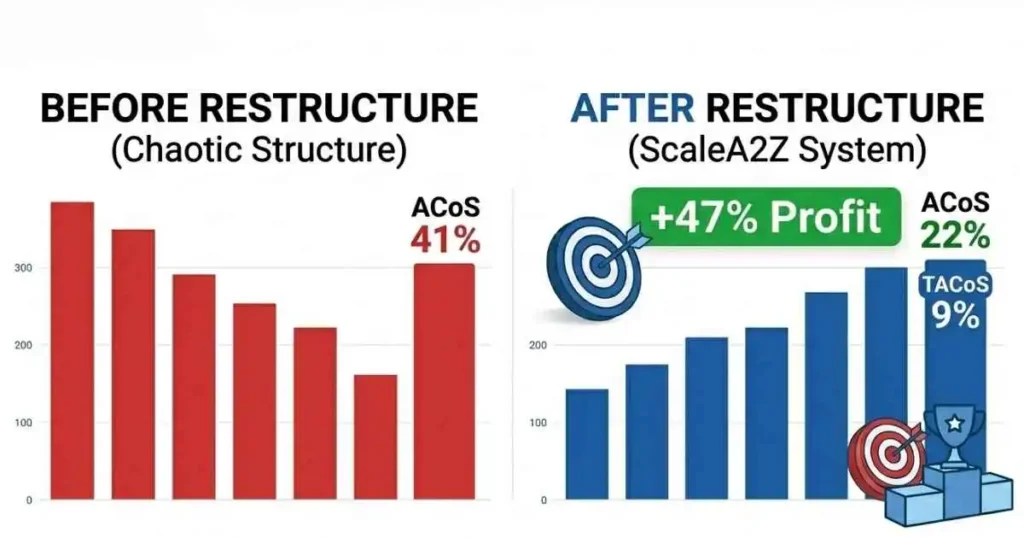
| Overall ACoS | 41% | 22% | ↓ 46% |
| Top Keyword ACoS | 58% | 24% | ↓ 59% |
| Auto Campaign ACoS | 67% | 31% | ↓ 54% |
| Profit Campaign ACoS | — | 14% | New Segment |
Before the fix, auto campaigns were running unchecked with no negative keywords and no match-type separation. The top keywords were appearing in four different campaigns simultaneously, inflating CPC and fragmenting attribution. Once the structure was cleaned up, ACoS dropped to a manageable level within the first 45 days and continued tightening through day 90.
The profit campaign segment did not exist before the rebuild. It now runs the top 22 exact- match keywords and consistently maintains a 14% ACoS, the most efficient part of the entire account.
TACoS and ROAS Improvement
| Metric | Before | After | Change |
|---|---|---|---|
| TACoS | 18% | 9% | ↓ 50% |
| ROAS | 2.1x | 4.3x | ↑ 105% |
| Monthly Ad Spend | $8,400 | $6,100 | ↓ 27% |
| Attributed Sales | $17,640 | $26,230 | ↑ 49% |
TACoS dropping from 18% to 9% tells the deeper story. It suggests that paid ads became more efficient while total sales improved, which often happens when campaigns are organized around outcomes instead of activity. When ad spend becomes more targeted and waste is removed, organic rank improves because the conversion rate on the listing goes up. Better CVR signals Amazon’s algorithm that the listing deserves more organic visibility.
ROAS more than doubling is a direct result of the keyword harvesting process. As proven converters moved into the profit campaigns, every dollar spent started working harder.
Profit Growth Breakdown
| Metric | Before | After |
|---|---|---|
| Monthly Revenue | $52,800 | $68,400 |
| Monthly Ad Spend | $8,400 | $6,100 |
| Net Profit | $11,200 | $16,500 |
| Profit Increase | — | +47% |
The 47% profit increase came from two directions at once — revenue went up, and ad spend went down. That combination is only possible when the Amazon PPC structure is doing its job correctly. More revenue from better-targeted campaigns. Lower spend from eliminating wasted clicks, campaign overlap, and keyword duplication.
This is what a properly structured account looks like when it runs for 90 days.
Amazon PPC Structure Checklist
A good Amazon PPC audit does not have to take days. If you know what to look for, you can identify the biggest structural problems in your account within a few hours. Use this checklist to find where your profit is leaking.
7 Common PPC Structure Mistakes
These are the mistakes we find in almost every account that comes to us after months of flat or declining results.
- Auto and manual campaigns sharing the same keywords: No negative keyword separation means both campaign types are competing in the same auction, driving up your own CPC and splitting attribution
- Multiple SKUs in one campaign: Budget flows to the bestseller, and everything else gets starved. You also lose clean performance data at the product level
- No goal-based campaign segmentation: Running discovery, ranking, and profit campaigns all under the same structure with the same bids makes it impossible to optimize for any specific outcome
- Keyword duplication across campaigns: The same keyword in three different campaigns means you are bidding against yourself. Find duplicates with a simple keyword audit and consolidate
- Ignoring the search term report: Not harvesting converting search terms weekly means profitable keywords stay in auto campaigns, where bids cannot be properly controlled
- No Amazon campaign naming convention: When you cannot tell what a campaign is for just by reading its name, campaign management becomes slow, messy, and error-prone
- Negative keyword list under 50 terms: If your account has been running for more than 60 days and you have fewer than 50 negative keywords, budget leakage is almost certainly happening right now
Quick Tip: Export your search term report and filter for terms with more than 3 clicks and zero conversions. If that list has more than 20 terms, your negative keyword process needs immediate attention.
What to Fix First
Not every fix carries the same weight. If you are working through structural issues on your own, prioritize in this order:
- Separate auto and manual campaigns with a negative keyword wall between them — this stops the bleeding fastest
- Eliminate keyword duplication across campaigns — consolidate to one campaign per match type per keyword
- Add negative keywords from the last 60 days of search term data — do this before changing any bids
- Split SKUs into individual campaigns if the budget allows
- Build a naming convention and rename every active campaign before the next optimization cycle
Fix the structure before you touch bids. Bid optimization on top of a broken PPC campaign structure will not produce meaningful results — it will just move the problem around. A proper Amazon PPC strategy always begins with structure, and that is what consistently helps sellers improve ACoS without guesswork.
How ScaleA2Z Fixes PPC Structure
Every account we take on at ScaleA2Z starts with the same first step — a full Amazon PPC audit before anything else is touched. No bid changes, no keyword additions, no budget shifts until we understand exactly what the current structure is doing and where it is breaking down.
What we find almost always follows the same pattern. Campaigns built in a hurry, keywords duplicated across match types, auto and manual running without separation, and no clear system connecting ad spend to profit goals. It is not a reflection of how hard the seller has worked — it is a reflection of how easy it is to let structure slip when you are focused on everything else that comes with running an Amazon business.
Our Amazon ads management approach is straightforward. We rebuild the Amazon PPC structure around three things — clarity, control, and profitability. From Sponsored Products optimization to full account restructuring, every Amazon PPC strategy we build starts with the same audit-first process. Every campaign gets a defined goal. Every keyword gets a single home. Every dollar of ad spend gets tracked back to a measurable outcome.
The results in this case study are not an exception. A 47% profit increase in 90 days is what happens when structure is fixed properly, and optimization has a clean foundation to work on.
If your account looks anything like what we described in the audit section, campaign overlap, keyword duplication, no segmentation, and no naming system, the fix is available. It starts with understanding exactly where your current Amazon PPC structure stands.
Frequently Asked Questions
What is the Amazon PPC structure?
Amazon PPC structure refers to how your ad campaigns, ad groups, and keywords are organized inside your Amazon Ads account. A well-built structure separates campaigns by goal, isolates match types, assigns individual SKUs to their own campaigns, and uses a consistent naming convention. Without this organization, budget leaks across overlapping campaigns, and optimization becomes guesswork.
Why does the PPC structure affect profit?
Because structure controls where every dollar goes. When campaigns overlap, keywords duplicate, and auto and manual campaigns share the same traffic pool, you end up paying more per click for sales you were already winning. Fix the structure and CPC drops, wasted ad spend disappears, and profit margins widen — without changing your products or listings.
What is the best PPC campaign structure for Amazon?
The most effective approach separates campaigns into three tiers — discovery, ranking, and profit. Discovery campaigns use auto targeting to find new converting search terms. Ranking campaigns use broad and phrase match to build visibility on priority keywords. Profit campaigns run exact match on proven converters with tight bids. Each tier has a defined budget, a defined goal, and feeds into the next.
Should auto and manual campaigns be separate?
Yes, always. Auto campaigns are research tools — they find search terms. Manual campaigns are execution tools — they convert known keywords efficiently. When they run without negative keyword separation, they compete against each other in the same auction, driving up your own CPC and fragmenting your attribution data. Keep them separate from day one.
How do negative keywords stop wasted spend?
Negative keywords block your ads from showing on irrelevant or non-converting search terms. Every click on an irrelevant term costs money without producing a sale. Over 90 days, those clicks add up to significant budget leakage. A well-maintained negative keyword list — built from consistent search term report analysis — redirects that spend toward terms that actually convert.
When should you restructure PPC campaigns?
Restructure when your ACoS is stable, but profit is still shrinking, when the same keywords appear across multiple campaigns, when you cannot identify which campaigns are driving organic rank versus direct sales, or when your account has been running for more than 90 days without a proper audit. The longer a broken structure runs, the more historical spending data gets distorted, and the harder clean optimization becomes.