How Our Amazon Agency Manages 10+ Brands at Once
On almost every discovery call, sellers ask the same question in different ways about how Amazon agencies manage multiple brands without letting one account get buried under dashboards, automation, and overloaded account managers.
They nod along while we talk about strategy and reporting, but what they are really thinking is simpler and a little more nervous. If you are already running a dozen other brands, how do I know mine will not get buried?
It’s a fair question. It might be the most important one a seller can ask before signing with any Amazon agency. Because the uncomfortable truth is that plenty of agencies can’t manage multiple brands well — they just hide it behind dashboards and monthly reports until the cracks show.
So instead of another what does an Amazon agency do explainer, this is the honest version: a look inside the machine. You’ll see how the team is built, what systems keep every account on track, how attention gets divided so no brand quietly slips, and why we’d rather cap our roster than stuff it. No pitch, just the real operating model behind managing multiple Amazon brands without letting quality drop.
Already know you want a real partner, not a buried account? Book a free consultation
Table of Contents
How Amazon Agencies Manage Multiple Brands
Agencies that handle multiple brands well rely on a clear team structure, dedicated account ownership, documented SOPs, weekly health checks, PPC reviews, listing optimization, catalog monitoring, and simple reporting. The best ones don’t rely on automation alone — they cap account loads, assign specialists, and proactively review every brand so no account gets ignored.
The Question Sellers Really Ask
Before we open the hood, it’s worth naming the real concern — because everything about how a good Amazon agency workflow operates is designed to answer it.
Can one team manage 10+ brands well?
Yes — but only if “manage” means something specific. Managing 10+ Amazon brands isn’t about one heroic person juggling tabs until midnight. It’s about repeatable systems, clear ownership, and capacity limits that protect quality. Agencies that scale on hustle alone hit a ceiling fast. Agencies that scale on standard operating procedures and a sane account-manager workload can take on more brands without the service getting thinner. The difference isn’t effort. Its structure.
What sellers fear most
The fear is rarely “they’ll do a bad job.” It’s “they’ll forget about me.” You become client number eleven, your account manager is buried, and your brand turns into a once-a-month bid tweak while the squeaky-wheel clients get the real attention. That’s brand neglect, and it’s the quiet killer in Amazon agency account management — not dramatic mistakes, just slow, invisible drift while everyone’s looking at someone else’s account.
What good management looks like
Good multi-brand Amazon management is boring in the best way. Every account has a named owner. Every week has a plan. Every change has a reason and a record. When you can predict what’s happening on your account without chasing anyone, that’s the sign of an agency built to handle volume. The rest of this article is just the details behind that sentence.
Why Multiple Brands Break Most Agencies
Most agencies don’t fail their clients on purpose. They fail because their Amazon account management process does not scale — and they keep selling growth they can’t operationally support. Here’s exactly where it breaks — and why most agencies never figure out how Amazon agencies manage multiple brands without something slipping.
The volume trap
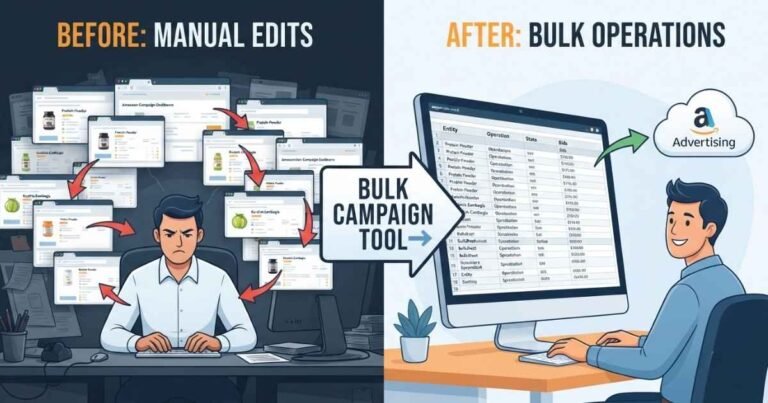
The math that ruins most agencies is simple. Sign as many clients as possible, hire as few account managers as you can get away with, and lean on software to cover the gap. It looks profitable on a spreadsheet. One manager “handling” 25, 40, or even 60 accounts with automated bid rules can produce clean-looking reports for a while, but that is not real Amazon account management. Nobody at that ratio is actually thinking about your brand. They’re firefighting. The volume trap is why so many sellers feel like their agency is technically present but mentally absent — and it’s a big part of why most Amazon PPC agencies fail the brands they sign.
When automation replaces management
Automation is a tool, not a strategy — especially when an agency is responsible for multiple Amazon brands. Bid management software, rule-based budget controls, and reporting dashboards are useful — we use them too. The problem starts when they become a substitute for human judgment instead of an extension of it. An algorithm can lower a bid when ACoS climbs. It can’t notice that your hero ASIN is about to go out of stock, that a competitor just slashed prices, or that your Buy Box dropped because of a catalog glitch. Real Amazon brand management is proactive and contextual. Automation alone is reactive and blind to everything outside the ad console.
The rotating manager problem
The third failure is turnover. You’re on board with a sharp strategist, and three months later, you’re emailing someone new who’s never read your account history. At high-volume agencies, account managers burn out and churn, and every handoff resets the relationship and loses context. A dedicated Amazon account manager who actually knows your margins, your seasonality, and your supplier quirks is worth more than any tool — and a rotating cast of junior staff is the opposite of that.
How We Structure the Team
The way an agency answers “how do you manage so many brands?” lives almost entirely in its org chart, because team structure decides whether multi-brand Amazon management works or breaks. Ours is built to keep ownership clear and capacity sane.
The pod model
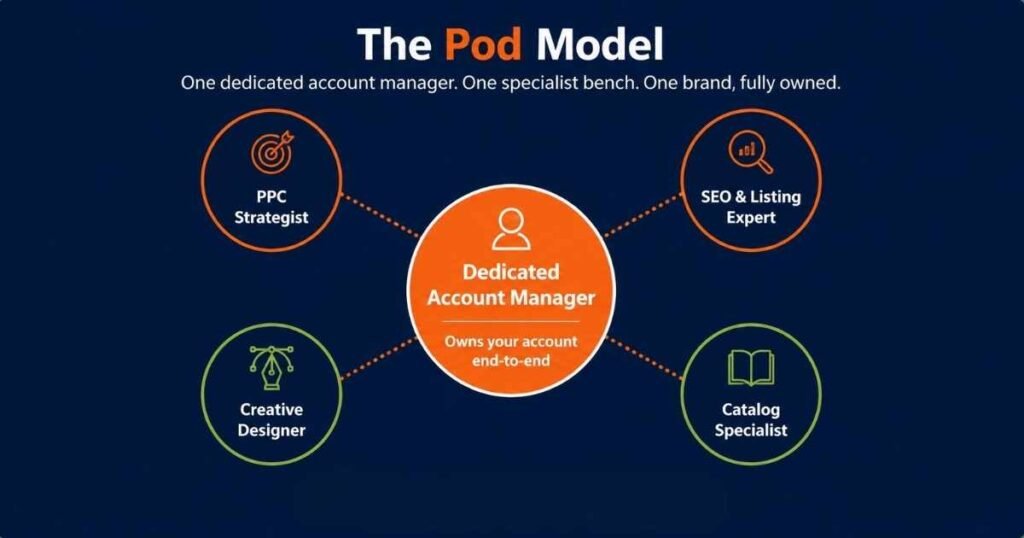
Instead of a single overworked manager and a support queue, we run small pods — a dedicated account manager paired with the specialists their brands need. Your pod owns your account end-to-end. They know your products, your goals, and your account history, and they’re the same people you talk to in month one and month twelve. A pod can give a small group of brands real, focused attention precisely because it isn’t trying to serve forty accounts at once.
Specialists behind every account
No single person is world-class at PPC strategy, listing copy, creative design, catalog troubleshooting, and inventory planning all at once — and pretending otherwise is how accounts get half-managed. Behind each account manager sits a bench of specialists: Amazon Ads strategists running Sponsored Products, Sponsored Brands, and Sponsored Display; SEO and listing experts; designers building A+ Content and Brand Store assets; and catalog specialists who handle the unglamorous Seller Central problems that wreck listings. Your account manager coordinates; the specialists execute in their lane. That’s how a full-service Amazon agency delivers depth instead of a generalist spreading thin across PPC, SEO, catalog, inventory, and reporting.
Why we cap brands per manager
This is the part most agencies won’t put in writing: we limit how many brands each Amazon account manager carries. A capacity cap isn’t a weakness — it’s the whole point. There’s a real number of hours a brand needs each week to be managed properly, and once a manager blows past it, something gets dropped. By capping the roster per pod, we protect the one thing that can’t be automated: thinking time on your specific account. When we’re full, we’d rather wait or hire than overload a manager and let service quality slide.
The Systems That Keep Brands on Track
Talented people aren’t enough on their own. What lets a team manage 10+ brands consistently is the system underneath them — the part that makes quality repeatable instead of dependent on who’s having a good week.
SOPs for consistent quality
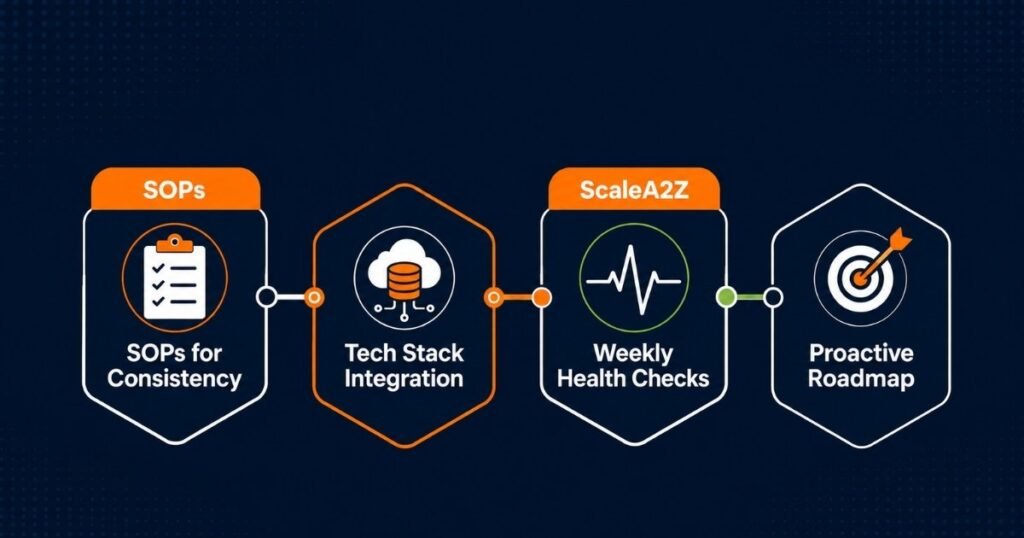
Every recurring task on your account runs on a standard operating procedure. Search-term harvesting, negative-keyword sweeps, bid reviews, listing audits, inventory checks — each has a documented workflow so it gets done the same way, to the same standard, every time, regardless of who’s at the keyboard. SOPs are why a new specialist can step in without quality dipping, and why nothing important depends on one person remembering to do it.
Our Amazon agency tech stack
Software does the heavy lifting on data so our people can spend their time on decisions. Our Amazon agency tech stack combines tools like Helium 10 for keyword research and tracking, the native Amazon Ads console and reporting for campaign data, project-management software to keep every pod’s tasks visible, and shared dashboards that surface ACoS, TACoS, conversion rate, and inventory health at a glance. The stack isn’t there to replace management — it’s there to make sure nothing hides in a spreadsheet until it becomes a problem.
Weekly account health checks
Once a week, every account gets a structured health check — not a glance, a checklist. We review campaign performance, wasted spend, keyword movement, listing and Buy Box status, account-health notifications, and stock levels. The point is to catch the small stuff early: a creeping ACoS, a slipping rank, a low-inventory warning. Issues found on a Tuesday cost a fraction as much as those found in next month’s report.
| System | What It Controls | Why It Matters |
|---|---|---|
| Pod model | Account ownership | Prevents brand neglect |
| SOPs | PPC, SEO, catalog, and reporting | Keeps quality consistent |
| Weekly checks | Ads, inventory, Buy Box, and account health | Catches issues early |
| Tech stack | Data, tasks, and dashboards | Makes account work visible |
| Quality review | Major account changes | Reduces mistakes before they hurt sales |
How We Manage PPC, SEO, and Catalog
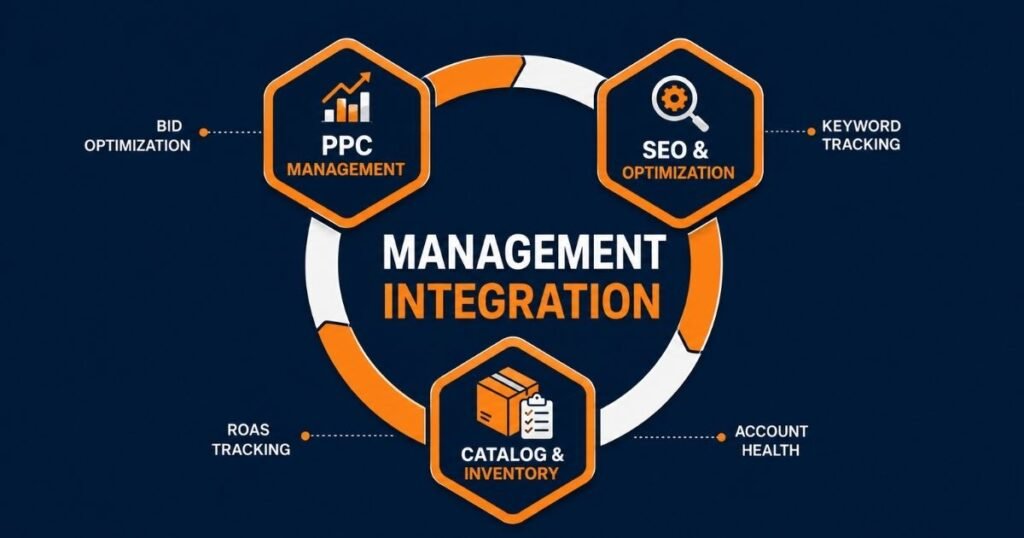
Structure and systems are how we work. Here’s what that work actually covers across every brand, week to week — PPC management, Amazon SEO, catalog health, inventory checks, and reporting. This is the day-to-day of Amazon account management — the layered oversight that keeps ads, organic, and catalog pulling in the same direction.
PPC checks and budget control
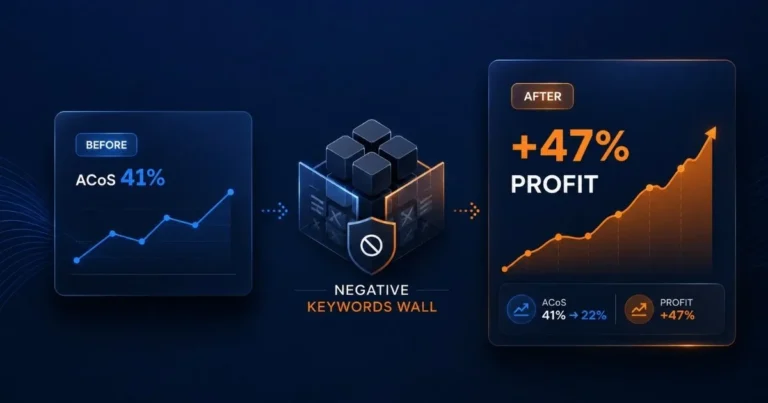
Advertising is where money moves fastest, so it gets the closest watch. We monitor spend pacing and budgets, separate branded from non-branded campaigns, mine search-term reports for new converting keywords and wasteful ones, and keep campaign structure clean so the data stays readable. The goal is never just a lower ACoS — it’s profitable, controlled growth across Sponsored Products, Sponsored Brands, Sponsored Display, and total account performance. If you want the deeper framework behind this, we break it down in how to structure Amazon PPC for profit.
Listing SEO and conversion reviews
Ads send traffic; listings decide whether that traffic converts into profitable sales. So alongside PPC, we keep an eye on Amazon SEO and conversion: keyword coverage in titles, bullets, and backend search terms, plus image quality, A+ Content, and price competitiveness. A listing that ranks but doesn’t convert just burns ad budget faster — which is one of the most common and expensive Amazon SEO mistakes we see when we take over an account.
Catalog and inventory monitoring
This is the layer pure-PPC agencies ignore, and it’s where Amazon brands quietly bleed. We monitor catalog health and Brand Registry status, watch for listing suppressions, variation errors, and hijackers, and keep an eye on inventory so we’re not scaling ads toward a stockout. A suppressed listing or a lost Buy Box can erase a month of ad gains overnight, so catalog hygiene isn’t an afterthought — it’s part of managing every brand.
How No Brand Gets Neglected
This is the section that answers the fear directly: how Amazon agencies manage multiple brands without letting quieter accounts disappear. Systems keep work consistent; these habits keep attention fairly distributed, so no account becomes an afterthought.
Planned hours per account
Every brand gets planned time on the calendar, not leftover time. Because we cap accounts per manager, there are actual hours reserved for your account each week — for review, optimization, and proactive work — instead of your brand competing for whatever’s left after the loudest client is handled. Attention is allocated on purpose, not by who emailed last.
Proactive, not reactive
A neglected account is one that only gets touched when something breaks. We work the other way: weekly checks, planned tests, and a forward-looking roadmap mean we’re usually acting before you’d notice a problem. Proactive account management is the difference between an agency that reports what happened and one that shapes what happens next.
Quality control and review
People make mistakes, especially when multiple Amazon accounts are moving at once, so we build in a second set of eyes. Significant changes — campaign restructures, listing rewrites, budget shifts — get reviewed before and after they go live. This quality-control layer catches errors early and keeps standards even across every brand, so the newest account on the roster gets the same rigor as the oldest. The cost of skipping this is exactly what we covered in the real cost of poor Amazon account management.
How Communication Works at Scale
Managing many brands well only works if every client still feels like they have a clear line of sight into their own account. Communication is where that’s won or lost.
Weekly updates
You hear from your pod on a regular cadence — not silence punctuated by a monthly PDF or a vague dashboard screenshot. Consistent client communication keeps you informed on what’s been done, what’s working, and what’s next, so you’re never wondering whether your account is actually being touched.
Clear action items
Updates without next steps are just noise. Every check-in includes clear action items — what we’re doing, what (if anything) we need from you, and what to expect next. Decision bottlenecks on the seller’s side are one of the biggest reasons growth stalls, so we keep the asks specific and the ownership obvious.
Reporting sellers can understand
Amazon agency reporting should explain, not impress. Rather than dumping every metric, we focus on what moved and why — ACoS, TACoS, conversion rate, and overall sales — in plain language tied to decisions. For the full picture of how reporting and communication should work from your side of the screen, we walk through it in what happens after you hire an Amazon agency.
Boutique by Design
All of this leads to a deliberate choice about size — one that runs against how most Amazon agencies grow.
Why we stay focused
We could chase a hundred logos and hire a thin layer of managers to “cover” them. We don’t, because the model that maximizes client count is the same model that produces the neglect sellers fear. Staying focused is a strategy, not a limitation — it’s how the service stays sharp as we grow.
Why fewer brands get better attention
It’s not complicated: fewer accounts per manager means more thinking time per account. A pod that owns a manageable roster can spot opportunities, move faster, and actually know your brand — the things that disappear the moment a manager is buried under volume. Capacity discipline is what keeps quality and scale from being a trade-off.
What this means for growth
For your brand, boutique-by-design means you get an Amazon account management agency that scales with you instead of past you. You stay a priority, not a line item. And because every account runs on the same systems, specialists, and standards, the quality you sign up for is the quality you keep — whether you’re our newest brand or one we’ve grown for years.
See How We'd Manage Your Brand
That’s how Amazon agencies manage multiple brands without losing quality — the pod structure, the capacity caps, the SOPs and tech stack, the capacity caps, the SOPs and tech stack, the weekly health checks, and the proactive habits that keep 10+ brands on track without any of them slipping through the cracks. The systems exist for one reason — so your brand gets real attention, every week, from people who know it.
At ScaleA2Z, that’s the entire operating model. As an Amazon Ads Certified and Helium 10 Trusted Partner agency, we pair every brand with a dedicated account manager and a specialist bench, run full account management on documented systems, and cap our roster so quality never gets diluted by volume.
Want to see how we’d manage your brand? Book a free consultation, and we’ll audit your account, flag the quick wins, and walk you through exactly how your brand would be run — with no obligation.
Frequently Asked Questions
How do Amazon agencies manage multiple brands?
Amazon agencies manage multiple brands by using dedicated account owners, SOPs, weekly account checks, PPC reviews, listing optimization, catalog monitoring, and clear reporting. The best agencies also cap account loads, so every brand gets planned attention instead of leftover time.
Can one Amazon agency manage 10+ brands properly?
Yes, one Amazon agency can manage 10+ brands properly if it has the right team structure, specialist support, documented systems, and realistic capacity limits. Problems usually start when one account manager is responsible for too many brands without enough support.
How many brands should one Amazon account manager handle?
There is no perfect number for every agency, but one account manager should only handle the number of brands they can review, plan, communicate with, and improve every week. If the manager is only reacting to problems, the account load is probably too high.
What systems do Amazon agencies use to manage accounts?
Amazon agencies use SOPs, project management tools, Amazon Ads reports, Seller Central checks, keyword tracking, performance dashboards, and weekly review processes to manage accounts consistently.
Why do some Amazon agencies fail with multiple brands?
Some Amazon agencies fail with multiple brands because they overload account managers, rely too much on automation, rotate staff too often, and treat reporting as a replacement for real strategy.
What should sellers expect from Amazon agency reporting?
Sellers should expect clear reporting that explains what changed, why it changed, what results moved, and what the next action is. Good reporting should cover ACoS, TACoS, conversion rate, sales, catalog issues, and growth priorities.