How Much Budget to Start Amazon in 2026? A Full Cost Breakdown
If you are planning your first move onto Amazon, the first question is simple — how much budget to start Amazon in 2026, how much money do you actually need? The honest answer is that there is no single number — your Amazon startup budget depends almost entirely on the business model you choose. A lean arbitrage start can cost $500 to $1,000, while a private-label test typically requires $2,500 to $5,000.
A proper brand launch with inventory, listing assets, PPC, and reorder cash usually lands between $5,000 and $15,000. Everything in between comes down to your seller account, your first inventory order, Amazon’s fees, and how much you set aside to launch and advertise.
This guide breaks down exactly where your money goes, what a healthy budget looks like at each tier, and the costs most beginners forget until they are already short on cash. If you are still weighing the bigger picture before you spend, our guide to launching a brand on Amazon in 2026 pairs well with this one. We work with sellers at every stage at ScaleA2Z, and the pattern is consistent: the people who succeed are not the ones who start with the most money — they are the ones who plan it properly.
Start Selling on Amazon the Right Way → Get a Free Budget Plan
Table of Contents
How Much Does It Really Cost to Start Selling on Amazon?
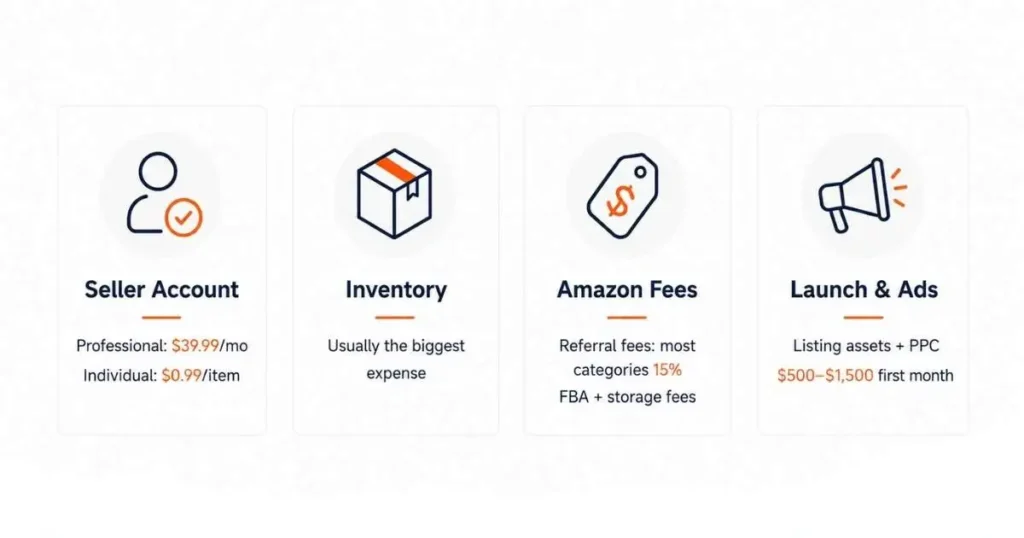
Before the detailed breakdown, here is the short version. Your Amazon seller startup costs fall into four buckets:
- Your Amazon seller account — a Professional plan is $39.99/month, or you can pay $0.99 per item on the Individual plan.
- Inventory — almost always your largest expense.
- Amazon fees — referral fees, FBA fulfillment fees, and storage fees that come out of every sale.
- Launch and advertising — your listing assets plus a starting PPC budget.
How much budget to start Amazon depends on how you weight those four buckets, and that weighting is decided by your business model. A retail arbitrage seller might spend $600 and never touch a supplier. A private-label seller building a brand will spend several thousand dollars before their first unit goes live. Same platform, completely different selling on Amazon costs.
Amazon Startup Budget by Business Model
This is the part most cost guides skip — and it is the part that actually answers your question. “Starting on Amazon” is not one thing. Here is what each path realistically costs.
Retail Arbitrage — The Leanest Start
Retail arbitrage means buying discounted or clearance products from physical stores and reselling them on Amazon. Retail arbitrage is the cheapest way to get started. You can begin with $100 to $500 in inventory, a free Amazon Seller app to scan products, and not much else. There is no supplier, no minimum order quantity, and no branding to pay for.
The trade-off is that profit margins are thin, sourcing is time-intensive, and it does not build a long-term asset. It is a way to learn the platform with real money on the line, not a way to build a brand.
Online Arbitrage
Online arbitrage follows the same buy-low-sell-high logic, but you source from websites instead of stores. The budget is similar — roughly $500 to $1,500 — with one addition: sourcing software.
Tools that scan thousands of online listings for profitable products typically cost $90 or more per month, so your monthly running cost is higher than retail arbitrage. The upside is that you can source from your laptop and speed up product validation far faster than walking store aisles.
Wholesale
Wholesale means buying established, brand-name products in bulk from a distributor and reselling them. Because you are ordering in volume, your inventory commitment is larger — usually $2,000 to $5,000 to meet supplier minimums and stock enough units to be worthwhile. You will also spend time getting approved to sell certain brands. The advantage is that you are selling products with existing demand, so you are not paying to create a market from scratch.
Amazon Private Label Startup Cost
Private label is the model most people picture when they think of FBA: you find a generic product, brand it as your own, and build a listing around it. It is also the most expensive to start.
A realistic Amazon private label startup cost in 2026 lands between $2,500 and $5,000, and often more once you account for product samples, your first inventory order, professional product photography, listing optimization, and a launch advertising budget.
According to Jungle Scout’s seller research, new sellers spend on average around $3,800 to get their first product live — a useful benchmark if private label is your goal. Many land in the $2,500 to $5,000 range, while some start with less and others invest considerably more. The payoff is that you are building a brand you own and can eventually scale or sell, which arbitrage and wholesale do not offer.
FBA vs FBM — Which Needs More Budget?
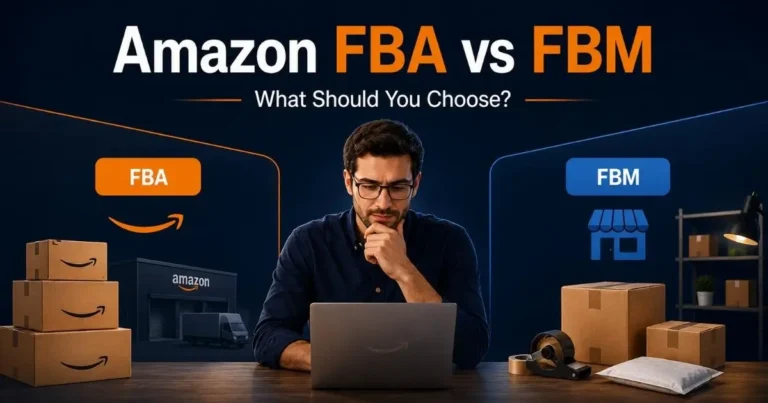
Your fulfillment method also shapes your budget. With Fulfillment by Amazon (FBA), you ship inventory to Amazon’s warehouses, and they handle storage, packing, shipping, and returns — in exchange for FBA fulfillment and storage fees. With Fulfillment by Merchant (FBM), you store and ship orders yourself, so you avoid those FBA fees but absorb your own warehousing, packaging, and shipping costs.
| Factor | FBA | FBM |
|---|---|---|
| Upfront cost | Higher because fulfillment and storage fees are built in | Lower per unit because you handle fulfillment yourself |
| Storage | Amazon’s warehouses | You handle it |
| Prime eligibility | Yes, which can boost conversion | Limited unless you qualify for Seller Fulfilled Prime |
| Best for | Most beginners and small/light products | Oversized, low-margin, or slow-moving items |
For most small and lightweight products, FBA is the smarter choice — Amazon handles storage, packing, shipping, customer service, and returns so you can focus on growing the business. But for oversized, slow-moving, or low-margin products, FBM may protect profit better.
Prime eligibility alone tends to lift your listing conversion rate enough to outweigh the fees, which keeps your Amazon FBA startup cost working harder. If your product is large, heavy, or tight on margin, your Amazon FBM startup cost may actually come out lower, so run the numbers first. We cover this decision in depth in our guide on Amazon FBA vs FBM.
The Core Costs in Your Amazon Seller Startup Costs
Whichever model you choose, four core costs apply. Here is what each one actually involves.
Amazon Seller Account Cost
You have two options. The Individual plan charges $0.99 per item sold with no monthly fee, fine if you are testing with fewer than 40 units a month. The Professional plan costs $39.99/month with no per-item fee, and unlocks advertising, bulk tools, and the Buy Box.
The break-even is about 40 sales a month, so any serious seller should start on Professional. This is the one fixed cost every seller pays through Seller Central before making a single sale.
Inventory — Your Biggest Line Item
For most sellers, your Amazon inventory budget is where the majority of the money goes. The figure depends on your product cost, your minimum order quantity (MOQ), and how many units you order. A common beginner mistake is going “deep” — ordering a large quantity of one untested product — instead of going “wide” with a smaller, safer first order.
If you are sourcing overseas, remember to budget for product samples before you commit, plus supplier cost, freight, and customs duties to get your initial inventory to Amazon. And critically: set aside a reorder budget. Running out of stock right after your listing gains traction kills the momentum you paid to build.
Amazon Fees: What Selling on Amazon Actually Costs
Amazon takes a cut of every sale, and selling on Amazon costs more than most beginners assume. The main fees are:
- Referral fees — Amazon’s commission on each sale. Most categories charge 15% of the total sale price, with a range from 6% to 45% depending on category, and a $0.30 minimum per item. Referral fees were frozen for both 2025 and 2026, so these rates are stable.
- FBA fulfillment fees — what Amazon charges to pick, pack, and ship, based on size and weight. These typically run from about $3.22 for small standard items to $10 or more for large, heavy products.
- Monthly storage fees — charged per cubic foot, and they spike 2–3x during Q4. Inventory that sits too long hits storage limits and triggers aged-inventory surcharges.
Add it up, and Amazon fees commonly consume 30–45% of an item’s selling price point before you have spent a cent on ads. Always confirm the numbers against Amazon’s official fee schedule for your exact category, because understanding your profit margin and break-even before you order is what keeps a product profitable.
Listing and Launch Setup Costs
Your listing is your storefront, and it is worth budgeting for. This covers product photography, listing optimization, and Amazon SEO, and — if you have a registered trademark — Brand Registry, which unlocks A+ Content and Sponsored Brands. You may also need a UPC barcode (or a GTIN exemption) to list.
You can do some of this yourself to save money, but weak images and thin copy are one of the most common reasons new listings fail to convert. Spending a little here protects everything you spend on inventory and ads.
Amazon FBA Startup Cost in 2026
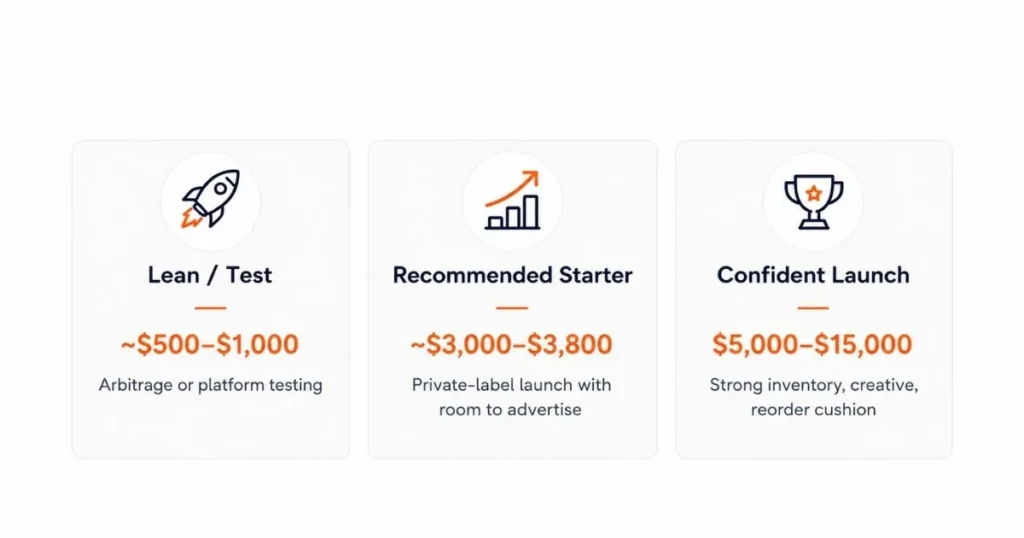
Pulling it together, here is what the cost to start Amazon FBA looks like across three realistic tiers. Think of these as planning ranges, not promises.
| Tier | Total Budget | Best For |
|---|---|---|
| Lean / Test | ~$500–$1,000 | Arbitrage or testing the platform with minimal risk |
| Recommended Starter | ~$2,500–$5,000 | A lean private-label launch with room for inventory, listing setup, and initial advertising |
| Confident Launch | $5,000–$15,000 | A full brand launch with strong inventory, creative assets, PPC, and a reorder cushion |
Amazon FBA Budget for Beginners
If you are working with a smaller pot, understanding how much budget to start Amazon FBA takes is the first step — and the answer is always: start disciplined, not broke. Choose one simple product, order a modest first batch, validate that real demand exists, and keep enough cash in reserve to reorder and advertise. The goal of an early budget is not to spend the least possible — it is to survive long enough for your listing to prove itself. Underfunding a launch is one of the most common reasons new sellers stall before they ever get going.
2026 Amazon Fee Changes New Sellers Should Know
Amazon’s fee structure shifted in 2026, and a budget built on last year’s numbers will be wrong. Three things to factor in:
- A new fuel and logistics surcharge. As of April 17, 2026, Amazon added a 3.5% surcharge on all FBA fulfillment fees in the US and Canada. It is applied on top of the base fulfillment fee, not the sale price, but it adds up with volume.
- Higher FBA fulfillment fees. Fulfillment fees rose by an average of $0.08 per unit on January 15, 2026, with uneven impact — some small, higher-priced items climbed more.
- Steeper penalty fees. Inbound-defect and aged-inventory surcharges increased notably in 2026, punishing sellers who ship late or let stock sit.
The good news for planning: referral fees stayed frozen, so your commission math is unchanged. Always check Amazon’s current fee schedule for your exact product before finalizing margins.
Your Amazon Launch Budget: Inventory + First Ads
Once your product is live, you need traffic — and on a brand-new listing, organic ranking is close to zero. That means a launch budget is not optional. A realistic Amazon PPC budget for launch is $500 to $1,500 for your first month, on top of inventory, alongside a launch coupon and competitive pricing to build early sales velocity.
Keep an eye on your ACoS and TACoS from day one so your Sponsored Products spend stays tied to profit, not just clicks. You do not need a huge budget, but you do need to advertise.
Treat this Amazon product launch cost as one line item in your overall startup budget rather than the whole strategy. If you want the full playbook on getting those first sales, we walk through it step by step in our guides on how to launch a new product on Amazon and how to get your first 100 sales.
Hidden Costs Beginners Forget to Budget For
The headline costs are easy to plan for. It is the quiet ones that catch people out:
- Samples before you commit to a supplier
- Freight and customs if you import (especially from China)
- Product photography and design if you outsource it
- Returns, which Amazon processes and partially charges back to you
- Software tools for keyword research and competitive research
- Refund admin fees in higher-return categories like apparel
None of these are huge on their own, but together they can add several hundred dollars to a launch you thought was fully funded. Build a buffer of 10–20% into your budget for them.
Where New Sellers Waste Their Amazon Budget
Most failed launches do not fail because the budget was too small. They fail because the budget was spent in the wrong order. These are the five mistakes we see most often.
Buying Too Much Inventory Too Early
It is tempting to order more to lower your per-unit cost. But if the product does not sell, that “discount” becomes thousands of dollars frozen in a warehouse, quietly racking up storage fees until you cut your losses. Start with a smaller first order, prove demand through real product validation, then scale.
Spending on PPC Before the Listing Converts
Driving paid traffic to a weak listing is pouring money into a leaky bucket. If your main image, title, and product reviews are not pulling their weight, ads will just expose the problem faster and more expensively. Fix your listing conversion rate first, then advertise.
Ignoring Amazon Fees
Plenty of sellers calculate their margin on product cost and selling price alone, forgetting that referral and FBA fees can swallow 30–45% of the sale. Know your true break-even ACoS before you order, or you will scale a product that loses money on every unit.
Not Saving for Reorders
Your product starts selling, momentum builds — and then you are out of stock because every dollar went into the first order. A stockout resets the organic ranking you paid to earn. Always hold back a reorder budget.
Choosing Revenue Over Profit
Revenue feels good on a dashboard, but it is not the same as profit. Sellers who chase top-line sales while ignoring fees, ad costs, and margin often grow themselves straight into losses. Watch your profit and cash flow, not just your sales numbers.
How to Start Amazon on a Smaller Budget
If your budget is tight, you can still start smart. Go “wide, not deep” on your first order so a dud product does not lock up your cash. Use free tools — the Amazon Seller app, free trials, and Amazon’s own calculators — before paying for software.
Take advantage of Amazon’s New Seller Incentives, which can include credits and percentage-back on early branded sales. And a useful rule of thumb many sellers follow: budget roughly three times your planned inventory spend as your total launch budget, so you have runway for shipping, ads, and the unexpected. A disciplined $1,500 launch beats a careless $5,000 one.
Does a Bigger Amazon Business Budget Mean More Profit?
Not necessarily. A bigger Amazon business budget buys you flexibility — better samples, stronger creative, more PPC testing, and a bigger reorder cushion. But it does not buy a good product. If the product is weak, the margin is thin, or the niche is too competitive, a larger budget simply makes the mistake more expensive.
Likewise, a small budget can absolutely work in the hands of a disciplined seller who validates carefully and spends in the right order. Budget buys runway. What you do with that runway decides whether you profit.
How an Amazon Agency Helps You Spend Your Budget Wisely
A lot of sellers who research how much budget to start Amazon end up underestimating the hidden costs — and that gap between plan and reality is where launches fail. A listing that does not convert, ad spend on the wrong keywords, and an order placed before demand was validated. This is where having experienced eyes on your plan pays for itself.
At ScaleA2Z, we help sellers spend their launch budget where it actually moves the needle: validated product selection, listing optimization built to convert, and Amazon PPC management structured to protect margin from day one. The goal is simple — make sure your first few thousand dollars works as hard as it can, instead of teaching you expensive lessons.
Plan Your Amazon Budget With Confidence
Knowing how much budget to start Amazon in 2026 is not about finding the biggest number — it is about having a realistic one and spending it in the right order. Decide on your business model, plan for your seller account, inventory, fees, and launch, and keep a buffer for the costs that catch beginners out. Do that, and even a modest Amazon business budget can turn into a brand that lasts.
If you would rather not guess your way through it, our team can help you map out a budget and launch plan tailored to your product and goals — so you start with a plan, not a hunch.
Frequently Asked Questions
How much money do most beginners need to start selling on Amazon?
It depends on your business model. Arbitrage sellers can start near $500–$1,000, a private-label test typically needs $2,500–$5,000 (Jungle Scout puts the average first launch at around $3,800), and a fuller brand launch with stronger inventory, creative, PPC, and reorder cash usually runs $5,000–$15,000.
Can I start Amazon with $500?
Yes, but realistically only with retail or online arbitrage, where you buy discounted products to resell and skip suppliers and branding. A full private-label launch with inventory, photography, and ads needs more. $500 is enough to learn the platform with real stakes, not to build a brand.
What is the cheapest way to start Amazon FBA?
Retail arbitrage is the cheapest entry point. You can start with around $100–$500 in clearance inventory, the free Amazon Seller app, and no supplier or minimum order. It is the lowest-cost way to learn, though margins are thin, and it does not build a long-term asset.
How much budget to start Amazon private label?
A realistic Amazon private label startup cost in 2026 is $2,500–$5,000. That covers samples, your first inventory order, Brand Registry and listing assets, product photography, Amazon fees, and a launch PPC budget — with a reserve for reorders.
Is Amazon FBA still worth it in 2026?
For sellers who treat it as a real business, yes. It remains one of the most accessible e-commerce models, but margins are tighter, and fees have risen in 2026, so success depends on solid product research, careful margin management, and disciplined spending rather than luck.
How long until I make my money back?
Most sellers see their first sales within 30 to 90 days, but recovering your full startup investment usually takes several months and depends on your margin, sell-through rate, and how much you reinvest. Plan your cash flow for a 3–6 month runway, not an instant return.